
You are using an outdated browser and your browsing experience will not be optimal. Please update to the latest version of Microsoft Edge, Google Chrome or Mozilla Firefox. Install Microsoft Edge

June 9, 2026

Myanmar Issues New Foreign Remittance Business Regulations

On April 28, 2026, the Central Bank of Myanmar (CBM) issued Notification No. 18/2026 introducing the new Foreign Remittance Business Regulations. The new regulations apply to companies intending to operate foreign remittance businesses in Myanmar that are not licensed banks, non-bank financial institutions, or other financial institutions. The regulations supersede and replace the previous regulatory framework governing foreign remittance businesses under CBM Notification No. 21/2019.

While the overall structure remains familiar, the new regulations introduce more detailed requirements for licensing, operations, reporting, and compliance, with a stronger focus on transparency and regulatory oversight.

Broader Licensing Requirements

Under the new regulations, applicants must submit detailed business plans describing the use of information technology and mobile platforms, along with clear plans for handling remittances from workers abroad and resolving customer complaints.

Financial Thresholds and Reporting Requirements

The baseline financial thresholds remain unchanged. Licensees must maintain a security deposit of MMK 100 million in an escrow account, along with a separate revolving fund dedicated solely to remittance operations.

The new regulations introduce more structured reporting obligations. Licensees are now required to submit daily remittance transaction data by the next business day before noon, in addition to monthly and periodic reporting requirements. Foreign bank account statements must also be submitted regularly, and licensees must provide updates on business operations every six months.

Strengthened AML and CFT Framework

The new regulations place a greater emphasis on anti-money laundering (AML) and counter financing of terrorism (CFT), with tighter controls over management changes. Any changes in shareholding, share transfers, or the appointment of key management personnel such as the managing director require prior approval from the CBM.

Licensing Fees and Validity

The new regulations increase licensing costs, while maintaining the same validity period of three years.
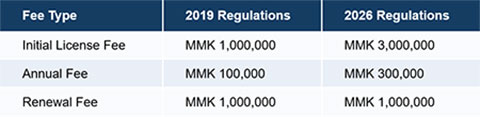
The new regulations provide more detailed grounds for suspension and revocation of licenses. These include failure to commence operations within one year, delays in remittance processing, and non-compliance with regulatory requirements. Penalties remain significant, with fines of at least MMK 10 million for certain violations.

Currency Requirement

A key highlight of the new regulations is the requirement that all outward remittance transactions must be conducted in Myanmar kyat (MMK). Specifically, remittance businesses are required to receive funds in MMK and disburse payments to customers exclusively in MMK.

Outlook

Remittance businesses operating in Myanmar should review their current practices against the new regulations. In particular, businesses may need to update their internal compliance frameworks, strengthen reporting systems, and ensure that ownership and governance structures align with the new approval requirements.

Companies planning to enter the market should prepare for a more detailed licensing process and ensure that all supporting documentation, particularly in relation to foreign operations and AML/CFT compliance, is in place before applying.


RELATED INSIGHTS​ 

September 4, 2026
Foreign business restrictions on telecommunications, treasury center businesses, and intragroup support services were eased when Thailand published the Ministerial Regulation Prescribing Service Businesses Not Requiring Permission for Foreign Business Operations (No. 5) B.E. 2569 (2026) in the Government Gazette on August 28, 2026. The ministerial regulation expands the categories of service businesses that foreign investors may operate without a foreign business license (FBL) under the Foreign Business Act B.E. 2542 (1999) (FBA). Of particular relevance to the telecommunications, fintech, and technology sectors, the ministerial regulation exempts: Type 1 telecommunications licensees, which do not have their own networks; Treasury center businesses operated in accordance with Thailand’s exchange control regulations; and Certain intragroup administrative, human resources, and information technology management services. Telecommunications Services Foreign-owned businesses providing telecommunications services under a type 1 telecommunications license may now operate without obtaining an FBL. This may streamline market entry for qualifying telecommunications and digital infrastructure businesses. The exemption applies only to the FBA licensing requirement. Operators must continue to comply with applicable requirements under the Telecommunications Business Act and the regulations of the National Broadcasting and Telecommunications Commission, and the change does not affect foreign ownership restrictions applicable to type 2 or type 3 telecommunications businesses. Treasury Center Businesses The ministerial regulation also exempts qualifying treasury center businesses from the FBL requirement. This may facilitate centralized treasury functions in Thailand, including liquidity management, foreign exchange management, and intragroup funding arrangements. Treasury center operations remain subject to applicable requirements of the Bank of Thailand and other competent authorities. Intragroup Administrative, HR, and IT Services Certain administrative, human resources, and information technology management services provided between affiliated entities are also exempt, provided the relevant entities satisfy prescribed ownership or management criteria. The exemption is available where the service provider and recipient are related through specified ownership
September 1, 2026
Thailand has taken another step toward liberalizing its foreign business framework, exempting additional service activities and derivatives brokerage or agency businesses from the licensing requirements of the Foreign Business Act (FBA). Since the FBA came into effect, Thailand has taken a measured approach to opening its economy to foreign investment. While the FBA regulates foreign participation in businesses that may affect domestic interests, the framework has also evolved to allow foreign participation in certain business activities where sector-specific laws and regulatory frameworks already provide sufficient oversight, making additional FBA restrictions unnecessary. This is particularly true where Thai businesses are sufficiently capable of competing in certain service sectors, or where liberalization is intended to facilitate the provision of services among companies within the same corporate group. Against this backdrop, two new ministerial regulations have been issued pursuant to the FBA. Service Businesses Under the FBA Under the FBA, certain categories of business are restricted for foreign operators. List 3 of the FBA sets out businesses that foreigners may operate only if they obtain a foreign business license (FBL) or a foreign business certificate (FBC), or unless a specific exemption applies. List 3 (21) covers “other service businesses,” which is a catch-all provision that captures a wide range of service businesses not specifically enumerated elsewhere in the FBA. In practice, this means that most service activities carried on by foreigners in Thailand require an FBL or FBC unless otherwise exempted. Notwithstanding the foregoing, the FBA provides a mechanism to address this breadth by empowering the Minister of Commerce to issue ministerial regulations excluding specific types of service businesses from List Three (21). Once a service business is so excluded, foreigners may operate it without obtaining an FBL or FBC. Prior to the new regulations, four ministerial regulations had been issued to
August 31, 2026
Thailand has introduced a new regulatory framework that may expose foreign nationals who violate the Foreign Business Act (FBA) to deportation. The Regulation of the Office of the Prime Minister on Deportation B.E. 2569 was published in the Government Gazette on August 27, 2026. The regulation establishes an administrative process for referring foreign nationals for deportation where this is deemed necessary in the interests of public order or public morality. It does not create new substantive deportation powers, but it expressly identifies unlawful business conduct under the FBA—including nominee arrangements—as grounds for referral. Grounds for Deportation Referral The regulation sets out five grounds that may give rise to a referral to the relevant authorities: Unlawful entry into, or unlawful stay in, Thailand in violation of immigration laws. Unlawful employment or engagement in work in violation of laws governing the employment of foreign nationals. Carrying on business in violation of the FBA, including through the use of nominee arrangements. Forging official documents or using forged official documents. Committing an offense punishable by imprisonment of five years or more. The framework takes a broad approach, extending not only to the perpetrators of these acts but also to those who facilitate, instigate, or otherwise support such acts. Deportation Risk Following a Criminal Judgment Where a foreign national has committed any of the above offenses and has fully served the sentence imposed pursuant to a final judgment, the interior minister has the power to order deportation. This power also applies where a court has issued a final judgment sentencing a foreign national to imprisonment but has suspended the execution of the sentence, or has imposed a fine. A deportation order may also specify a period during which the foreign national is prohibited from reentering Thailand. FBA Noncompliance: Broader Consequences Noncompliance with the FBA—including
August 27, 2026
The Bank of Thailand (BOT) is seeking public feedback on a proposed overhaul of the regulatory framework for licensed money changers authorized by the finance minister, under the Exchange Control Act, to buy and sell foreign banknotes separately from commercial banks and specialized financial institutions. The BOT published the draft principles on August 19, 2026, for public consultation, with comments accepted through September 18, 2026. If adopted in its current form, the new framework would substantially raise licensing standards, require existing licensees to undergo a review and upgrade process, temporarily freeze new applications in 2027, and reduce application intake rounds from 2028 onward, with significant implications for both existing operators and prospective new entrants. The overhaul initiative stems from the BOT’s recognition of a need to prevent the use of licensed money changers as channels for financial crime. The stated objectives are to build public confidence, ensure the safety of financial service users, and align the supervisory framework with the current risk profile of the business and evolving market conditions. Upgraded Licensing Standards The BOT intends to significantly revise the licensing framework, including requirements relating to registered capital, branch management, operational standards, and customer transaction limits. Detailed criteria have not yet been released and are expected to be subject to further consultation. All existing licensees will be required to upgrade to meet the new standards and submit evidence of compliance for BOT review on a case-by-case basis. Existing licensees that are unable to satisfy the upgraded requirements may face regulatory consequences, subject to the final framework and BOT review process. Freeze and Reopening The BOT will temporarily stop accepting new license applications throughout 2027 to focus resources on inspecting and upgrading existing money changers. Any party wishing to obtain a new money changer license must submit its application by