
You are using an outdated browser and your browsing experience will not be optimal. Please update to the latest version of Microsoft Edge, Google Chrome or Mozilla Firefox. Install Microsoft Edge

March 2, 2021

Methods of Stamp Duty Payment in Thailand

Informed Counsel

Like many countries, Thailand requires stamp duty to be paid on the execution of certain legal instruments. A liable person who fails to pay stamp duty on a required instrument can be subject to a maximum surcharge of six times the applicable stamp duty, and an instrument on which stamp duty has not been paid will not be admissible as evidence in civil cases (that is, it will have limited legal weight and enforceability).

Before July 2019, there were three methods for paying stamp duty:

  1. Affixing adhesive stamps on the instrument (and canceling it by the liable person in order to make sure that the adhesive stamp duty cannot be reused);
  2. Having a stamp impressed on the paper instrument; or
  3. Filing a prescribed form and paying the duty by cash or cashiers cheque at an area revenue office.

In addition to paying the correct amount of stamp duty, the law also requires that stamp duty on certain instruments be paid using a specific prescribed method from the list above. Failure to use the prescribed method would be considered as that the stamp duty not having been paid.

For example, a hire-of-work instrument is subject to stamp duty, but if the remuneration stated within the agreement is at least THB 1,000,000 (approximately USD 33,500), the stamp duty must be paid by filing a prescribed form and paying by cash or cashier’s cheque at an area revenue office. Affixing adhesive stamp duty is not allowed in that circumstance.

E-Stamp Duty

In June 2019, the Revenue Department introduced a fourth method of paying stamp duty, allowing online payments in specific circumstances (e-Stamp Duty). After the launch of the e-Stamp Duty system, the Revenue Department issued a notification (Notification of the Director-General of Revenue concerning Stamp Duty (No. 58)) requiring stamp duty on five instruments that are executed in electronic format (e-Instruments), to be paid via the e-Stamp Duty system.

The five e-Instruments are:

  • hire of work service instruments;
  • loan instruments or bank overdraft instruments;
  • powers of attorney (POA);
  • proxy letters for voting at company meetings; and
  • guarantee instruments.

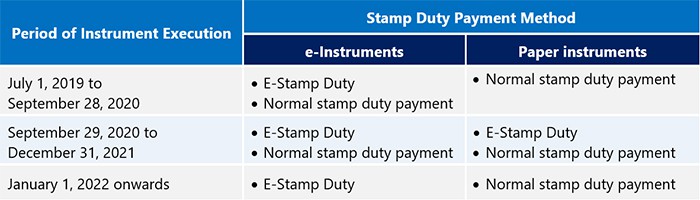
To allow taxpayers to become acquainted with the e-Stamp Duty system, the Revenue Department issued another notification (Notification of the Director-General of Revenue concerning Stamp Duty (No. 59)) which temporarily allowed taxpayers to omit the use of the e-Stamp Duty system by paying stamp duty on these e-Instruments at an area revenue office instead. Originally due to end on December 31, 2020, the measure was extended to December 31, 2021, under Notification of the Director-General of Revenue concerning Stamp Duty (No. 61), and now applies to e-Instruments executed between July 1, 2019 and December 31, 2021.

The Revenue Department also issued a notification allowing taxpayers to use the e-Stamp Duty system to pay stamp duty on the same five instruments executed in the traditional paper format; provided that the instruments are executed during September 29, 2020 to December 31, 2021. Again, this was originally due to end on December 31, 2020 (Notification of the Director-General of Revenue Re: Stamp Duty (No. 60)), but has been extended to December 31, 2020 (Notification of the Director-General of Revenue Re: Stamp Duty (No. 62)).

The table below summarizes the methods of stamp duty payment for the five instrument categories mentioned above.
Practicalities of the e-Stamp Duty System

The e-Stamp Duty system allows taxpayers to pay stamp duty online by filing the prescribed form (Form Or.Sor.9) through the website of the Revenue Department (www.rd.go.th) or the Revenue Department’s Application Programming Interface.

The e-Stamp Duty system allows taxpayers to file Form Or.Sor.9 and pay stamp duty before or within 15 days from the date of instrument execution. As of the date of this article, taxpayers can file a request to pay e-Stamp Duty no earlier than 30 days before the date on which an instrument is executed. If a taxpayer opts to pay e-Stamp Duty after executing an instrument, and the last date of paying stamp duty is due on public holiday, then the due date is extended to the next working day.

For example, if an instrument is due to be executed on March 31, 2021, the liable person can file Form Or.Sor.9 and pay e-Stamp Duty as early as March 2, 2021, or as late as April 16, 2021, (extended from April 15, 2021 which is a public holiday).

Taxpayers should note that the e-Stamp Duty system does not currently support late payment. Therefore, late filing and paying stamp duty will have to be done at an area revenue office.

After a taxpayer submits Form Or.Sor.9, they will receive a QR code and a pay-in-slip which can be used to make the e-Stamp Duty payment to the designated bank account of the Revenue Department.

Once the e-Stamp Duty is duly paid, the Revenue Department will generate a unique receipt code for the taxpayer to use as evidence of payment. This evidence of e-Stamp Duty payment can be downloaded from www.rd.go.th, or from the API (depending on where the taxpayer submitted Form Or.Sor.9).

Taxpayers should maintain the downloaded unique code and receipt for reference in the future. For instruments executed in paper format, taxpayers can maintain the downloaded unique code for reference in the future or print out the unique code and receipt and attach them to the instrument (instead of the usual official endorsement for paying stamp duty in cash at an area revenue office).

RELATED INSIGHTS​ 

May 28, 2025
Tilleke & Gibbins attorneys in Vietnam have contributed the 2025 edition of Doing Business in Vietnam, a comprehensive Q&A-style resource from Thomson Reuters Practical Law that provides essential insights for companies navigating business operations in Vietnam. The guide presents a detailed overview of the country’s legal framework and regulatory environment, reflecting recent updates in Vietnamese legislation and practice. This annually updated guide offers key information on the following areas: Legal system: Structure of the Vietnamese judiciary and the role of codified law. Foreign investment: Conditions for market access, licensing requirements, foreign ownership restrictions, and investment incentives. Business vehicles: Formation and operation of legal entities, including limited liability companies, joint-stock companies, and representative offices. Employment: Employment contracts, social insurance, labor rights, and procedures for hiring foreign nationals. Tax: Overview of corporate income tax, personal income tax, value-added tax, and other tax obligations. Intellectual property: Procedures for protecting and enforcing patents, trademarks, copyrights, and other IP rights. Data protection: Compliance requirements under Vietnam’s data privacy laws, including the Personal Data Protection Decree. Competition law: Antitrust rules and regulatory oversight under the Law on Competition. Anti-bribery and corruption: Legal framework and enforcement practices aimed at curbing corrupt activities. E-commerce and digital business: Regulations governing online platforms, digital content, and cross-border services. Marketing and advertising: Laws and guidelines on advertising standards and consumer protection. Product regulation and liability: Safety requirements, product liability issues, and roles of relevant authorities. Doing Business in Vietnam is part of Practical Law’s global series of legal guides designed to support international practitioners and businesses. To access the most recent edition of the Vietnam guide, visit the Practical Law website and sign up for a free trial.
May 2, 2025
Attorneys from Tilleke & Gibbins have updated the latest edition of Doing Business in Thailand, a Q&A-style guide from Thomson Reuters Practical Law that offers an overview of key legal considerations for companies operating in jurisdictions worldwide. The contribution outlines the country’s legal and regulatory framework for foreign investment and business operations and reflects the latest legislative developments. The chapter addresses the following core topics: Legal system: Structure of the courts and the codified nature of Thai law. Foreign investment: Business restrictions under the Foreign Business Act, sector-specific regulations, exchange control rules, and investment incentives. Business vehicles: Overview of partnerships, private and public limited companies, and other legal entities. Employment: Labor protections, employment contracts, foreign worker requirements, and termination procedures. Tax: Corporate and personal income tax, indirect taxes, and tax obligations for residents and non-residents. Intellectual property: Registration and enforcement of patents, trademarks, designs, and copyrights. Data protection: Key provisions of the Personal Data Protection Act and related compliance obligations. Competition law: Regulatory framework under the Trade Competition Act. Anti-bribery and corruption: Relevant legislation and enforcement mechanisms. E-commerce and digital business: Legal regime for online transactions and digital platforms. Marketing and advertising: Consumer protection laws and regulations affecting advertising and marketing practices. Product regulation and liability: Safety standards, liability regimes, and roles of enforcement authorities. Practical Law, a legal reference resource from Thomson Reuters, publishes a range of guides for hundreds of jurisdictions and practice areas. The insurance and reinsurance guide is a valuable resource for legal practitioners, covering numerous jurisdictions worldwide. To view the latest version of the guide, please visit the Practical Law website and enroll in the free Practical Law trial to gain full access.
March 13, 2025
Vietnam’s Ministry of Finance has released a draft Decree on Tax Administration for E-Commerce and Digital Platforms (“Draft Decree”), introducing significant tax compliance obligations that could reshape how digital platforms, and individuals and business households conducting business through the platforms, manage their tax responsibilities. Aimed at strengthening tax enforcement, the Draft Decree requires e-commerce and digital platforms to actively track and withhold taxes from business households and individual sellers, and remit payments to tax authorities. While it has not yet been promulgated, the Draft Decree is expected to take effect on April 1, 2025, leaving platforms with a limited window to prepare for compliance. Who Is Affected by the New Tax Rules? The Draft Decree significantly broadens the tax administration scope beyond traditional e-commerce platforms to cover a wide range of digital economy participants. Specifically, the Draft Decree places direct tax-related responsibilities on two major categories (collectively, “Regulated Operators”): E-commerce and digital platforms with payment functions (e.g., platforms that process buyer payments via e-wallets, bank transfers, cards, or cash-on-delivery); and Other digital-economy players that enable e-commerce transactions, including (i) intermediary service platforms connecting service providers with consumers, (ii) digital content platforms, (iii) online advertising providers, (iv) cloud computing and data storage providers, (v) social media platforms engaged in business activities (e.g., live-stream, in-app transactions), (vi) online education, gaming, and digital entertainment platforms generating revenue from digital transactions, (vii) Vietnam-based partners of foreign digital service providers facilitating local payments for overseas platforms, and (viii) intermediary payment service providers handling financial transactions for e-commerce activities. Under the Draft Decree, Regulated Operators will be required to track, report, and enforce tax compliance for both resident and nonresident individuals and households conducting business through their platforms (“Sellers”). What New Tax Obligations Do Platforms Face? Onshore platforms For the first time, Regulated Operators will
March 12, 2025
In November 2024, Thai Prime Minister Paethongtarn Shinawatra unveiled ambitious plans to enhance tax incentives for foreign film productions during a networking reception in Los Angeles, coinciding with her visit to the APEC Economic Leaders’ Meeting in Lima, Peru. This event, attended by Motion Picture Association executives and leaders from top US film companies, marked a significant commitment to boosting foreign investment in Thailand’s film industry. Thailand’s Department of Tourism (DOT) prioritized the initiative by updating the Announcement on Guidelines, Procedures, and Conditions for Applying for Benefits Under the Incentive Measures for Foreign Film Production in Thailand in December 2024 to further position Thailand as a destination for large-scale international film and television productions. Key Amendments to Film Incentives under the 2024 Announcement The 2024 announcement introduced major changes, including (1) removal of the rebate cap, previously set at THB 150 million (approx. USD 4.5 million) per project, enabling rebates based on total qualified spending, and (2) an increase in cash rebate rates. The maximum allowable cash rebate rate was increased to 30 percent from the previous cap of 20 percent. The base rate of 15 percent remains unchanged. The primary incentive available under the 2024 announcement is a 15 percent cash rebate on qualified spending in Thailand of at least THB 50 million (approx. USD 1.5 million). On top of this primary incentive, additional incentives are available; however, the total possible cash rebate is capped at 30 percent, and the additional incentives can only amount to an added 15 percent. Also, the total rebate (including both primary and additional incentives) for films with a budget of less than THB 100 million (approx. USD 3 million) is capped at 25%. To obtain a higher rebate rate, productions may apply for the following additional incentives: Compliance Requirements Foreign production companies