
You are using an outdated browser and your browsing experience will not be optimal. Please update to the latest version of Microsoft Edge, Google Chrome or Mozilla Firefox. Install Microsoft Edge

June 7, 2024

Laos Regulates Management of Foreign Currency from Exports

On March 7, 2024, Laos moved to regulate the management of foreign-currency income from the exportation of goods and services. Effective March 29, 2024, Decision No. 333 (formally the Decision on Management of Income in Foreign Currency from Exportation of Goods and Services No. 333/BOL) from the Bank of Lao PDR (BOL) aims to incentivize the inflow of such foreign currency into Laos and its sale to licensed commercial banks.

Decision No. 333 sets minimum required proportions for importing income in foreign currency derived from the exportation of goods and services, as well as the timeframe for doing so. It also stipulates the requirements for selling such foreign currency to commercial banks in Laos and the minimum proportions that must be sold.

Importing Foreign-Currency Income

Exporters must receive payments from abroad via bank transfer into a dedicated bank account designated for import-export business activities within the timeline specified in the sale-purchase agreement, but not exceeding 180 days from the date of export. Each sector must import income in foreign currency into the Lao PDR according to the minimum proportion of currency to be imported, and it must be done within the required timeframes, as specified in the table below.
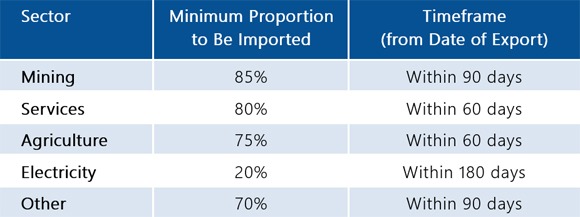
The ratios and timeframes are subject to change depending on the circumstances. If exporters cannot comply with the required ratio and timeline, exporters must provide relevant explanatory documents for the BOL’s consideration.

Selling Foreign-Currency Income

Exporters of goods and services must sell at least the minimum required proportion of their foreign-currency income (see table below) to a commercial bank in Laos. This foreign currency exchange must occur within three working days of receiving the foreign currency into the dedicated bank account in Laos. The selling rate will be determined by the prevailing rate of the commercial bank on the day of the transaction.
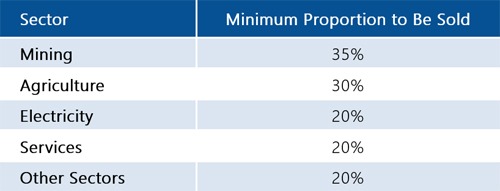
In conducting these transactions, commercial banks are required to carefully consider and manage their reserves and overall liquidity to ensure that they can meet public demand.

If an exporter does not sell at least the minimum required amount of foreign currency within three working days, the relevant commercial bank must proceed with the minimum required exchange and notify the exporter that they are doing so.

These requirements do not apply to re-exporters, such as importers of unprocessed raw materials for re-export to other countries, as determined by the Department of Foreign Currency Management (DFCM).

After selling the minimum required amount to a commercial bank, the remaining foreign-currency income must be used for foreign-currency exchange purposes, such as payments to parties in foreign countries, fulfilling obligations to the state, and so on.

Exporters can sell foreign currency to the BOL by notifying it of the need to sell the foreign currency to the DFCM in the BOL, after which they can sell the currency to the BOL through a commercial bank.

Registration

Decision No. 333 requires service exporters to register as importers and exporters to bring in income generated from exporting services. Although it doesn’t specify the types of service businesses that need to register, a March 2024 notice from the Ministry of Industry and Commerce offers examples of such businesses, including those in international transport, insurance, tourism and hotels, construction, and consulting.

Violations

First-time violations of Decision No. 333 that do not cause damage are subject to training on the importance of complying with Lao law or a warning. If the violation persists after the training or warning, the violator will face suspension of its ability to export goods and services.

For more information on Decision No. 333, or on any aspect of foreign currency management in Laos, please contact Tilleke & Gibbins at [email protected].

RELATED INSIGHTS​ 

June 23, 2026
On May 14, 2026, Thailand published a ministerial regulation in the Government Gazette to prescribe measures for prevention and suppression of technology crimes. The regulation creates a comprehensive procedural framework for returning money and digital assets to victims of technology crimes. It will take effect 90 days after publication (in mid-August 2026), giving affected entities a limited window to prepare. Mandatory Reporting Obligations for Financial Institutions When a deposit account, e-money account, or digital asset wallet is frozen in connection with a technology crime, the relevant financial institution or business operator must report transaction data to the Anti-Money Laundering Office (AMLO) via AMLO’s designated electronic system. Required data elements include account numbers (sender and receiver), names, identification or passport numbers, legal entity registration numbers, phone numbers, remaining balance, damage amount, transaction reference numbers, and the bank case ID. Institutions that already share data through the information-sharing system under the emergency decree are deemed to have satisfied this reporting obligation, creating an incentive for platform participation. When the Royal Thai Police or the Department of Special Investigation seize or freeze assets related to technology crimes, they must provide AMLO with investigation reports, complaint evidence, money-trail data, and account statements. Notification and Claims Process Once the AMLO secretary-general approves verified reports of a technology crime, the account information of persons connected to the crime will be published in the Government Gazette, triggering a 90-day window for victims to file claims and for related persons to file objections. Officers will also publish details on AMLO’s electronic media and send registered mail to identified victims, which will be deemed received after 7 days domestically or 15 days internationally. Victims have 90 days from the date the crime is published in the Government Gazette to file claims through AMLO’s electronic system. Claims must include
June 9, 2026
On April 28, 2026, the Central Bank of Myanmar (CBM) issued Notification No. 18/2026 introducing the new Foreign Remittance Business Regulations. The new regulations apply to companies intending to operate foreign remittance businesses in Myanmar that are not licensed banks, non-bank financial institutions, or other financial institutions. The regulations supersede and replace the previous regulatory framework governing foreign remittance businesses under CBM Notification No. 21/2019. While the overall structure remains familiar, the new regulations introduce more detailed requirements for licensing, operations, reporting, and compliance, with a stronger focus on transparency and regulatory oversight. Broader Licensing Requirements Under the new regulations, applicants must submit detailed business plans describing the use of information technology and mobile platforms, along with clear plans for handling remittances from workers abroad and resolving customer complaints. Financial Thresholds and Reporting Requirements The baseline financial thresholds remain unchanged. Licensees must maintain a security deposit of MMK 100 million in an escrow account, along with a separate revolving fund dedicated solely to remittance operations. The new regulations introduce more structured reporting obligations. Licensees are now required to submit daily remittance transaction data by the next business day before noon, in addition to monthly and periodic reporting requirements. Foreign bank account statements must also be submitted regularly, and licensees must provide updates on business operations every six months. Strengthened AML and CFT Framework The new regulations place a greater emphasis on anti-money laundering (AML) and counter financing of terrorism (CFT), with tighter controls over management changes. Any changes in shareholding, share transfers, or the appointment of key management personnel such as the managing director require prior approval from the CBM. Licensing Fees and Validity The new regulations increase licensing costs, while maintaining the same validity period of three years. The new regulations provide more detailed grounds for suspension and
May 25, 2026
After several years of policy discussion and continued efforts led by the Ministry of Commerce (MOC) to relax the list of reserved businesses under the Foreign Business Act B.E. 2542 (1999) (FBA), the reform process has now reached a significant milestone. On May 12, 2026, the Thai cabinet approved in principle two draft subordinate legislative instruments aimed at delisting certain reserved business activities under the FBA and reducing licensing requirements for foreign business operators. These developments signal a renewed and concrete effort by the government to modernize Thailand’s business regulatory framework in order to attract foreign investment and boost Thailand’s competitiveness in the global market. Nine Businesses Set for FBA Delisting Below is a list of the nine businesses that are being targeted for delisting from the FBA’s restrictions. A draft ministerial regulation would delist the first eight reserved businesses, while a royal decree has been drafted to delist the ninth business: Telecommunications services (Type 1 license only, covering operators without their own telecommunications infrastructure), under the supervision of the Office of the National Broadcasting and Telecommunications Commission. Treasury center services subject to the Foreign Exchange Control Act B.E. 2485 and under the supervision of the Bank of Thailand. Securities-collateralized lending, pursuant to the laws governing securities and exchange and derivatives regulated by the Securities and Exchange Commission. Agency, dealer, advisory, or fund management services relating to derivatives where the underlying assets fall outside the scope of the Derivatives Act B.E. 2546 (2003) Intra-group shared services, including administrative, human resources, and IT functions Intra-group domestic debt guarantee services Leasing of partial space for installation of financial service machines and automatic vending machines for employee use Petroleum drilling services Trading of agricultural product derivatives through a futures exchange, with physical delivery or receipt of agricultural products at a futures exchange–designated
May 22, 2026
Thailand recently concluded the latest round of high-level trade discussions with its US trade counterparts. In addition to addressing concerns over claimed human rights abuses, forced labor, and the current trade imbalance with the US, one critical area of focus was US allegations of transshipment in Thailand’s import-export sector. Transshipment is the practice of routing goods through a third country to circumvent duties or tariffs on goods exported to the receiving country. Specifically, the US alleges that many Thai exporters declare a Thai origin for goods to qualify for preferential duties or exemptions without meeting the legal standards for establishing Thai product origin—an act that it claims masks the goods’ true origin. This is a particular matter of concern for US authorities, since transshipment is perceived to be a means by which Thai origin is claimed for many Chinese goods exported abroad. This perception affects a wide range of otherwise legitimate Thai-origin goods. The Thai trade delegation, led by Deputy Prime Minister and Commerce Minister Suphajee Suthumpun, met with counterparts from the Office of the United States Trade Representative (USTR) on May 3–6. A subsequent team of Thai trade representatives, led by the Thai Ministry of Commerce vice minister, met with the USTR on May 13–14. These discussions directly impact the trade enforcement environment in Thailand, potentially affecting numerous business operators involved in the manufacture, import, or export of goods and components. Thailand’s position is that it strictly adheres to and enforces the legal standards for determining qualifying origin and that allegations of transshipment are largely unjustified. Nonetheless, it has agreed to increase its focus on trade compliance and enforcement in Thailand in return for commitments on reciprocal trade benefits with the US, including consideration of tariff exemptions on certain critical Thai imports into the US. Notable Outcomes There