
You are using an outdated browser and your browsing experience will not be optimal. Please update to the latest version of Microsoft Edge, Google Chrome or Mozilla Firefox. Install Microsoft Edge

June 7, 2024

Laos Regulates Management of Foreign Currency from Exports

On March 7, 2024, Laos moved to regulate the management of foreign-currency income from the exportation of goods and services. Effective March 29, 2024, Decision No. 333 (formally the Decision on Management of Income in Foreign Currency from Exportation of Goods and Services No. 333/BOL) from the Bank of Lao PDR (BOL) aims to incentivize the inflow of such foreign currency into Laos and its sale to licensed commercial banks.

Decision No. 333 sets minimum required proportions for importing income in foreign currency derived from the exportation of goods and services, as well as the timeframe for doing so. It also stipulates the requirements for selling such foreign currency to commercial banks in Laos and the minimum proportions that must be sold.

Importing Foreign-Currency Income

Exporters must receive payments from abroad via bank transfer into a dedicated bank account designated for import-export business activities within the timeline specified in the sale-purchase agreement, but not exceeding 180 days from the date of export. Each sector must import income in foreign currency into the Lao PDR according to the minimum proportion of currency to be imported, and it must be done within the required timeframes, as specified in the table below.
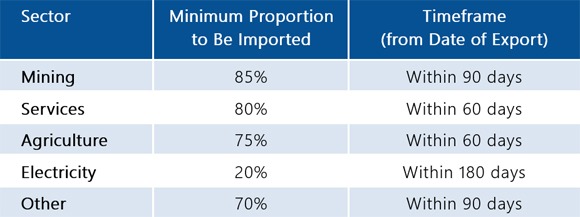
The ratios and timeframes are subject to change depending on the circumstances. If exporters cannot comply with the required ratio and timeline, exporters must provide relevant explanatory documents for the BOL’s consideration.

Selling Foreign-Currency Income

Exporters of goods and services must sell at least the minimum required proportion of their foreign-currency income (see table below) to a commercial bank in Laos. This foreign currency exchange must occur within three working days of receiving the foreign currency into the dedicated bank account in Laos. The selling rate will be determined by the prevailing rate of the commercial bank on the day of the transaction.
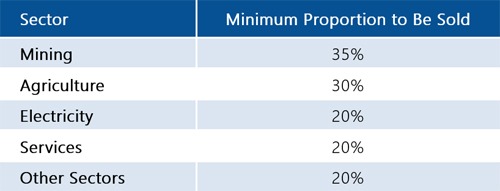
In conducting these transactions, commercial banks are required to carefully consider and manage their reserves and overall liquidity to ensure that they can meet public demand.

If an exporter does not sell at least the minimum required amount of foreign currency within three working days, the relevant commercial bank must proceed with the minimum required exchange and notify the exporter that they are doing so.

These requirements do not apply to re-exporters, such as importers of unprocessed raw materials for re-export to other countries, as determined by the Department of Foreign Currency Management (DFCM).

After selling the minimum required amount to a commercial bank, the remaining foreign-currency income must be used for foreign-currency exchange purposes, such as payments to parties in foreign countries, fulfilling obligations to the state, and so on.

Exporters can sell foreign currency to the BOL by notifying it of the need to sell the foreign currency to the DFCM in the BOL, after which they can sell the currency to the BOL through a commercial bank.

Registration

Decision No. 333 requires service exporters to register as importers and exporters to bring in income generated from exporting services. Although it doesn’t specify the types of service businesses that need to register, a March 2024 notice from the Ministry of Industry and Commerce offers examples of such businesses, including those in international transport, insurance, tourism and hotels, construction, and consulting.

Violations

First-time violations of Decision No. 333 that do not cause damage are subject to training on the importance of complying with Lao law or a warning. If the violation persists after the training or warning, the violator will face suspension of its ability to export goods and services.

For more information on Decision No. 333, or on any aspect of foreign currency management in Laos, please contact Tilleke & Gibbins at [email protected].

RELATED INSIGHTS​ 

May 8, 2026
The global trade environment for Thai exporters in 2026 has shifted significantly. Recent enforcement developments in both the United States and the European Union show a clear shift in trade policy: regulators are no longer focused solely on tariff levels, but also on whether products genuinely originate where exporters claim they do. Adding to this complexity, the US Supreme Court’s February 2026 decision striking down the use of the International Emergency Economic Powers Act (IEEPA) to impose tariffs has upended the legal basis for a major pillar of US tariff policy, creating significant legal and commercial uncertainty for exporters worldwide, including in Thailand. For Thai companies integrated into regional supply chains, this change carries material implications. Although the IEEPA-based US reciprocal tariffs have been struck down, intensified circumvention enforcement continues under separate legal authorities, and the administration has signaled its intent to reimpose tariffs under alternative statutory frameworks, while EU authorities are using anti-circumvention investigations where trade patterns shift. In both jurisdictions, the decisive issue is whether manufacturing in Thailand constitutes substantial transformation under applicable rules of origin. Such origin determinations increasingly drive duty exposure, audit risk and commercial disputes. In 2026, the ability to defend a product’s Thai origin is not merely a procedural step, it is central to preserving market access in the US and EU. Impact Of US Circumvention Enforcement and an Uncertain Tariff Landscape Following the 2025 Framework for an Agreement on Reciprocal Trade, Thailand saw a shift in its tariff relationship with the US. A substantial range of Thai-origin goods were subject to a 19% reciprocal tariff under the IEEPA. However, the Supreme Court’s ruling invalidating the use of IEEPA for tariffs has removed the legal basis for that rate. The Administration has indicated it intends to pursue replacement tariffs under other statutory authorities,
April 9, 2026
In March 2026, the United States Trade Representative (USTR) initiated two significant investigations under Section 301(b) of the Trade Act of 1974 that directly affect Thailand. The first investigation examines overproduction in manufacturing sectors caused by government support or policies that distort normal market conditions across 16 economies, including Thailand. The second investigation, launched the following day, targets 60 economies, also including Thailand, for alleged failures to impose and effectively enforce prohibitions on the importation of goods produced with forced labor. Taken together, these investigations represent a significant escalation in US trade enforcement and create substantial risk for Thai exporters, manufacturers, and businesses with supply chain connections to the United States. The investigations are moving on an accelerated timeline, with the USTR indicating that potential trade measures, including tariffs, could be imposed as early as July 2026. This article provides an overview of the investigations, highlights their specific implications for Thailand, and outlines practical considerations for affected businesses. Section 301 as a Trade Enforcement Tool Section 301 of the Trade Act of 1974 gives the USTR authority to investigate foreign acts, policies, or practices that are considered unreasonable or discriminatory and that burden or restrict US commerce. If the USTR concludes that such practices exist, the statute allows a wide range of remedial measures, including the imposition of tariffs, nontariff trade restrictions, and negotiated agreements with foreign governments. Unlike other trade authorities, Section 301 does not set limits on the level of tariffs or the duration of measures, giving the USTR considerable flexibility to address perceived trade imbalances or unfair practices. Historically, Section 301 investigations take up to a year to complete. In this instance, however, the USTR has indicated that the investigations will proceed on a much faster timetable, with an unofficial target of concluding by July 2026.
April 1, 2026
On March 30, 2026, Thailand’s Customs Department announced a strategy to raise import duties on a broad range of consumer goods—including plastic items and electronics accessories—to their maximum statutory ceilings, which often sit at 30% or 40%. Many of these goods currently benefit from promotional or incentive rates as low as 5%. For importers, e-commerce platforms, and logistics providers, this development demands immediate attention. While these increases generally require cabinet approval, they do not require full parliamentary amendment of the Customs Tariff Decree B.E. 2530, as the Customs director-general and the finance minister hold delegated authority to adjust rates within existing statutory bounds. Businesses should not assume that the legislative process will provide significant lead time before higher rates take effect. Death of the De Minimis: Abolishing the THB 1,500 Loophole This “ceiling-rate” policy, which is designed to equalize the landed cost of foreign goods with the domestic production costs of Thai manufacturers, builds on a sweeping set of customs reforms that have already begun to reshape Thailand’s trade environment. The foundation of this new regime was laid on January 1, 2026, when Thailand formally abolished the longstanding THB 1,500 duty exemption for small imported parcels under Customs Notification No. 219/2568. Every imported item is now subject to VAT and applicable import duties for its declared value, regardless of parcel size or transaction amount. By narrowing the scope of exemptions previously granted to low-value goods under the Customs Tariff Decree B.E. 2530, the government has made clear that the era of tax-free cross-border micro-imports is over. Three-Phased Strategy and Legal Modernization The March 30 announcement is the second phase of a three-part regulatory roadmap: Immediate enforcement: The removal of the THB 1,500 loophole and the imposition of VAT on all parcels, effective January 1, 2026. Tariff realignment: The current
March 5, 2026
Amid increasing financial globalization, Vietnam’s establishment of an International Financial Center (IFC) represents a strategic initiative to attract high-quality foreign investment and enhance the country’s position in the global financial system. In support of this objective, a Specialized Court was introduced under Resolution No. 222/2025/QH15 as a dedicated dispute resolution mechanism within the IFC framework. The Specialized Court at the IFC was subsequently operationalized by Law on the Specialized Court No. 150/2025/QH15, effective from January 1, 2026. Organizational Structure of the Specialized Court The Specialized Court at the IFC is a court within the system of the People’s Courts, organized and operating in accordance with the Law on the Specialized Court, and vested with jurisdiction to adjudicate and resolve cases at the IFC. The Specialized Court is located in Ho Chi Minh City and comprises (i) a Court of First Instance; (ii) a Court of Appeal, and (iii) a supporting apparatus. Jurisdiction of the Specialized Court The jurisdiction of the Specialized Court at the IFC is strictly defined based on both (i) the subject matter of the cases and (ii) the membership status of the parties involved. Specifically, the Specialized Court has jurisdiction over (except for cases involving public interests or the interests of the state) the following: Disputes arising from investment and business activities. Requests for recognition and enforcement in Vietnam of judgments and decisions of foreign courts and foreign arbitral awards. Requests related to dispute resolution by arbitration. Other disputes directly related to investment and business activities (to be specified by the Supreme People’s Court). Additionally, at least one party in the case must be a member of the IFC. The IFC’s membership status is established through registration, recognition as a member, or the grant of a license for establishment and operation within the IFC. In the