
You are using an outdated browser and your browsing experience will not be optimal. Please update to the latest version of Microsoft Edge, Google Chrome or Mozilla Firefox. Install Microsoft Edge

June 7, 2024

Laos Regulates Management of Foreign Currency from Exports

On March 7, 2024, Laos moved to regulate the management of foreign-currency income from the exportation of goods and services. Effective March 29, 2024, Decision No. 333 (formally the Decision on Management of Income in Foreign Currency from Exportation of Goods and Services No. 333/BOL) from the Bank of Lao PDR (BOL) aims to incentivize the inflow of such foreign currency into Laos and its sale to licensed commercial banks.

Decision No. 333 sets minimum required proportions for importing income in foreign currency derived from the exportation of goods and services, as well as the timeframe for doing so. It also stipulates the requirements for selling such foreign currency to commercial banks in Laos and the minimum proportions that must be sold.

Importing Foreign-Currency Income

Exporters must receive payments from abroad via bank transfer into a dedicated bank account designated for import-export business activities within the timeline specified in the sale-purchase agreement, but not exceeding 180 days from the date of export. Each sector must import income in foreign currency into the Lao PDR according to the minimum proportion of currency to be imported, and it must be done within the required timeframes, as specified in the table below.
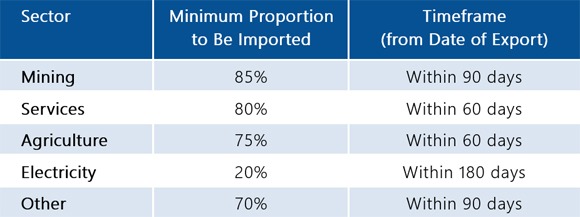
The ratios and timeframes are subject to change depending on the circumstances. If exporters cannot comply with the required ratio and timeline, exporters must provide relevant explanatory documents for the BOL’s consideration.

Selling Foreign-Currency Income

Exporters of goods and services must sell at least the minimum required proportion of their foreign-currency income (see table below) to a commercial bank in Laos. This foreign currency exchange must occur within three working days of receiving the foreign currency into the dedicated bank account in Laos. The selling rate will be determined by the prevailing rate of the commercial bank on the day of the transaction.
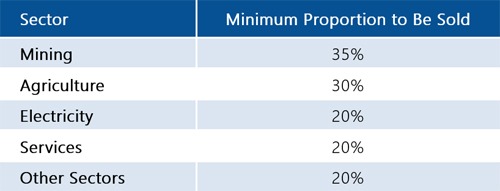
In conducting these transactions, commercial banks are required to carefully consider and manage their reserves and overall liquidity to ensure that they can meet public demand.

If an exporter does not sell at least the minimum required amount of foreign currency within three working days, the relevant commercial bank must proceed with the minimum required exchange and notify the exporter that they are doing so.

These requirements do not apply to re-exporters, such as importers of unprocessed raw materials for re-export to other countries, as determined by the Department of Foreign Currency Management (DFCM).

After selling the minimum required amount to a commercial bank, the remaining foreign-currency income must be used for foreign-currency exchange purposes, such as payments to parties in foreign countries, fulfilling obligations to the state, and so on.

Exporters can sell foreign currency to the BOL by notifying it of the need to sell the foreign currency to the DFCM in the BOL, after which they can sell the currency to the BOL through a commercial bank.

Registration

Decision No. 333 requires service exporters to register as importers and exporters to bring in income generated from exporting services. Although it doesn’t specify the types of service businesses that need to register, a March 2024 notice from the Ministry of Industry and Commerce offers examples of such businesses, including those in international transport, insurance, tourism and hotels, construction, and consulting.

Violations

First-time violations of Decision No. 333 that do not cause damage are subject to training on the importance of complying with Lao law or a warning. If the violation persists after the training or warning, the violator will face suspension of its ability to export goods and services.

For more information on Decision No. 333, or on any aspect of foreign currency management in Laos, please contact Tilleke & Gibbins at [email protected].

RELATED INSIGHTS​ 

February 27, 2026
On January 26, 2026, Vietnam’s Ministry of Finance issued Circular No. 06/2026/TT-BTC (Circular 06), amending and supplementing Circular No. 13/2015/TT-BTC, which provides guidance on dossiers and procedures for customs recordal and customs supervision in relation to intellectual property rights (IPR). Circular 06 has an effective date of March 1, 2026. Some notable points of Circular 06 include the following: Simplified Documentation for Customs Recordal Applications Circular 06 reduces some documentary requirements for IPR owners: A power of attorney is no longer required to be legalized. Applicants are no longer required to submit title or registration certificates if such documents are issued in digital form. In such cases, it is sufficient to declare comprehensive information on the relevant IPR, enabling customs authorities to verify the information through publicly accessible databases. In practice, this amendment is particularly beneficial for international trademark registrations designating Vietnam. IPR owners may no longer need to obtain a confirmation letter from the Intellectual Property Office of Vietnam regarding the validity of a trademark registration in Vietnam. Instead, they may rely on registration status information available from the World Intellectual Property Organization (WIPO) database, reflecting that the international registration has been granted protection in Vietnam. Clearer Mechanism for Ex Officio Suspension of Suspected Infringing Goods Although ex officio suspension has been referenced in earlier regulations, Circular 06 provides clearer guidance on the circumstances and procedures under which customs may proactively suspend customs procedures for consignments suspected of being counterfeit or pirated goods. Accordingly, customs authorities may initiate the suspension of clearance without waiting for a formal request from IPR owners. Enhanced Supervision of Imported/Exported Goods in E-Commerce Circular 06 also supplements provisions on the inspection of imported and exported goods transacted through e-commerce channels. Customs authorities may apply risk management measures to assess goods traded via e-commerce
February 27, 2026
The Bank of Thailand (BOT) has officially implemented a new regulatory framework supervising systemically important retail payment systems (SIRPS), effective February 21, 2026, with PromptPay being the first payment system designated as a SIRPS. Under this new set of regulations, the BOT may designate payment systems under the Payment Systems Act B.E. 2560 (2017) as SIRPSs based on quantitative and qualitative assessments. Once a system is designated as a SIRPS, the operator becomes subject to expanded supervisory obligations beyond the general requirements of the Payment Systems Act. Enhanced Supervisory Requirements SIRPS operators must comply with a heightened supervisory regime across three key areas, outlined below. 1. Governance SIRPS operators must maintain robust and transparent governance structures, including: Balanced board composition, with at least one-third of the board comprising independent directors who represent stakeholders in the system (such as payment service providers, consumers, and experts). Independent directors may serve for no more than two consecutive terms. Subcommittees to assist the board in overseeing compliance, policy implementation, and operational strategy. Clear separation between executives responsible for risk and information security and those overseeing day-to-day business operations. Risk Management and System SecuritySIRPS operators must implement comprehensive risk management frameworks, including: Clear service agreements between the SIRPS operator and its direct participants (payment service providers who connect directly to the SIRPS), defining roles and responsibilities among stakeholders. These agreements must include obligations for direct SIRPS participants to supervise any indirect participants they onboard to ensure compliance with service agreements and business rules. A business continuity plan covering both IT and non-IT aspects, with annual review. The SIRPS must target service availability comparable to international payment infrastructures, including the ability to recover operations within two hours of a disruption and to maintain scalable operational capacity. Tools and controls to monitor and manage material or
February 25, 2026
Tilleke & Gibbins has updated the Vietnam chapter in the newly released Licensing 2026 guide, published by Lexology Panoramic. The comparative guide provides companies and other interested readers with information on licensing law and practice in various countries around the world. Licensing 2026 provides detailed information on the following topics: Restrictions, laws and licensing arrangements Intellectual property issues: Paris Convention for the Protection of Industrial Property, contesting the validity of licensor’s IP rights, invalidity and expiry of IP rights, security interests, proceedings against third parties, sublicensing, jointly owned IP, first to file, scope of patent protection, trade secrets, copyright Software licensing: Perpetual licensing, legal requirements, user restrictions Royalties and payments, currency conversion, and taxes: Relevant legislation, restrictions, taxation of foreign licensors Competition law issues: Restrictions on trade, legal restrictions, and IP-related court rulings Indemnification, disclaimers, and damages: Prevalence and enforceability of indemnity provisions and contractual waivers of damages Termination: Right to terminate, impact of termination Bankruptcy: Impact of licensee or licensor bankruptcy Dispute resolution: Governing law, arbitration, enforceability, injunctive relief, contractual waivers The Vietnam chapter is available below as a PDF. Readers can gain 30 days of complementary access to the full Licensing 2026 guide and the rest of Lexology Panoramic’s varied offerings through this link.
February 20, 2026
On February 2, 2026, Myanmar’s Ministry of Finance and Revenue issued Notification No. 19/2026, reducing the customs duty rate to 0% for certain battery‑electric vehicles, machinery, and related spare parts, applicable from February 2, 2026, through March 31, 2026. Under the notification, imports of battery‑electric special‑purpose vehicles, battery‑electric industrial machinery, and associated spare parts listed in the notification’s annex are eligible for a zero‑percent customs duty rate. These items must be supported by technical recommendations from the Ministry of Electric Power and a recommendation from the Ministry of Industry. The notification applies to a broad range of battery electric equipment, including the following categories: Special purpose vehicles, such as crane trucks, mobile drilling trucks, concrete mixers, mobile clinics, broadcast vans, and street‑cleaning vehicles. Heavy machinery, including excavators, bulldozers, loaders, cranes, rollers, forklifts, and port handling equipment. Spare parts, covering 16 specified categories, including key components such as chargers, inverters, and controllers. Importers and businesses using electric‑powered industrial equipment should review the scope of the eligible items and confirm whether their planned imports fall within the lists covered by the notification.