
You are using an outdated browser and your browsing experience will not be optimal. Please update to the latest version of Microsoft Edge, Google Chrome or Mozilla Firefox. Install Microsoft Edge

June 7, 2024

Laos Regulates Management of Foreign Currency from Exports

On March 7, 2024, Laos moved to regulate the management of foreign-currency income from the exportation of goods and services. Effective March 29, 2024, Decision No. 333 (formally the Decision on Management of Income in Foreign Currency from Exportation of Goods and Services No. 333/BOL) from the Bank of Lao PDR (BOL) aims to incentivize the inflow of such foreign currency into Laos and its sale to licensed commercial banks.

Decision No. 333 sets minimum required proportions for importing income in foreign currency derived from the exportation of goods and services, as well as the timeframe for doing so. It also stipulates the requirements for selling such foreign currency to commercial banks in Laos and the minimum proportions that must be sold.

Importing Foreign-Currency Income

Exporters must receive payments from abroad via bank transfer into a dedicated bank account designated for import-export business activities within the timeline specified in the sale-purchase agreement, but not exceeding 180 days from the date of export. Each sector must import income in foreign currency into the Lao PDR according to the minimum proportion of currency to be imported, and it must be done within the required timeframes, as specified in the table below.
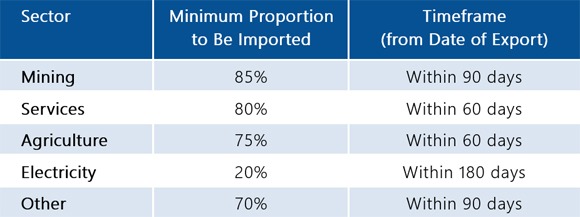
The ratios and timeframes are subject to change depending on the circumstances. If exporters cannot comply with the required ratio and timeline, exporters must provide relevant explanatory documents for the BOL’s consideration.

Selling Foreign-Currency Income

Exporters of goods and services must sell at least the minimum required proportion of their foreign-currency income (see table below) to a commercial bank in Laos. This foreign currency exchange must occur within three working days of receiving the foreign currency into the dedicated bank account in Laos. The selling rate will be determined by the prevailing rate of the commercial bank on the day of the transaction.
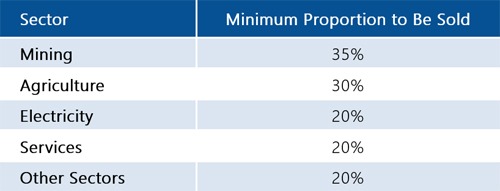
In conducting these transactions, commercial banks are required to carefully consider and manage their reserves and overall liquidity to ensure that they can meet public demand.

If an exporter does not sell at least the minimum required amount of foreign currency within three working days, the relevant commercial bank must proceed with the minimum required exchange and notify the exporter that they are doing so.

These requirements do not apply to re-exporters, such as importers of unprocessed raw materials for re-export to other countries, as determined by the Department of Foreign Currency Management (DFCM).

After selling the minimum required amount to a commercial bank, the remaining foreign-currency income must be used for foreign-currency exchange purposes, such as payments to parties in foreign countries, fulfilling obligations to the state, and so on.

Exporters can sell foreign currency to the BOL by notifying it of the need to sell the foreign currency to the DFCM in the BOL, after which they can sell the currency to the BOL through a commercial bank.

Registration

Decision No. 333 requires service exporters to register as importers and exporters to bring in income generated from exporting services. Although it doesn’t specify the types of service businesses that need to register, a March 2024 notice from the Ministry of Industry and Commerce offers examples of such businesses, including those in international transport, insurance, tourism and hotels, construction, and consulting.

Violations

First-time violations of Decision No. 333 that do not cause damage are subject to training on the importance of complying with Lao law or a warning. If the violation persists after the training or warning, the violator will face suspension of its ability to export goods and services.

For more information on Decision No. 333, or on any aspect of foreign currency management in Laos, please contact Tilleke & Gibbins at [email protected].

RELATED INSIGHTS​ 

February 24, 2025
On January 31, 2025, the Bank of Thailand (BOT) announced a new Notification re: Responsible Lending, replacing a similar notification from 2023. This new notification provides updated measures to assist debtors in different circumstances and clear implementation guidelines for lenders, with the aim of resolving household debt issues. Scope The service providers covered by the notification include banks and nonbanks (e.g., credit card companies, asset management companies, licensed personal loan providers, and nano finance operators) that conduct lending business. New Requirements The notification’s core focus remains loan management throughout the lifecycle of a loan—from credit product development to legal proceedings and debt transfers to other creditors—but with further clarification and detail compared to the 2023 notification. The key revisions in the new notification are summarized below. Advertising standards: The notification tightens requirements in some areas and relaxes them in others. Stricter requirements: It is now clearly stipulated that the BOT oversees taglines that may encourage excessive borrowing. More examples of noncompliant statements are also added (e.g., “Elevate your lifestyle now, pay later”; “Get approved, even with credit challenges”). In addition, advertising material that contains multiple credit products should provide clear minimum and maximum interest rates, especially when there are significant differences in the interest rates of each product. Relaxed requirements: The required information for some marketing activities is now reduced. For example, in marketing events with staff promoting loan products and offering free giveaways, service providers have the discretion to provide effective interest rate information in the manner they deem appropriate, and the advertisement material can display only the mandatory warning statements without providing interest rate details. Encouraging customer financial discipline: The notification requires service providers to implement more elaborate and extensive tools to influence customer behavior (termed “nudging” by the BOT) at every stage of the lending cycle. This
February 19, 2025
On January 3, 2025, the Bank of the Lao PDR (BOL) issued Decision No. 11/BOL on the Use of Foreign Currency in Lao PDR, taking effect on the same date. This decision sets out the rules for using foreign currency in Laos and ensures the Lao kip (LAK) remains the primary currency while allowing flexibility for international transactions. Key points in the decision are outlined below. Permissible Activities for Foreign Currency The decision provides that authorized entities can use foreign currency as a secondary currency to LAK in the setting of cost and pricing structures, announcing and advertising prices, and making or receiving payments for goods and services that are imported or have manufacturing inputs imported from other countries. Otherwise, LAK is the only permitted currency. The decision also stipulates that foreign exchange must be conducted only via authorized commercial banks or foreign exchange markets. The exchange rate for setting costs, pricing structures, announcing and advertising prices, and making and receiving payments for goods and services in foreign currency must match the exchange rate announced by commercial banks from time to time. Businesses Allowed to Use Foreign Currency The decision allows certain businesses and organizations to use foreign currency. These entities are divided into two groups: those that need approval before using foreign currency, and those that can use it immediately. Enterprises that can use foreign currency with BOL approval include: Businesses that export goods or services and entities that lease or obtain concessions from the government, generating revenue in foreign currency through commercial banks. Enterprises that provide international freight and passenger transportation services. Enterprises that provide services related to cross-border logistics and warehousing. Enterprises located at international borders and airports, such as duty-free shops and restaurants. Enterprises that have obligations to make payments in foreign currency to other
February 17, 2025
Thailand’s draft Emergency Decree on Technology Crimes Suppression, which we covered in a client alert in January 2025 primarily addressed to telecom operators and financial institutions, is expected to have significant implications for a wide range of business operators.  The draft emergency decree has already been approved by the cabinet but may undergo further developments as it continues in the legislative process. In this article, we will highlight the material impacts of the draft emergency decree on overseas and local fintech operators. Expanded Definition of “Technology Crimes” The definition of “technology crimes” now includes the following acts of forgery or alteration: Forging or altering the identity of individuals and biometric characteristics by utilizing computer or communication systems or other electronic means to commit offenses. Forging or altering symbols, trademarks, or seals of groups (e.g., foundations, community enterprises) or juristic persons, including acts by juristic persons using individuals or juristic persons as nominal directors or shareholders, regardless of whether such individuals or legal juristic persons reside in Thailand. Forging or altering digital or online platforms, regardless of the platform’s location or legal status. Individuals who conspire, utilize, assist, or support the commission of these offenses will face the same penalties as the principal offender. Business Operator Definition The scope of “business operators” is now expanded to cover various fintech and digital asset operators beyond those under the Payment Systems Act (PSA). The draft emergency decree now includes the following operators, whether they are legally authorized or not: Business operators under the PSA and business operators who operate “as if” they are payment system operators Business operators under the Royal Decree on Digital Asset Businesses or business operators who operate “as if” they are digital asset business operators. Foreign exchange business operators. Disclosure and Exchange of Information Business operators must disclose
January 30, 2025
The Thai cabinet has approved a draft amendment of the Emergency Decree on Measures for the Prevention and Suppression of Technological Crimes as proposed by the Ministry of Digital Economy and Society to strengthen measures against technological crimes, particularly targeting call center scams and cyber fraud. Following the Council of State’s review, the emergency decree will be become effective immediately upon its enactment and publication in the Government Gazette. While the draft amendment is not yet publicly available, the government recently indicated that the emergency decree aims to empower authorities with decisive measures to combat cybercrime effectively. It underscores the shared responsibility among various sectors, including banking, telecommunications, and online platforms, in safeguarding against technological crimes. Key provisions of the draft amendment of the emergency decree include: Telecommunications provider obligations: Telecommunications service providers must suspend SIM cards associated with criminal activities. The National Broadcasting and Telecommunications Commission and mobile service providers themselves are authorized to temporarily suspend mobile phone numbers if there is reasonable suspicion of involvement in criminal activities. Banking responsibilities: Financial institutions are required to promptly report mule accounts to the Anti-Money Laundering Office to facilitate quick restitution to victims. The Anti-Money Laundering Transaction Committee is empowered to order the return of funds to victims without requiring a final court ruling. Penalties for noncompliance: The amended emergency decree introduces penalties for noncompliance by regulated entities that fail to prevent criminal activities for offenses related to technology crimes in the following cases: Digital asset services: Those engaged in the buying, selling, or exchanging of digital assets, such as cryptocurrencies and digital tokens, as well as digital asset businesses that launder money obtained from online crimes by converting it into digital currency, will be subject to imprisonment for up to one year, a fine of up to THB 100,000,