
You are using an outdated browser and your browsing experience will not be optimal. Please update to the latest version of Microsoft Edge, Google Chrome or Mozilla Firefox. Install Microsoft Edge

June 7, 2024

Laos Regulates Management of Foreign Currency from Exports

On March 7, 2024, Laos moved to regulate the management of foreign-currency income from the exportation of goods and services. Effective March 29, 2024, Decision No. 333 (formally the Decision on Management of Income in Foreign Currency from Exportation of Goods and Services No. 333/BOL) from the Bank of Lao PDR (BOL) aims to incentivize the inflow of such foreign currency into Laos and its sale to licensed commercial banks.

Decision No. 333 sets minimum required proportions for importing income in foreign currency derived from the exportation of goods and services, as well as the timeframe for doing so. It also stipulates the requirements for selling such foreign currency to commercial banks in Laos and the minimum proportions that must be sold.

Importing Foreign-Currency Income

Exporters must receive payments from abroad via bank transfer into a dedicated bank account designated for import-export business activities within the timeline specified in the sale-purchase agreement, but not exceeding 180 days from the date of export. Each sector must import income in foreign currency into the Lao PDR according to the minimum proportion of currency to be imported, and it must be done within the required timeframes, as specified in the table below.
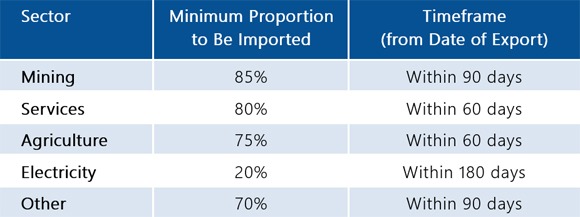
The ratios and timeframes are subject to change depending on the circumstances. If exporters cannot comply with the required ratio and timeline, exporters must provide relevant explanatory documents for the BOL’s consideration.

Selling Foreign-Currency Income

Exporters of goods and services must sell at least the minimum required proportion of their foreign-currency income (see table below) to a commercial bank in Laos. This foreign currency exchange must occur within three working days of receiving the foreign currency into the dedicated bank account in Laos. The selling rate will be determined by the prevailing rate of the commercial bank on the day of the transaction.
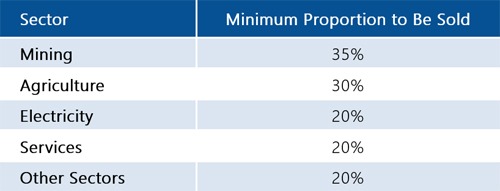
In conducting these transactions, commercial banks are required to carefully consider and manage their reserves and overall liquidity to ensure that they can meet public demand.

If an exporter does not sell at least the minimum required amount of foreign currency within three working days, the relevant commercial bank must proceed with the minimum required exchange and notify the exporter that they are doing so.

These requirements do not apply to re-exporters, such as importers of unprocessed raw materials for re-export to other countries, as determined by the Department of Foreign Currency Management (DFCM).

After selling the minimum required amount to a commercial bank, the remaining foreign-currency income must be used for foreign-currency exchange purposes, such as payments to parties in foreign countries, fulfilling obligations to the state, and so on.

Exporters can sell foreign currency to the BOL by notifying it of the need to sell the foreign currency to the DFCM in the BOL, after which they can sell the currency to the BOL through a commercial bank.

Registration

Decision No. 333 requires service exporters to register as importers and exporters to bring in income generated from exporting services. Although it doesn’t specify the types of service businesses that need to register, a March 2024 notice from the Ministry of Industry and Commerce offers examples of such businesses, including those in international transport, insurance, tourism and hotels, construction, and consulting.

Violations

First-time violations of Decision No. 333 that do not cause damage are subject to training on the importance of complying with Lao law or a warning. If the violation persists after the training or warning, the violator will face suspension of its ability to export goods and services.

For more information on Decision No. 333, or on any aspect of foreign currency management in Laos, please contact Tilleke & Gibbins at [email protected].

RELATED INSIGHTS​ 

January 29, 2025
The fourth round of negotiations of the EU-Thailand Free Trade Agreement (FTA) wrapped up in Bangkok in November 2024. Now that the latest summary report is out, it is worth highlighting some of the intellectual property (IP)-related changes we might see once the chapter is complete. Copyright If Thailand were to agree to follow the EU proposal, we would see the term of protection for copyright extended. Currently under Thai law, protection is the life of the author plus fifty years. This is twenty years less than the EU proposal. It seems that copyright is one area the two sides have yet to agree on, and it is no wonder as agreeing to follow Thai law would deprive authors from the EU of an additional twenty years of protection post-death. On the other hand, Thailand agreeing to the EU proposal would likely result in legislative change in the country to align domestic law with the FTA. We may also see more robust and streamlined collective management organizations (CMOs) in Thailand. The current proposal calls for each party to promote cooperation between their CMOs, which would extend to transparency over their running, including revenue and representation agreements. Thailand does currently have CMOs within the territory, and the Department of Intellectual Property (DIP) has a voluntary CMO code. However, it is unclear whether existing practice will be sufficient for EU rightsholders. CMOs have been an area that is difficult to regulate as there has been a balancing act between tightening the examination of reporting and not wanting to limit the freedom of rightsholders and how they commercialize their IP. Trademarks There is a fair amount of overlap between the Trademark Act in Thailand and the EU proposals. However, it is unclear to what degree the existing laws would satisfy the requests
January 22, 2025
Tasked with implementing the Politburo’s policy outlined in Notice No. 47-TB/TW dated November 15, 2024, the prime minister of Vietnam issued Decision No. 1718/QD-TTg on December 31, 2024, appointing himself as the head of a steering committee dedicated to the establishment of an international financial center in Ho Chi Minh City and a regional financial center in Da Nang by 2025. The Ministry of Planning and Investment has subsequently drafted an outline for the National Assembly’s Resolution on the Establishment of Regional and International Financial Centers in Vietnam (“Draft Resolution”). This Draft Resolution introduces two key policy groups: (i) policies governing the quantity, location, structure, organization, functions, and responsibilities of the financial centers; and (ii) policies applicable to various areas and matters within the financial centers. Notably, under the Draft Resolution, fintech has been identified as a key sector, with a specific focus on the implementation of a “controlled sandbox” policy for business models involving virtual assets and cryptocurrencies. Under this framework, transactions related to virtual assets and cryptocurrencies will be permitted from July 1, 2026, subject to licensing, management, impact assessment, and risk oversight by the financial centers’ Management and Operations Committee. Scope of Application and Key Principles The Draft Resolution applies to a wide range of stakeholders, including investors, regulatory agencies, organizations, and individuals involved in the establishment, organization, and operation of regional and international financial centers in Vietnam. These financial centers will have clearly defined geographical boundaries and specific locations, which will be further specified and detailed by the People’s Committees of Ho Chi Minh City and Da Nang. Companies successfully registered as members of these financial centers will benefit from special investor-friendly policy principles, which may differ from the general legal and regulatory framework applicable in other parts of Vietnam. Most notably, the state will
January 13, 2025
The State Bank of Vietnam’s Circular No. 50/2024/TT-NHNN regulating safety and security for the provision of online services in the banking sector (“Circular 50”), issued on October 31, 2024, took effect on January 1, 2025, with delayed effectiveness for certain provisions on (i) network, communication, and security systems, online banking application software, and mobile banking application software (July 1, 2025); (ii) transaction confirmation for payment transactions conducted via the straight-through processing method (January 1, 2026); and (iii) authentication forms and reporting obligations (July 1, 2026). The cybersecurity situation in Vietnam is complicated, and the banking and finance sector has been one of the top targets of high-tech criminals. Circular 50 seeks to enhance user protection by expanding the technical requirements to more services in the banking sector as well as standardizing how transactions are authenticated. Expanded Scope of Services Covered Previous regulations on safety and security of online services in the banking sector only covered banking services and intermediary payment services. Circular 50 expands the scope to include other services of credit institutions and foreign bank branches such as credit information services, foreign exchange services, securities depository services, and services related to factoring and letters of credit, which now need to comply with technical requirements and standards for online services such as firewalls and DMZ network barriers. Risk-Based Approach to Authentication Circular 50 sets out standards for payment transactions and card transactions by: Classifying various online transactions based on the type of client, the purpose of the transfer, the value of the specific transaction, and the total value of certain transactions during the day; and Applying various types of authentication for the corresponding types of online transactions, e.g., using passwords or PINs for small-value online transactions, and using OTPs (through SMS, voice, or email), biometric matching, or e-signatures for
January 10, 2025
Project finance specialists from Tilleke & Gibbins’ Bangkok office have once again contributed the Thailand chapter to the latest edition of The Legal 500’s Project Finance guide. Part of The Legal 500’s Country Comparative Guides series, the publication serves as a valuable resource for investors and businesses seeking detailed insights into project finance in key jurisdictions worldwide. Each Q&A-style chapter offers comprehensive guidance on the legal frameworks impacting various aspects of project finance, including: Ownership structures and corporate governance; Security interests, regimes, and enforcement; Regulatory requirements and consents; Foreign exchange considerations; Environmental, social, and governance (ESG) issues; Public-private partnerships; Foreign judgments; Tax considerations; Common funding structures; and Insurance law principles. In addition to the Thailand chapter, Tilleke & Gibbins has contributed the Vietnam chapter to the guide. The Thailand chapter is available as a PDF through the link below. The full guide can also be accessed for free on The Legal 500 website.