
You are using an outdated browser and your browsing experience will not be optimal. Please update to the latest version of Microsoft Edge, Google Chrome or Mozilla Firefox. Install Microsoft Edge

June 7, 2024

Laos Regulates Management of Foreign Currency from Exports

On March 7, 2024, Laos moved to regulate the management of foreign-currency income from the exportation of goods and services. Effective March 29, 2024, Decision No. 333 (formally the Decision on Management of Income in Foreign Currency from Exportation of Goods and Services No. 333/BOL) from the Bank of Lao PDR (BOL) aims to incentivize the inflow of such foreign currency into Laos and its sale to licensed commercial banks.

Decision No. 333 sets minimum required proportions for importing income in foreign currency derived from the exportation of goods and services, as well as the timeframe for doing so. It also stipulates the requirements for selling such foreign currency to commercial banks in Laos and the minimum proportions that must be sold.

Importing Foreign-Currency Income

Exporters must receive payments from abroad via bank transfer into a dedicated bank account designated for import-export business activities within the timeline specified in the sale-purchase agreement, but not exceeding 180 days from the date of export. Each sector must import income in foreign currency into the Lao PDR according to the minimum proportion of currency to be imported, and it must be done within the required timeframes, as specified in the table below.
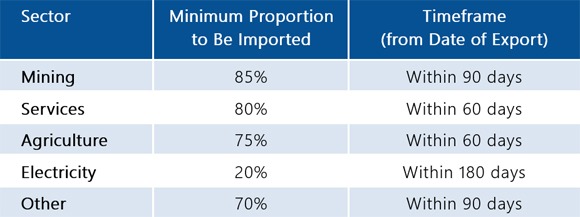
The ratios and timeframes are subject to change depending on the circumstances. If exporters cannot comply with the required ratio and timeline, exporters must provide relevant explanatory documents for the BOL’s consideration.

Selling Foreign-Currency Income

Exporters of goods and services must sell at least the minimum required proportion of their foreign-currency income (see table below) to a commercial bank in Laos. This foreign currency exchange must occur within three working days of receiving the foreign currency into the dedicated bank account in Laos. The selling rate will be determined by the prevailing rate of the commercial bank on the day of the transaction.
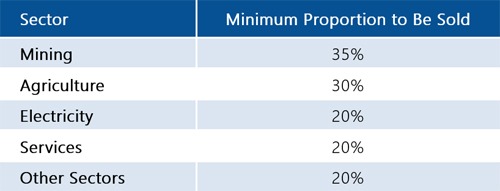
In conducting these transactions, commercial banks are required to carefully consider and manage their reserves and overall liquidity to ensure that they can meet public demand.

If an exporter does not sell at least the minimum required amount of foreign currency within three working days, the relevant commercial bank must proceed with the minimum required exchange and notify the exporter that they are doing so.

These requirements do not apply to re-exporters, such as importers of unprocessed raw materials for re-export to other countries, as determined by the Department of Foreign Currency Management (DFCM).

After selling the minimum required amount to a commercial bank, the remaining foreign-currency income must be used for foreign-currency exchange purposes, such as payments to parties in foreign countries, fulfilling obligations to the state, and so on.

Exporters can sell foreign currency to the BOL by notifying it of the need to sell the foreign currency to the DFCM in the BOL, after which they can sell the currency to the BOL through a commercial bank.

Registration

Decision No. 333 requires service exporters to register as importers and exporters to bring in income generated from exporting services. Although it doesn’t specify the types of service businesses that need to register, a March 2024 notice from the Ministry of Industry and Commerce offers examples of such businesses, including those in international transport, insurance, tourism and hotels, construction, and consulting.

Violations

First-time violations of Decision No. 333 that do not cause damage are subject to training on the importance of complying with Lao law or a warning. If the violation persists after the training or warning, the violator will face suspension of its ability to export goods and services.

For more information on Decision No. 333, or on any aspect of foreign currency management in Laos, please contact Tilleke & Gibbins at [email protected].

RELATED INSIGHTS​ 

January 10, 2025
Tilleke & Gibbins’ project finance team in Vietnam has contributed the Vietnam chapter to the 2025 edition of The Legal 500’s Project Finance guide. As part of The Legal 500’s Country Comparative Guides series, this publication provides businesses and investors with crucial information about the legal and regulatory aspects of project finance across jurisdictions worldwide. The Q&A-format chapters deliver detailed insights into the legal regimes governing an array of project finance topics, including: Ownership structures and corporate governance; Security interests, regimes, and enforcement; Regulatory requirements and consents; Foreign exchange considerations; Environmental, social, and governance (ESG) issues; Public-private partnerships; Foreign judgments; Tax considerations; Common funding structures; and Insurance law principles. Tilleke & Gibbins also prepared the Thailand chapter for this edition. The Vietnam chapter is available as a PDF via the button below, with the full guide freely accessible on The Legal 500 website.
January 9, 2025
Thailand’s Fiscal Policy Office (FPO) has released a draft of its planned Financial Business Hub Act, which is in line with the government’s aim of positioning Thailand as a regional financial hub and a critical player in the global economy. The draft act, on which the FPO is accepting comments until January 9, 2025, details the framework for promoting and attracting international financial businesses and related services to operate in Thailand, proposes various incentives, and outlines supervisory guidelines. This article examines key elements of the draft Financial Business Hub Act relevant to financial business operators. Incentivized Financial Businesses The draft act identifies the financial businesses to be promoted and incentivized. These target businesses include: Commercial banking businesses, Payment service businesses, Securities businesses, Derivatives businesses, Digital assets businesses, Insurance and reinsurance brokerage businesses, and Other financial-related businesses as determined by the Committee for the Supervision and Promotion of Financial Centers. Thailand’s finance minister explained that initially, the draft law intends to target businesses using an “out-out” model, which describes the raising of capital abroad for investment abroad, before expanding to an “out-in” model, in which capital is raised abroad for investment domestically. Therefore, the draft law currently specifies that the target businesses must only provide services to nonresidents without soliciting residents of Thailand to use their services. Authorization Targeted financial business operators will need to receive authorization from the Committee for the Supervision and Promotion of Financial Centers. The main eligibility criteria for authorization are the incorporation an entity (e.g., a company registered in Thailand, a branch of a foreign juristic person) with an office in designated areas to be specified in a royal decree (currently expected to be Bangkok and adjacent provinces) and the possession of other qualifications as prescribed in the draft act. Target businesses in Thailand will
January 7, 2025
Myanmar’s Ministry of Commerce (MOC) announced a significant policy change allowing foreign companies incorporated in Myanmar under the Myanmar Companies Law 2017 to export eight categories of locally produced commodities, with effect from December 17, 2024. Notification 93/2024 allows eligible foreign companies—companies with more than 35% of their shares held by foreign entities or individuals—to export, manufacture, or trade the following additional commodities: Value-added meats, fish, and fishery products Value-added agricultural products Pulp and various papers Seeds Refined metals Semifinished or finished horticultural products, including fruits and vegetables Wood-based furniture Products supporting environmental conservation The notification, which was issued under the Export and Import Law 2012, does not set a minimum capital requirement for foreign companies taking advantage of these opportunities. Any type of foreign company can apply to export the eight commodities listed above. Companies permitted or endorsed by the Myanmar Investment Commission (MIC) that wish to engage in these opportunities must also adhere to the rules and regulations set by the MIC. To facilitate the export process, the notification specifies that foreign companies must obtain an export recommendation from the relevant government departments and an export license from the MOC’s Department of Trade for each of these commodities. For more information on this announcement, the relevant licensing authorities for different commodities, or any other aspect of import and export matters in Myanmar, please contact Tilleke & Gibbins at [email protected].
December 18, 2024
The EU-Thailand Free Trade Agreement is drawing a lot of interest as the fourth round recently concluded in Bangkok. Despite negotiations starting in 2013, there was a ten-year pause before we saw the first round of negotiations end in September 2023. The initial plan was for four rounds of negotiations, with the free trade agreement (FTA) finalized in 2025. However, following the fourth round it is clear that the negotiations are still ongoing. Now, the question is: how much closer are the EU and Thailand to concluding their FTA? The EU initially submitted 13 chapter proposals for the FTA, followed by a further 12, and these became the springboard for the negotiations. Given the complexity of agreeing on an accord of this size, there will probably be additional proposals submitted in 2025. These chapters have seen sector-specific negotiation groups formed, and although it has been difficult to truly gauge the status, steady progress has been made in each. Arguably one of the biggest points of discussion pertains to the customs process for imports and exports. Both sides aim to align their practices in relation to rules of origin and custom rates, with preferential tariff treatments offered to goods originating from Thailand and the EU, as well as talks of eliminating or reducing relevant taxes. The desire for a faster customs clearance can be seen in EU proposals for clearance of goods on arrival. Although there has been progress in agreeing to a more simplified customs process, more work needs to be done before we hear news of the agreed-upon fees and charges, or confirmation of what goods would be allowed temporary admission. When we consider customs clearance, it is important to also examine what this FTA could mean for rightsholders. One piece of good news is that it appears