
You are using an outdated browser and your browsing experience will not be optimal. Please update to the latest version of Microsoft Edge, Google Chrome or Mozilla Firefox. Install Microsoft Edge

June 7, 2024

Laos Regulates Management of Foreign Currency from Exports

On March 7, 2024, Laos moved to regulate the management of foreign-currency income from the exportation of goods and services. Effective March 29, 2024, Decision No. 333 (formally the Decision on Management of Income in Foreign Currency from Exportation of Goods and Services No. 333/BOL) from the Bank of Lao PDR (BOL) aims to incentivize the inflow of such foreign currency into Laos and its sale to licensed commercial banks.

Decision No. 333 sets minimum required proportions for importing income in foreign currency derived from the exportation of goods and services, as well as the timeframe for doing so. It also stipulates the requirements for selling such foreign currency to commercial banks in Laos and the minimum proportions that must be sold.

Importing Foreign-Currency Income

Exporters must receive payments from abroad via bank transfer into a dedicated bank account designated for import-export business activities within the timeline specified in the sale-purchase agreement, but not exceeding 180 days from the date of export. Each sector must import income in foreign currency into the Lao PDR according to the minimum proportion of currency to be imported, and it must be done within the required timeframes, as specified in the table below.
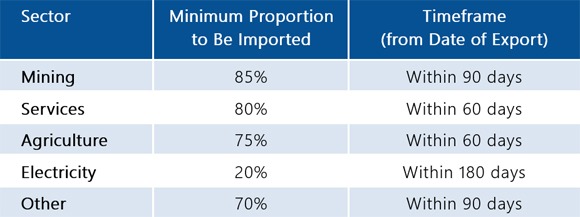
The ratios and timeframes are subject to change depending on the circumstances. If exporters cannot comply with the required ratio and timeline, exporters must provide relevant explanatory documents for the BOL’s consideration.

Selling Foreign-Currency Income

Exporters of goods and services must sell at least the minimum required proportion of their foreign-currency income (see table below) to a commercial bank in Laos. This foreign currency exchange must occur within three working days of receiving the foreign currency into the dedicated bank account in Laos. The selling rate will be determined by the prevailing rate of the commercial bank on the day of the transaction.
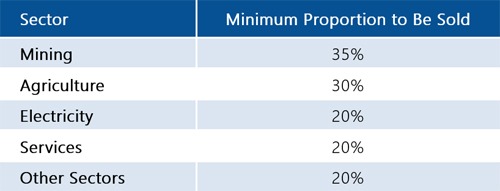
In conducting these transactions, commercial banks are required to carefully consider and manage their reserves and overall liquidity to ensure that they can meet public demand.

If an exporter does not sell at least the minimum required amount of foreign currency within three working days, the relevant commercial bank must proceed with the minimum required exchange and notify the exporter that they are doing so.

These requirements do not apply to re-exporters, such as importers of unprocessed raw materials for re-export to other countries, as determined by the Department of Foreign Currency Management (DFCM).

After selling the minimum required amount to a commercial bank, the remaining foreign-currency income must be used for foreign-currency exchange purposes, such as payments to parties in foreign countries, fulfilling obligations to the state, and so on.

Exporters can sell foreign currency to the BOL by notifying it of the need to sell the foreign currency to the DFCM in the BOL, after which they can sell the currency to the BOL through a commercial bank.

Registration

Decision No. 333 requires service exporters to register as importers and exporters to bring in income generated from exporting services. Although it doesn’t specify the types of service businesses that need to register, a March 2024 notice from the Ministry of Industry and Commerce offers examples of such businesses, including those in international transport, insurance, tourism and hotels, construction, and consulting.

Violations

First-time violations of Decision No. 333 that do not cause damage are subject to training on the importance of complying with Lao law or a warning. If the violation persists after the training or warning, the violator will face suspension of its ability to export goods and services.

For more information on Decision No. 333, or on any aspect of foreign currency management in Laos, please contact Tilleke & Gibbins at [email protected].

RELATED INSIGHTS​ 

December 4, 2024
Tilleke & Gibbins has contributed the Cambodia, Laos, Myanmar, Thailand, and Vietnam chapters to Restructuring in Southeast Asia, a comparative guide produced by Drew Network Asia (DNA). The publication outlines the principal debt restructuring processes available to corporate debtors across nine Southeast Asian jurisdictions and provides an accessible overview for lenders, creditors, and companies navigating financial distress in the region. Structured in a question-and-answer format, each jurisdictional chapter addresses the same core topics, allowing readers to compare approaches across markets. The guide covers key issues such as available restructuring mechanisms, court-supervised and out-of-court options, the roles and powers of creditors, and the implications of restructuring on ongoing business operations. As with other DNA resources, the guide aims to provide practical orientation rather than exhaustive analysis. Legislative developments and jurisdiction-specific considerations may affect the applicability of certain procedures, and readers requiring tailored advice are encouraged to contact the practitioners listed at the end of each chapter. The full guide is available for download using the button below or directly from the DNA website.
December 4, 2024
Thailand Legal Basics, a valuable primer for foreign investors, explores all aspects of living and doing business in Thailand. Written by specialists at Tilleke & Gibbins in Bangkok, it is the only comprehensive English-language guide to the Thai legal system with a focus on the concerns of foreign business and investment.
October 24, 2024
On September 27, 2024, the Securities and Exchange Commission of Thailand (SEC) issued a circular clarifying reporting obligations in relation to listed company securities held by the company’s directors, executives, auditors, or persons related to them (“Key Persons”). The circular aimed to address growing concerns over transparency in shareholding, particularly when shares are used as loan collateral by company executives without sufficient public disclosure, which can lead to sudden share loss and executive departures, destabilizing the company. This circular is likely a stopgap measure, and a full overhaul of the reporting regulations may be needed. The current reporting obligations came into effect on March 16, 2024, and were designed to simplify reporting procedures while still maintaining transparency in the capital markets. The rules allow the Key Persons to consolidate multiple transactions and report them only when certain thresholds are crossed — such as when the total transaction value reaches THB 3 million or when six months have passed since the last report. The rules were intended to reduce the number of minor reports and limit penalties for missed deadlines. However, recent scandals have raised concerns about the reporting rules, particularly issues related to the enforcement of share collateral on executives’ or directors’ loans where the listed company may face a change of direction and management due to such forced sales. To ease these concerns, the SEC issued the new circular to reiterate the rules and lay out three key situations triggering a reporting duty: Force-Selling Due to Default: If shares are forcibly sold due to a loan default, this must be reported, and the transaction should be recorded with the Thailand Securities Depository (TSD). Transfer of Shares to Custodians: Under current rules, the transfer of shares to/from a custodian holding them on behalf of a beneficial owner does not
October 20, 2024
Following the U.S. Securities and Exchange Commission’s approval of spot Bitcoin ETFs, Thailand’s Securities and Exchange Commission (SEC) is reassessing regulations on the investments of mutual funds and private funds (collectively “Funds”). The SEC has launched a public consultation on new draft notifications introducing  the new asset classes that can be held by Funds, and aims to bring these rules into effect on January 1, 2025. The highlights of these changes are set out below. Eligible New Asset Classes The new asset classes that can be held by Funds can be categorized into two types—investment tokens and crypto assets—and the determination will focus on substance over form. Investment tokens: If the substance involves raising funds, regardless of what the assets are called, and they are legally issued and offered or approved by home regulators that are members of the International Organization of Securities Commissions (IOSCO), Funds can invest in these types of assets as transferable securities within the permitted ratio. Crypto assets: The eligible crypto assets which Funds are entitled to hold focus on crypto ETFs or offshore funds investing in crypto assets, and they are subject to investment limits. Funds can hold crypto assets directly, but only temporarily, and only for the purpose of purchasing, selling, or exchanging the crypto assets, not speculative purposes. The notifications state that Funds may hold Bitcoin/Ethereum for no longer than five business days and USDT/USDC for no more than one month. Investment Limits Typically, the rules segregate investment limits into listed and non-listed digital assets, and the limits depend on the sophistication of the investors in the Funds. In general, UI Funds (mutual funds offered to institutional investors or ultra-high net worth investors) can invest in these new asset classes without any limitations, although net exposure to other crypto assets  –  which