
You are using an outdated browser and your browsing experience will not be optimal. Please update to the latest version of Microsoft Edge, Google Chrome or Mozilla Firefox. Install Microsoft Edge

October 1, 2024

Indonesia Prepares to Require Nutritional Labeling for Sugar, Salt, and Fat Content

The Indonesian food and drug authority, also known as “BPOM,” issued a draft regulation on September 9, 2024, proposing standard labeling disclosing the sugar, salt, and fat content of packaged food products sold in the country.

The draft Regulation on Nutritional Value Information on Food Labels to implement Government Regulation No. 28 of 2024 on the Implementation of the Health Law seeks to mandate “Nutri-Level” front-of-pack nutrition labeling to indicate the amount of sugar, salt, and fat at four possible levels, with a modified stoplight-color system:

  • Level “A” (lowest amount) has a dark green background
  • Level “B” has a light green background
  • Level “C” has a yellow background
  • Level “D” (highest amount) has a red background

These levels are shown in the following sample image:
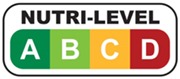
The requirements for sugar, salt, and fat content for each level are based on amounts per 100 milliliters of ready-to-eat processed food as follows:

Further requirements relating to nutrients reflected in the Nutri-Level labeling include:

  • Foods labeled as level A are not allowed to contain natural or artificial sweetening food additives, either through direct addition or carried over from other ingredients.
  • Foods labeled as level B may only contain natural sweetening food additives.
  • Foods labeled as level C or D may use natural and artificial sweetening food additives.
  • “Sugar” includes all monosaccharides and disaccharides, excluding lactose.
  • Processed plain liquid milk and plain milk powder are exempt from the requirement to declare total fat content on the Nutri-Level label.

Labeling Implementation

The implementation of Nutri-Level labeling must comply with the following requirements:

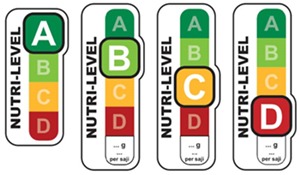
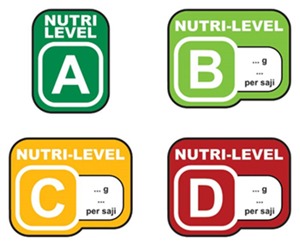
  • The Nutri-Level label must list all four letters (as shown in the examples below) unless the package meets the criteria for display of a simplified format label.
  • The Nutri-Level of the processed food must be indicated by enlarging the relevant letter, as shown in the examples below.
  • Processed foods at levels C and D must include a Nutri-Level label, while processed foods at levels A and B may do so on a voluntary basis.
  • The inclusion of a Nutri-Level label on processed foods at levels C and D must be accompanied by the sugar, salt, and fat content per serving (per saji in Indonesian, as shown in the examples below) or per package.

Nutri-Level Label Format

The draft regulation provides Nutri-Level label examples in both full and simplified formats. The simplified format applies to small packages of 30 square centimeters or less, while the full format must be used on other packages.

Full (horizontal)
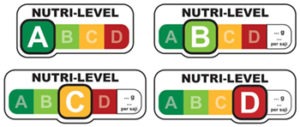
Full (vertical)
Simplified
Timeline for Compliance

The draft regulation provides a grace period for existing product registrations:

  • Processed food that has obtained a product registration or for which a product registration application is pending before the regulation comes into effect must be amended within 30 months of the effective date of the regulation.
  • Ready-to-drink beverages, liquid concentrates, and powdered beverages must be amended within 18 months of the effective date of the regulation.

It is anticipated that the draft regulation will be finalized by the end of 2024.

For more details on this draft regulation, or on any aspect of food labeling requirements in Indonesia, please contact Tilleke & Gibbins at [email protected].

RELATED INSIGHTS​ 

May 2, 2025
Attorneys from Tilleke & Gibbins have updated the latest edition of Doing Business in Thailand, a Q&A-style guide from Thomson Reuters Practical Law that offers an overview of key legal considerations for companies operating in jurisdictions worldwide. The contribution outlines the country’s legal and regulatory framework for foreign investment and business operations and reflects the latest legislative developments. The chapter addresses the following core topics: Legal system: Structure of the courts and the codified nature of Thai law. Foreign investment: Business restrictions under the Foreign Business Act, sector-specific regulations, exchange control rules, and investment incentives. Business vehicles: Overview of partnerships, private and public limited companies, and other legal entities. Employment: Labor protections, employment contracts, foreign worker requirements, and termination procedures. Tax: Corporate and personal income tax, indirect taxes, and tax obligations for residents and non-residents. Intellectual property: Registration and enforcement of patents, trademarks, designs, and copyrights. Data protection: Key provisions of the Personal Data Protection Act and related compliance obligations. Competition law: Regulatory framework under the Trade Competition Act. Anti-bribery and corruption: Relevant legislation and enforcement mechanisms. E-commerce and digital business: Legal regime for online transactions and digital platforms. Marketing and advertising: Consumer protection laws and regulations affecting advertising and marketing practices. Product regulation and liability: Safety standards, liability regimes, and roles of enforcement authorities. Practical Law, a legal reference resource from Thomson Reuters, publishes a range of guides for hundreds of jurisdictions and practice areas. The insurance and reinsurance guide is a valuable resource for legal practitioners, covering numerous jurisdictions worldwide. To view the latest version of the guide, please visit the Practical Law website and enroll in the free Practical Law trial to gain full access.
March 7, 2025
On November 22, 2024, the Ministry of Health (MOH) in Laos issued Decision No. 3730/MOH, which regulates the management, processing, production, and use of biopharmaceutical products, genes, and stem cells. This decision came into force on January 18, 2025, 45 days after its publication in the Lao Official Gazette on December 4, 2024. This decision signifies Laos’ recognition and acceptance of biopharmaceutical products, genes, and stem cells for use in medical treatments and the beauty industry, and it aligns with the ongoing development of biomedical sciences in the country. Definitions The MOH’s decision defines biopharmaceuticals, gene therapy, and stem cells as follows: “Biopharmaceutical products” refers to a type of biological or drug product that is produced or synthesized from natural substances, objects, or chemicals. This group of products includes blood, blood components, allergens, cells or cellular components, gene therapies, tissues, protein-based medicines, drugs derived from living cells, and biologics, which can be produced from sugars, proteins, amino acids, or substances with complex characteristics derived from organic sources such as human, animal, and plant parts; yeast; and microorganisms. These products exclude vaccines and biosimilar products, which will be specified under separate regulations. “Gene therapy” refers to a treatment approach that applies the principle of arranging amino acids (which could involve DNA or RNA sent to the patient’s cells in the form of a drug with the purpose of treating a certain disease). “Stem cells” are defined in the decision as cells or immature cells that can be sourced from various organs in the They are characterized by being undifferentiated, having the potential for differentiation, and being self-renewing. Stem Cell Production The decision outlines comprehensive provisions for managing and using raw materials in stem cell production. Key points include: Production location standards: Ensuring facilities meet specific standards of the MOH. Personnel
December 13, 2024
Experts from Tilleke & Gibbins have provided updates for the latest edition of The Pharma Legal Handbook: Vietnam, published by Pharma Boardroom. This comprehensive guide to the legal framework regulating the healthcare and life sciences industries in Vietnam was authored by by the Hanoi-based team of Hien Thi Thu Vu, head of regulatory affairs for Vietnam, and Mai Thi Le, regulatory affairs consultant, the handbook is a must-read for healthcare and life sciences companies that are interested in the Vietnam market. The guide includes eight sections on various important aspects of local regulations: Regulatory, Pricing, and Reimbursement Overview Preclinical & Clinical Trial Requirements Marketing, Manufacturing, Packaging & Labeling, and Advertising Traditional Medicines and Over-the-Counter Products Product Liability Patents and Trademarks Regulatory Reforms Orphan Drugs and Rare Diseases Tilleke & Gibbins has also authored The Pharma Legal Handbook: Thailand, which was updated at the same time as the Vietnam guide. The Pharma Legal Handbook: Vietnam, like all of the country guides from Pharma Boardroom, is available for purchase on the Pharma Boardroom website.
December 13, 2024
Attorneys from Tilleke & Gibbins in Bangkok have provided updates for the latest edition of The Pharma Legal Handbook: Thailand, published by Pharma Boardroom. This comprehensive guide to the legal framework regulating the healthcare and life sciences industries in Thailand was authored by Alan Adcock, partner and director, intellectual property, and head of the firm’s life sciences practice; Dr. Atthachai Homhuan, manager of regulatory affairs; and San Chaithiraphant, senior associate. The handbook is a must-read for healthcare and life sciences companies that are interested in exploring expansion into the Thai market.