
You are using an outdated browser and your browsing experience will not be optimal. Please update to the latest version of Microsoft Edge, Google Chrome or Mozilla Firefox. Install Microsoft Edge

October 1, 2024

Indonesia Prepares to Require Nutritional Labeling for Sugar, Salt, and Fat Content

The Indonesian food and drug authority, also known as “BPOM,” issued a draft regulation on September 9, 2024, proposing standard labeling disclosing the sugar, salt, and fat content of packaged food products sold in the country.

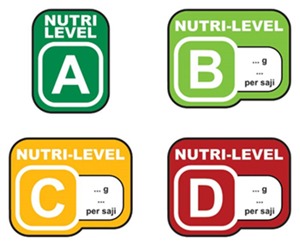
The draft Regulation on Nutritional Value Information on Food Labels to implement Government Regulation No. 28 of 2024 on the Implementation of the Health Law seeks to mandate “Nutri-Level” front-of-pack nutrition labeling to indicate the amount of sugar, salt, and fat at four possible levels, with a modified stoplight-color system:

  • Level “A” (lowest amount) has a dark green background
  • Level “B” has a light green background
  • Level “C” has a yellow background
  • Level “D” (highest amount) has a red background

These levels are shown in the following sample image:

The requirements for sugar, salt, and fat content for each level are based on amounts per 100 milliliters of ready-to-eat processed food as follows:

Further requirements relating to nutrients reflected in the Nutri-Level labeling include:

  • Foods labeled as level A are not allowed to contain natural or artificial sweetening food additives, either through direct addition or carried over from other ingredients.
  • Foods labeled as level B may only contain natural sweetening food additives.
  • Foods labeled as level C or D may use natural and artificial sweetening food additives.
  • “Sugar” includes all monosaccharides and disaccharides, excluding lactose.
  • Processed plain liquid milk and plain milk powder are exempt from the requirement to declare total fat content on the Nutri-Level label.

Labeling Implementation

The implementation of Nutri-Level labeling must comply with the following requirements:

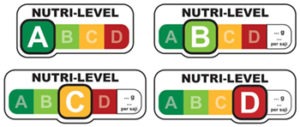
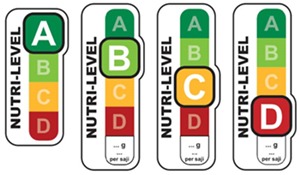
  • The Nutri-Level label must list all four letters (as shown in the examples below) unless the package meets the criteria for display of a simplified format label.
  • The Nutri-Level of the processed food must be indicated by enlarging the relevant letter, as shown in the examples below.
  • Processed foods at levels C and D must include a Nutri-Level label, while processed foods at levels A and B may do so on a voluntary basis.
  • The inclusion of a Nutri-Level label on processed foods at levels C and D must be accompanied by the sugar, salt, and fat content per serving (per saji in Indonesian, as shown in the examples below) or per package.

Nutri-Level Label Format

The draft regulation provides Nutri-Level label examples in both full and simplified formats. The simplified format applies to small packages of 30 square centimeters or less, while the full format must be used on other packages.

Full (horizontal)
Full (vertical)
Simplified
Timeline for Compliance

The draft regulation provides a grace period for existing product registrations:

  • Processed food that has obtained a product registration or for which a product registration application is pending before the regulation comes into effect must be amended within 30 months of the effective date of the regulation.
  • Ready-to-drink beverages, liquid concentrates, and powdered beverages must be amended within 18 months of the effective date of the regulation.

It is anticipated that the draft regulation will be finalized by the end of 2024.

For more details on this draft regulation, or on any aspect of food labeling requirements in Indonesia, please contact Tilleke & Gibbins at [email protected].

RELATED INSIGHTS​ 

December 12, 2024
On November 21, 2024, the National Assembly of Vietnam adopted a law amending and supplementing the 2016 Law on Pharmacy (“Amended Law on Pharmacy”). The Amended Law on Pharmacy simplifies some procedures for the pharmaceutical field, and will take effect on July 1, 2025, except for regulations on drug registration and rights and responsibilities of certain types of pharmaceutical business. Some outstanding points in the Amended Law on Pharmacy are presented below. E-commerce Distribution The Amended Law on Pharmacy allows trading in pharmaceutical products by the e-commerce channel, including e-commerce trading floors, e-commerce sales applications, and e-commerce sales websites with online ordering functions. Accordingly, e-commerce retail of non-prescription drugs is permitted if the drugs are neither specially controlled drugs nor drugs included in the list of drugs restricted for retail sale, and e-commerce wholesale of drugs and drug materials is permitted, as long as they are not specially controlled drugs. New Rights for Import FIEs The amendment provides some additional rights to foreign-invested enterprises (“FIEs”) that import drugs, including the rights to: Repurchase drugs and drug materials manufactured through the technology transfer of the FIE itself in Vietnam, and sell such products to wholesalers; Import drug materials to supply to drug manufacturers in Vietnam that are hired by or receive technology transfer from the FIE itself under a processing contract or technology transfer contract; Deliver and transport drugs and drug materials the FIE has imported, outsourced for processing, or transferred technology for in Vietnam, from the FIE’s warehouse to its wholesalers; Deliver and transport drugs used in aid, sponsorship, humanitarian, and disease prevention and control programs to medical facilities receiving funding; and Transport drug materials imported by the FIE from its warehouse to drug manufacturers that are hired by or receive technology transfer from the FIE itself under a
December 9, 2024
Cambodia’s Law on Seed Management and Plant Breeder’s Rights was enacted in 2008, but it was not until recently that new plant varieties could successfully be registered for protection in the country. Although the law has been in place for some time, recent developments confirmed the application process and a schedule of charges for the registration of new plant varieties. With these developments, breeders have been able to register their new plant varieties in Cambodia since March 1, 2024. Applicants for new plant variety protection must be Cambodian nationals, foreign nationals domiciled in Cambodia, or permanent residents of either a country that is a contracting party to the International Union for the Protection of New Varieties of Plants (UPOV) Convention or a country with which Cambodia has signed a memorandum of understanding on plant variety protection. Applicants can also claim a priority date from the first application for the same plant variety filed in any contracting party of the UPOV Convention within 12 months of the earliest application’s filing date. To be eligible for protection, new plant varieties must satisfy the following criteria: Novelty: A variety is considered “new” if, at the date of filing the application for new plant variety protection, it has not been sold, marketed, or otherwise disposed of others—by or with the consent of the breeder—for more than: One year for any plant variety in Cambodia; Six years for trees and vines or four years for all other plant varieties in countries besides Cambodia. Distinctiveness: A variety must be clearly distinguishable from any other existing varieties. Uniformity: A variety must be sufficiently uniform in its relevant characteristics. Stability: A variety must remain unchanged in its essential characteristics at the end of each cycle of propagation and in each generation. The last three criteria are often
December 4, 2024
On October 28, 2024, Indonesia officially amended its existing Patent Law when the president ratified Law Number 65 of 2024. This comprehensive update—the third such amendment in the history of Indonesia’s Patent Law—introduces several key changes that will significantly impact patent protection and application processes in Indonesia. Key highlights and changes are outlined below. Definition of Invention The new law broadens the definition of “invention” to explicitly include systems, methods, and uses. Additionally, the law introduces formal definitions for traditional knowledge and genetic resources. Patentability Criteria Notable changes include: Computer programs are now excluded, with an exception for computer-implemented inventions. Theories and methods in science and mathematics are added to the list of excluded inventions. Previous restrictions on new uses of existing products are removed. Grace Periods The grace periods for some patent-related actions have been adjusted: The grace period for disclosures has been extended to 12 months (from 6 months previously), providing inventors with more flexibility in filing patent applications after initial disclosure. A newly introduced item is the grace period for a conventional patent application claiming priority rights, which is 4 months after the 12-month filing deadline under the Paris Convention. The grace period for annuity payments is 6 months (from 12 months previously) with a fine for late payments of 100% of the annual fee payable. Patent Holder Rights and Obligations Patent holders can now grant permissions to enforce patents. There is a new requirement for patent holders to submit annual statements on patent implementation in Indonesia. Compulsory Licensing Significant changes to compulsory licensing include: Establishment of licenses based on the principle of expediency. Limitations on license scope and transferability. Prioritization of domestic market needs. New provisions for technical improvements and economic significance. Government Patent Exploitation The new law contains specific provisions for the government’s implementation
December 4, 2024
Thailand Legal Basics, a valuable primer for foreign investors, explores all aspects of living and doing business in Thailand. Written by specialists at Tilleke & Gibbins in Bangkok, it is the only comprehensive English-language guide to the Thai legal system with a focus on the concerns of foreign business and investment.