
You are using an outdated browser and your browsing experience will not be optimal. Please update to the latest version of Microsoft Edge, Google Chrome or Mozilla Firefox. Install Microsoft Edge

August 6, 2026

Green Packaging, Gray Areas: The Challenges of Protecting Minimalist Packaging Under Thai IP Law

Introduction: A Trademark Paradox in Sustainable Packaging

Walk into any Thai supermarket, and the label-free water bottle is no longer a novelty. Thailand’s packaging market, valued at approximately USD 15.68 billion in 2025, is shifting toward minimalist, plastic-light designs as ESG pressures reshape how brands present their products. The country generated roughly 5.68 million tons of plastic waste in 2021, with a recycling rate of only 19 percent, and regulators are now considering rules that would allow label-free bottled water relying on embossing, laser printing, or QR codes instead of wrap-around labels. As packaging itself becomes the brand identifier, a paradox emerges: designs built to say the least often struggle hardest for protection under Thai intellectual property law.

The Trademark Barrier: When Shape Is Not Enough

Section 7, paragraph 2(10) of the Thai Trademark Act deems a shape distinctive only if it is not the natural form of the goods, is not necessary to achieve a technical result, and does not add value to the goods. The Department of Intellectual Property’s 2022 examination guidelines apply this test conservatively, as the following examples illustrate.
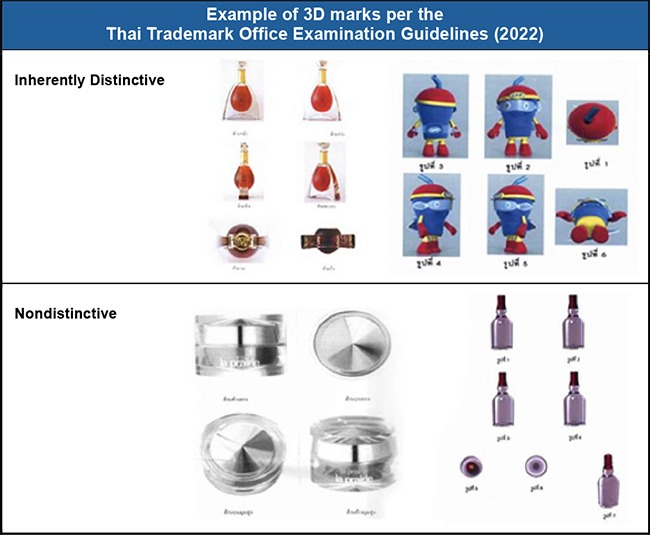
A plain water bottle relying on subtle contours to signal its brand is typically read as just another bottle, not a source identifier. Acquired distinctiveness offers a theoretical escape route, but it demands extensive evidence of sales, advertising, and consumer recognition—an especially heavy burden for new entrants whose minimalist packaging has not yet achieved market prominence. The result is a structural bias against precisely the design innovation that sustainability goals are meant to encourage.

Design Patents: A Partial, Imperfect Substitute

Design patent protection, covering a product’s shape, configuration, or ornamentation, appears to offer an alternative route. In practice, it is constrained by the same forces driving the minimalist trend. Because many brands converge on similar solutions—clear PET bottles, label-free surfaces, simple paperboard—new designs often “so nearly resemble” existing ones that they fail the novelty requirement under the Thai Patent Act. Even where novelty is established, protection lasts only ten years from filing, ill-suited to the indefinite life cycle of a brand identity that trademarks can offer. Narrow claim scope compounds the problem: because minimalist designs differ from competitors only in subtle details, rivals can make cosmetic tweaks and avoid infringement altogether.

A Layered Strategy for Now

Given these gaps, Thai practitioners should treat trademark and design patent filings as complementary layers rather than mutually exclusive options. Registration attempts can be supplemented with unfair competition claims for passing off, which remain available under Section 46 of the Trademark Act and Section 420 of the Civil and Commercial Code even where registration is refused. Contemporaneous evidence of consumer recognition—social media engagement, packaging redesign campaigns, and sales data tied to the new design—should be compiled from launch rather than assembled only once a dispute arises. Combining registered rights with common law remedies and a documented evidentiary record offers the most realistic protection available under the current framework.

Conclusion

The tension between Thailand’s IP framework and its sustainable packaging boom is unlikely to be resolved through litigation alone. The DIP’s examination guidelines predate the scale of today’s minimalist packaging trend and warrant revisiting, particularly in how consumer-perception evidence is weighed against abstract notions of “natural form” and “functionality.” Until that recalibration occurs, brands investing in green packaging should treat IP protection as a portfolio exercise: pursuing registration where possible, building an evidentiary record for acquired distinctiveness, and relying on passing-off remedies to fill the gaps. Minimalist packaging is not disappearing from Thai shelves; the law protecting it needs to catch up.


This article was prepare with the assistance of Tilleke & Gibbins intern Phuripat Kaewklom. It was originally published by the International Association for the Protection of Intellectual Property (AIPPI).

RELATED INSIGHTS​ 

March 25, 2024
Tilleke & Gibbins has provided an updated Thailand chapter for Fashion Law 2024 from Global Legal Post. The guide covers 20 key jurisdictions in the global fashion industry, offering insights into local legal frameworks surrounding issues such as brand enforcement and protection, e-commerce and marketing, and sustainability considerations. The Thailand chapter of Fashion Law 2024 provides detailed information on the following topics: Main intellectual property rights for fashion products Contractual arrangements in manufacturing, distribution, and advertising Regulations and enforcement of online marketing Unfair competition rules and judicial interpretation Specific regulations on sustainability and ESG in fashion Special import and export rules for fashion products The full Thailand chapter is available for free through the button below and on the Global Legal Post website. Tilleke & Gibbins also contributed the Vietnam chapter to the guide.
March 22, 2024
Indonesia’s Ministry of Industry (MOI) has issued a new regulation requiring importers of textiles, textile products, bags, and footwear to furnish applicable trademark certificates when applying for an import permit. This means that a letter of appointment to import from the trademark owner or authorized representative is no longer sufficient to obtain an import permit for these goods. The requirement is detailed in MOI Regulation No. 5 of 2024 concerning Procedures for Issuing Technical Considerations for Imports of Textiles, Textile Products, Bags and Footwear, which took effect on March 10, 2024. Affected Products The new regulation applies to the following products: Textiles: Fiber, thread, fabric Textile products: Carpets, other textile floor coverings, clothing, ready-made clothing accessories, other finished textile goods Bags: Suitcases, wallets, school bags, sports bags, handbags, other bags Footwear: Shoes, sandals, moccasins Import Permits In principle, businesses can import textiles, textile products, bags, and footwear as raw materials, auxiliary materials, or consumer goods (for trading) after obtaining the appropriate import permit from the Ministry of Trade (MOT). There are three categories of import permits: General import permits for consumption (API-U), which are required for parties that conduct import activities for the purpose of trading; Import permits for producers (API-P); and Import permits for suppliers of raw or auxiliary materials (PPBB). Applicants for an import permit must submit an application for general importer verification (VIU), the results of which will inform the MOI’s technical consideration process. If the MOI issues a recommendation or approval based on their technical consideration, applicants will be able to proceed with the submission of their import permit to the MOT. The process of applying for and obtaining an API-U import permit has several steps, as shown in the diagram below. New Trademark Certificate Requirement Under the MOI’s March 2024 regulation, when applying for
February 23, 2024
The newly released Licensing 2024 guide, published by Lexology Panoramic, features a chapter on Vietnam by four licensing specialists from Tilleke & Gibbins. The comparative guide provides companies and other interested readers with information on licensing law and practice in various countries around the world. Licensing 2024 provides detailed information on the following topics: Restrictions, laws and licensing arrangements Intellectual property issues: Paris Convention for the Protection of Industrial Property, contesting the validity of licensor’s IP rights, invalidity and expiry of IP rights, security interests, proceedings against third parties, sublicensing, jointly owned IP, first to file, scope of patent protection, trade secrets, copyright Software licensing: Perpetual licensing, legal requirements, user restrictions Royalties and payments, currency conversion, and taxes: Relevant legislation, restrictions, taxation of foreign licensors Competition law issues: Restrictions on trade, legal restrictions, and IP-related court rulings Indemnification, disclaimers, and damages: Prevalence and enforceability of indemnity provisions and contractual waivers of damages Termination: Right to terminate, impact of termination Bankruptcy: Impact of licensee or licensor bankruptcy Dispute resolution: Governing law, arbitration, enforceability, injunctive relief, contractual waivers The Vietnam chapter was authored by Linh Thi Mai Nguyen, partner and head of Tilleke & Gibbins’ trademark team in Vietnam; Son Thai Hoang, trademark executive; and Chi Lan Dang, associate, of Tilleke & Gibbins’ trademark team, along with corporate and commercial senior associate Tu Ngoc Trinh, who has extensive experience in franchising and competition law. The Vietnam chapter is available below as a PDF. Tilleke & Gibbins also contributed the Thailand chapter to Licensing 2024. Readers can gain 30 days of complementary access to the full Licensing 2024 guide and the rest of Lexology Panoramic’s varied offerings through this link.
February 23, 2024
Two of Tilleke & Gibbins’ licensing specialists in Bangkok have contributed the Thailand chapter to the newly issued Licensing 2024, a comprehensive guide from Lexology Panoramic to licensing in various jurisdictions around the world. The Thailand chapter covers the following topics: Laws and licensing arrangements: Unfair Contract Terms Act, Trade Competition Act, pre-contractual disclosure, registration of international licensing, implied obligations, Civil and Commercial Code, Trademark Act, Patent Act, Trade Secrets Act Intellectual property issues: Paris Convention for the Protection of Industrial Property, contesting the validity of licensor’s IP rights, invalidity and expiry of IP rights, security interests, proceedings against third parties, sublicensing, jointly owned IP, first to file, scope of patent protection, trade secrets, copyright Software licensing: Perpetual licensing, legal requirements, user restrictions Royalties and payments, currency conversion, and taxes: Relevant legislation, restrictions, taxation of foreign licensors Competition law issues: Restrictions on trade, legal restrictions, and IP-related court rulings Indemnification, disclaimers, and damages: Prevalence and enforceability of indemnity provisions and contractual waivers of damages Termination: Right to terminate, impact of termination Bankruptcy: Impact of licensee or licensor bankruptcy Dispute resolution: Governing law, arbitration, enforceability, injunctive relief, contractual waivers The Thailand chapter was authored by Alan Adcock, partner, and Kasama Sriwatanakul, counsel, both in the Thailand regulatory affairs team. The full Thailand chapter is available below as a PDF. Tilleke & Gibbins also contributed the Vietnam chapter to Licensing 2024. Readers can gain 30 days of complementary access to the full Licensing 2024 guide and the rest of Lexology Panoramic’s varied offerings through this link.