
You are using an outdated browser and your browsing experience will not be optimal. Please update to the latest version of Microsoft Edge, Google Chrome or Mozilla Firefox. Install Microsoft Edge

August 6, 2026

Green Packaging, Gray Areas: The Challenges of Protecting Minimalist Packaging Under Thai IP Law

Introduction: A Trademark Paradox in Sustainable Packaging

Walk into any Thai supermarket, and the label-free water bottle is no longer a novelty. Thailand’s packaging market, valued at approximately USD 15.68 billion in 2025, is shifting toward minimalist, plastic-light designs as ESG pressures reshape how brands present their products. The country generated roughly 5.68 million tons of plastic waste in 2021, with a recycling rate of only 19 percent, and regulators are now considering rules that would allow label-free bottled water relying on embossing, laser printing, or QR codes instead of wrap-around labels. As packaging itself becomes the brand identifier, a paradox emerges: designs built to say the least often struggle hardest for protection under Thai intellectual property law.

The Trademark Barrier: When Shape Is Not Enough

Section 7, paragraph 2(10) of the Thai Trademark Act deems a shape distinctive only if it is not the natural form of the goods, is not necessary to achieve a technical result, and does not add value to the goods. The Department of Intellectual Property’s 2022 examination guidelines apply this test conservatively, as the following examples illustrate.
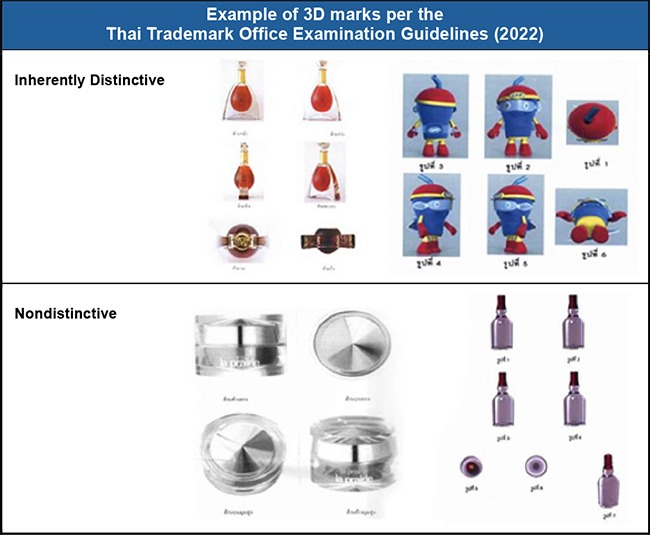
A plain water bottle relying on subtle contours to signal its brand is typically read as just another bottle, not a source identifier. Acquired distinctiveness offers a theoretical escape route, but it demands extensive evidence of sales, advertising, and consumer recognition—an especially heavy burden for new entrants whose minimalist packaging has not yet achieved market prominence. The result is a structural bias against precisely the design innovation that sustainability goals are meant to encourage.

Design Patents: A Partial, Imperfect Substitute

Design patent protection, covering a product’s shape, configuration, or ornamentation, appears to offer an alternative route. In practice, it is constrained by the same forces driving the minimalist trend. Because many brands converge on similar solutions—clear PET bottles, label-free surfaces, simple paperboard—new designs often “so nearly resemble” existing ones that they fail the novelty requirement under the Thai Patent Act. Even where novelty is established, protection lasts only ten years from filing, ill-suited to the indefinite life cycle of a brand identity that trademarks can offer. Narrow claim scope compounds the problem: because minimalist designs differ from competitors only in subtle details, rivals can make cosmetic tweaks and avoid infringement altogether.

A Layered Strategy for Now

Given these gaps, Thai practitioners should treat trademark and design patent filings as complementary layers rather than mutually exclusive options. Registration attempts can be supplemented with unfair competition claims for passing off, which remain available under Section 46 of the Trademark Act and Section 420 of the Civil and Commercial Code even where registration is refused. Contemporaneous evidence of consumer recognition—social media engagement, packaging redesign campaigns, and sales data tied to the new design—should be compiled from launch rather than assembled only once a dispute arises. Combining registered rights with common law remedies and a documented evidentiary record offers the most realistic protection available under the current framework.

Conclusion

The tension between Thailand’s IP framework and its sustainable packaging boom is unlikely to be resolved through litigation alone. The DIP’s examination guidelines predate the scale of today’s minimalist packaging trend and warrant revisiting, particularly in how consumer-perception evidence is weighed against abstract notions of “natural form” and “functionality.” Until that recalibration occurs, brands investing in green packaging should treat IP protection as a portfolio exercise: pursuing registration where possible, building an evidentiary record for acquired distinctiveness, and relying on passing-off remedies to fill the gaps. Minimalist packaging is not disappearing from Thai shelves; the law protecting it needs to catch up.


This article was prepare with the assistance of Tilleke & Gibbins intern Phuripat Kaewklom. It was originally published by the International Association for the Protection of Intellectual Property (AIPPI).

RELATED INSIGHTS​ 

February 22, 2024
Myanmar’s Intellectual Property Department (IPD) has released its announcement dated February 9, 2024, stating that it is now accepting applications for registration of copyrights and related rights under the Copyright Law of 2019. The Copyright Law of 2019 entered into force on October 31, 2023, replacing the old Copyright Act of 1914. The Ministry of Commerce (MOC) issued the Copyright Rules in Notification No. 70/2023 on October 23, 2023, setting the required procedures for copyright-related matters in Myanmar. Forms required for registration and related actions regarding copyrights and related rights were issued by the MOC under Notification No. 73/2023 on November 20, 2023. Regarding the official fees, the IP Agency issued Notification No. 1/2024 on February 13, 2024. While copyright protection arises automatically without the need for registration, rights holders can voluntarily apply for registration of their works under the new framework of the Copyright Law of 2019 if they wish to secure stronger evidence of ownership for their works in Myanmar. Applications can be filed by the applicant electronically, in person or through a local representative, or by post. Applicants incorporated or residing outside Myanmar must appoint a local representative to file the application with the IPD. For more information on the voluntary registration of copyrights and related rights in Myanmar, or for assistance in applying to register copyrights, please contact Tilleke & Gibbins at [email protected].
February 19, 2024
Indonesia is a multicultural country with diverse ethnicities, cultures, and religions, leading to a wealth of cultural creations, knowledge, and traditions. Where such creations, knowledge, and traditions are owned by a certain community and have become part of the identity of that community, they may be protected by Indonesian law as communal intellectual property. One type of communal intellectual property is traditional knowledge. A well-known example is a form of martial arts known as pencak silat. This martial art was traditionally performed when welcoming guests, usually accompanied by gondang borogong music, and is registered as traditional knowledge from Riau, Indonesia. New Regulation on Communal Intellectual Property Traditional knowledge used to be regulated by a number of laws, including three separate ones on copyright, patents, and cultural advancement. However, in December 2022, the Indonesian government issued Government Regulation No. 56 of 2022 on Communal Intellectual Property (“GR 56/2022”), establishing a single set of rules for the definition and protection of traditional knowledge. One of the aims of the regulation is to encourage the registration of communal intellectual property, which was part of the government’s priority program for 2023. Under GR 56/2022, traditional knowledge is defined as ideas and concepts that contain local values resulting from real experiences of interacting with the environment and that are developed continuously and passed on to the next generation. The regulation recognizes the following categories of traditional knowledge: Traditional methods or processes; Technical proficiency; Skills; Learning; Agricultural knowledge; Technical knowledge; Ecological knowledge; Knowledge related to genetic resources; Knowledge of medicine, traditional medicine, and healing procedures; Economic systems; Social organization systems; Knowledge related to the behavior of nature and the universe; and Other forms of knowledge. Traditional knowledge is a moral right belonging to the community, requiring any user of the traditional knowledge to acknowledge its
January 31, 2024
On January 31, 2024, Myanmar’s Intellectual Property Department (IPD) announced that it would officially start accepting industrial design applications under the Industrial Design Law on February 1, 2024. The IPD made this public in Announcement No. 1/2024, which comes three months after the Industrial Design Law entered into force on October 31, 2023. The Industrial Design Rules, issued by the Ministry of Commerce (MOC) on September 29, 2023, are another key instrument regulating the registration of industrial designs in Myanmar. In addition, the MOC’s Notification No. 71/2023 issued on October 27, 2023, specifies the forms required for industrial design registration and related actions, and the fees are specified by the IP Agency under Notification No. 2/2023, issued on December 29, 2023. Industrial design owners (individuals and legal entities) can file registration applications for new industrial designs with the IPD electronically, in person (directly or through a local representative), or by post. To be registered under the Industrial Design Law in Myanmar, industrial designs must be “new,” meaning that they must not have been disclosed to the public inside or outside Myanmar prior to the application date or the date of priority, if priority is claimed. Owners who wish to apply for and enjoy statutory protection of their industrial designs in Myanmar should start preparing all necessary documents and information for filing as soon as possible. For more information on industrial design registration in Myanmar or assistance in applying to register industrial designs, please contact Tilleke & Gibbins at [email protected].
January 24, 2024
Mickey Mouse (or, rather, a specific early version of the iconic Disney character) famously entered the public domain in the United States on January 1, 2024, almost 100 years after his 1928 debut in the short film Steamboat Willie. Mickey’s arrival highlighted the increasingly wide annual observance of “Public Domain Day”—the day when creative works enter the public domain for the first time, after the expiration of their copyright terms. This date, however, is not international, and depends on the copyright laws of each country. In Vietnam, Mickey Mouse had been in the public domain for years. Vietnam’s public domain regime Under Vietnam’s IP Law, the duration of copyright protection for moral rights is indefinite, except for rights to publish the works, which, together with economic rights, have a protection term of 75 years from first publication for cinematographic works, photography, applied art, and anonymous works. When these works are not published within 25 years from the date of their creation, the protection term is 100 years from the date of creation. For anonymous works, the protection term is determined when information about the author becomes available. For other types of copyrighted works (such as literary and musical works), following the Berne Convention, the protection term is for the life of the author and 50 years after the author’s death. Works for which the terms of protection have expired belong to the public. Everyone is entitled to use such works but must respect the moral rights of the authors. According to these regulations, Steamboat Willie and two other 1928 Mickey Mouse shorts, which are regarded as cinematographic works, have been in the public domain in Vietnam since 2003. This means that, for the past 21 years, anyone could legally copy, publish or distribute those shorts in Vietnam, and could