
You are using an outdated browser and your browsing experience will not be optimal. Please update to the latest version of Microsoft Edge, Google Chrome or Mozilla Firefox. Install Microsoft Edge

August 6, 2026

Green Packaging, Gray Areas: The Challenges of Protecting Minimalist Packaging Under Thai IP Law

Introduction: A Trademark Paradox in Sustainable Packaging

Walk into any Thai supermarket, and the label-free water bottle is no longer a novelty. Thailand’s packaging market, valued at approximately USD 15.68 billion in 2025, is shifting toward minimalist, plastic-light designs as ESG pressures reshape how brands present their products. The country generated roughly 5.68 million tons of plastic waste in 2021, with a recycling rate of only 19 percent, and regulators are now considering rules that would allow label-free bottled water relying on embossing, laser printing, or QR codes instead of wrap-around labels. As packaging itself becomes the brand identifier, a paradox emerges: designs built to say the least often struggle hardest for protection under Thai intellectual property law.

The Trademark Barrier: When Shape Is Not Enough

Section 7, paragraph 2(10) of the Thai Trademark Act deems a shape distinctive only if it is not the natural form of the goods, is not necessary to achieve a technical result, and does not add value to the goods. The Department of Intellectual Property’s 2022 examination guidelines apply this test conservatively, as the following examples illustrate.
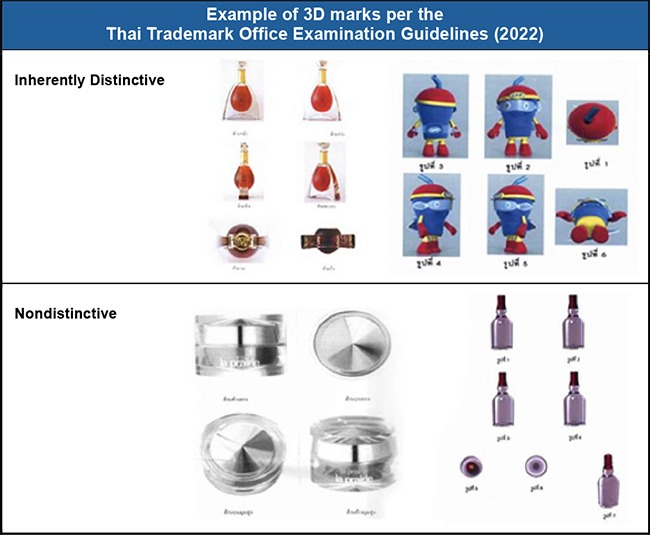
A plain water bottle relying on subtle contours to signal its brand is typically read as just another bottle, not a source identifier. Acquired distinctiveness offers a theoretical escape route, but it demands extensive evidence of sales, advertising, and consumer recognition—an especially heavy burden for new entrants whose minimalist packaging has not yet achieved market prominence. The result is a structural bias against precisely the design innovation that sustainability goals are meant to encourage.

Design Patents: A Partial, Imperfect Substitute

Design patent protection, covering a product’s shape, configuration, or ornamentation, appears to offer an alternative route. In practice, it is constrained by the same forces driving the minimalist trend. Because many brands converge on similar solutions—clear PET bottles, label-free surfaces, simple paperboard—new designs often “so nearly resemble” existing ones that they fail the novelty requirement under the Thai Patent Act. Even where novelty is established, protection lasts only ten years from filing, ill-suited to the indefinite life cycle of a brand identity that trademarks can offer. Narrow claim scope compounds the problem: because minimalist designs differ from competitors only in subtle details, rivals can make cosmetic tweaks and avoid infringement altogether.

A Layered Strategy for Now

Given these gaps, Thai practitioners should treat trademark and design patent filings as complementary layers rather than mutually exclusive options. Registration attempts can be supplemented with unfair competition claims for passing off, which remain available under Section 46 of the Trademark Act and Section 420 of the Civil and Commercial Code even where registration is refused. Contemporaneous evidence of consumer recognition—social media engagement, packaging redesign campaigns, and sales data tied to the new design—should be compiled from launch rather than assembled only once a dispute arises. Combining registered rights with common law remedies and a documented evidentiary record offers the most realistic protection available under the current framework.

Conclusion

The tension between Thailand’s IP framework and its sustainable packaging boom is unlikely to be resolved through litigation alone. The DIP’s examination guidelines predate the scale of today’s minimalist packaging trend and warrant revisiting, particularly in how consumer-perception evidence is weighed against abstract notions of “natural form” and “functionality.” Until that recalibration occurs, brands investing in green packaging should treat IP protection as a portfolio exercise: pursuing registration where possible, building an evidentiary record for acquired distinctiveness, and relying on passing-off remedies to fill the gaps. Minimalist packaging is not disappearing from Thai shelves; the law protecting it needs to catch up.


This article was prepare with the assistance of Tilleke & Gibbins intern Phuripat Kaewklom. It was originally published by the International Association for the Protection of Intellectual Property (AIPPI).

RELATED INSIGHTS​ 

December 21, 2023
Can rights holders record trademark and brand-related IP information with customs and, if so, how? Rights holders can record their registered marks with the Myanmar Customs Department to protect their intellectual property rights from cross-border trade in counterfeit goods bearing their registered marks under the Trademark Law, which came into force on April 1, 2023. Furthermore, regardless of whether they have filed a customs recordation, registered mark owners can request a suspension order to prevent the release of goods into free circulation if they have evidence giving reason to suspect that counterfeit goods are being—or will be—imported into the country, in accordance with Section 68 of the Trademark Law’s. According to Ministry of Planning and Finance (MOPF) Notification No. 50/2023, once a trademark is registered under the Trademark Law in Myanmar, the registered mark owner is entitled to apply for a customs recordation with the Customs Department directly or via a legal representative at no cost. Unless the mark is registered with the Intellectual Property Department (IPD) under the Trademark Law, a customs recordation or suspension order cannot be applied. A customs recordation is valid for two years from the date of the application’s acceptance. The recordation can be renewed every two years, 30 days before the expiration date. After the customs recordation is made, any information amended or withdrawn for the registered mark at the IPD must also be provided to the Customs Department within three working days, together with any necessary documentation reflecting the amendments or withdrawal. Customs recordation is not available for industrial designs. The Industrial Design Law and Industrial Design Rules do not provide the requirements and process for a customs recordation or suspension order in relation to industrial designs. Section 68 of the Industrial Design Law indicates that, upon a rights holder’s request, the
December 15, 2023
As part of its membership in Lex Mundi, Tilleke & Gibbins has published an updated edition of its Guide to Doing Business in Thailand for 2023. This guide outlines the key factors for starting and operating a business in the Thai market. Issues covered include: Investment incentives Financial facilities Exchange controls Import and export regulations Structures for doing business Requirements for the Establishment of a Business Operation of the Business Cessation or Termination of the Business Labor legislation, relations, and supply Tax Immigration requirements This publication is part of Lex Mundi’s Country Guides series prepared by member firms in more than 100 jurisdictions worldwide. The guides serve as a useful resource for planning international business strategy and researching new markets. The full Guide to Doing Business in Thailand is available through the button below.
December 11, 2023
On November 30, 2023, Vietnam’s Ministry of Science and Technology issued Circular No. 23/2023/TT-BKHCN detailing the implementation of some articles of the 2022 Intellectual Property Law (“IP Law”) and Decree No. 65/2023/ND-CP with respect to the establishment and protection of industrial property rights (“Circular 23”). Circular 23 took immediate effect upon issuance and provides further guidance and necessary clarifications for the implementation of the IP Law, which took effect on January 1, 2023. Some of the most critical provisions of Circular 23 related to the establishment of IP rights are discussed below. Common Procedures Circular 23 enumerates and details the cases where an application will be re-examined, as stipulated in various articles of the IP Law. The circular also adds the procedure in which a protection title can be partially granted, as newly stipulated in Article 118 of the IP Law. The procedure applies to patent, industrial design, and trademark applications. Grounds for IP rights invalidation are further detailed in the new circular. On the patent side, it provides a list of situations where claims are deemed to go beyond the scope of the specification. For trademark registrations, it specifically defines two conditions in which “bad faith” grounds can be used to cancel a registration. The circular sets out the procedure for opposing an application, as stipulated in the new Article 112a of the IP Law. Unlike previous regulations, Circular 23 sets out that the IP Office will inform the applicant of all oppositions (whether or not the opposition is grounded), except for obvious cases where the IP Office will consider the registrability of an opposed mark without informing the applicant. To facilitate applicants and related parties, some timeframes have been extended from one to two months. This includes, for example, the time limit for the applicant and the
December 7, 2023
The Hague Agreement Concerning the International Registration of Industrial Designs (the Hague Agreement) officially took effect in Vietnam on December 30, 2019. Since then the Hague Express Database reports that more than 1,300 international design applications have designated Vietnam, and many of them have been examined by Vietnam’s IP Office before a statement of grant of protection was issued. However, from the time the Hague Agreement took effect until the amended Intellectual Property Law took effect on January 1, 2023, there were no legal documents regulating the process and procedures for examining these applications in Vietnam. This caused some difficulties in the examination process and many applications filed from 2020 to date remain in limbo, with the applicants having submitted responses to refusals, but yet to receive further results on the grant or refusal of protection. The amended IP Law introduced Article 93.9 on the validity of international registrations of industrial designs according to the Hague Agreement. More recently, Decree 65/2023/ND-CP (Decree 65) introduced a new section on the filing and processing of Hague international design applications, with detailed regulations on the handling of Hague applications originating in Vietnam and Hague applications designating Vietnam. These new regulations have generally improved the international application process in Vietnam for both the IP Office and design applicants; however, they have not resolved some existing problems and in some cases have created more burdens for applicants. Submission of priority documents Article 24.8 of Decree 65 requires that within three months from the date of the International Bureau’s notification of the Hague Application designating Vietnam, applicants wishing to benefit from a priority must submit documents proving their priority right to the IP Office for approval. This is a completely new requirement that applies to all international design applications designating Vietnam starting from the effective