
You are using an outdated browser and your browsing experience will not be optimal. Please update to the latest version of Microsoft Edge, Google Chrome or Mozilla Firefox. Install Microsoft Edge

April 20, 2020

Current Requirements for Persons Traveling to Cambodia During the COVID-19 Pandemic

In order to prevent imported cases of COVID-19, on March 27, 2020, Cambodia’s Ministry of Foreign Affairs and International Cooperation imposed new requirements on foreigners entering Cambodia. These requirements are applicable to all foreigners, unless there is ban in effect for foreigners from specific countries. These legal requirements are effective from 23:59 of March 30, 2020.

Therefore, any foreigner considering a trip to Cambodia during this time should note the below requirements, plan appropriately and consider how they may impact their trip.
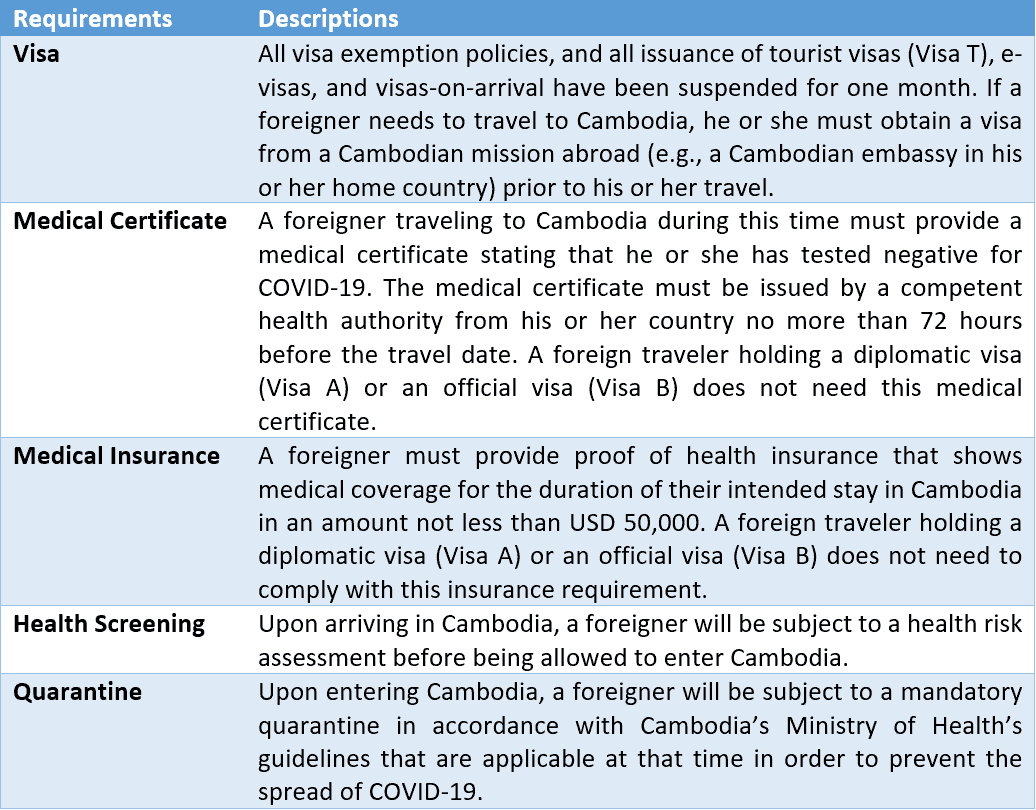
Cambodia’s Ministry of Foreign Affairs and International Cooperation notes that these requirements are temporary. The Cambodian government will review them regularly based on the current COVID-19 situation.

We would like to highlight that these travel requirements are in addition to the travel bans imposed earlier on travelers from the following six countries: France, Germany, Iran, Italy, Spain and the US as noted in our previous alert. These travel bans have been extended indefinitely until further notice, according to the Ministry of Foreign Affairs and International Cooperation’s letter on April 16, 2020.

RELATED INSIGHTS​ 

June 16, 2026
The president of Thailand’s Supreme Court has issued new recommendations providing courts with criminal jurisdiction with a comprehensive framework for identifying and dismissing criminal cases brought in bad faith. Published in the Government Gazette on May 29, 2026, after being signed on May 25, the Recommendations of the President of the Supreme Court Concerning Bad-Faith Litigation in Criminal Cases B.E. 2569 were issued under Section 5 of the Act on the Organization of Courts of Justice. The recommendations took effect upon publication and represent a significant step in Thailand’s efforts to curb abusive criminal litigation, including strategic lawsuits against public participation (SLAPP). Background Section 161/1 of Thailand’s Criminal Procedure Code empowers courts to dismiss criminal cases filed dishonestly or with the intent to harass or take unfair advantage of a defendant. The new recommendations provide detailed guidance that courts previously lacked on identifying and handling such prosecutions. Definition of Bad-Faith Litigation Under recommendation 1, filing a criminal case in bad faith is defined broadly to encompass three categories: Harassment-type filings involving intimidation, threats, or creating unreasonable hardship for the defendant; Coercive filings designed to pressure the defendant into acting or refraining from acting for illegitimate benefit; and False or misleading filings that deliberately assert incorrect material facts or conceal such facts. Circumstances Indicating Bad Faith Recommendation 2 sets out specific circumstances that should raise a court’s suspicion that a filing may violate section 161/1. These include: Filing in a distant court far from the defendant’s domicile without benefiting the adjudication; Retaliation against the defendant’s advocacy for human rights, environmental protection, consumer rights, labor rights, or other public interests—effectively establishing an express anti-SLAPP framework; Retaliation against whistleblowers who disclosed corruption or unlawful conduct; Retaliation against individuals responsible for investigating the plaintiff’s wrongdoing or who concluded such an investigation; Filing multiple
June 10, 2026
For multinational franchisors operating in Thailand, a key risk after franchise termination is that former outlets may continue operating in ways that could easily mislead consumers into believing they remain within the authorized network. To justify such operations, former franchisees often argue that the termination was invalid or ineffective. As a result, these cases are often treated as contractual disputes, making it difficult for franchisors to obtain injunctive relief before a final judgment confirms that the termination was lawful. Franchisors face significant commercial and reputational harm during lengthy proceedings, including consumer confusion, disruption to franchise restructuring, and damage to brand reputation and customer trust. In an encouraging development, the Thai court in a 2025 case responded to the problem of unauthorized post-termination franchise operations by granting interim relief, recognizing broader brand and consumer harm, and awarding substantial damages, highlighting a successful litigation strategy of framing the dispute not merely as a contractual termination issue but as trademark infringement causing ongoing commercial injury. The Subway Case From December 2024 to mid-2025, an unauthorized “Subway®” franchise operation in Thailand attracted substantial public and media attention. Reports and online discussions about unauthorized Subway® stores circulated widely after complaints arose about food quality and customer experience at certain outlets that were allegedly operating after their franchise rights had expired. Because these stores continued to use Subway® trademarks, trade dress, and overall commercial appearance, many consumers were unable to distinguish them from authorized operations, resulting in reputational risks and customer confusion that affected the franchisor’s brand and franchise system in Thailand. Subway treated this matter with the utmost seriousness and moved promptly to protect its brand, franchise system, and customers. It filed a civil action with the IP&IT Court seeking a permanent injunction and damages. During the proceedings, the court granted a preliminary injunction
June 9, 2026
On April 28, 2026, the Central Bank of Myanmar (CBM) issued Notification No. 18/2026 introducing the new Foreign Remittance Business Regulations. The new regulations apply to companies intending to operate foreign remittance businesses in Myanmar that are not licensed banks, non-bank financial institutions, or other financial institutions. The regulations supersede and replace the previous regulatory framework governing foreign remittance businesses under CBM Notification No. 21/2019. While the overall structure remains familiar, the new regulations introduce more detailed requirements for licensing, operations, reporting, and compliance, with a stronger focus on transparency and regulatory oversight. Broader Licensing Requirements Under the new regulations, applicants must submit detailed business plans describing the use of information technology and mobile platforms, along with clear plans for handling remittances from workers abroad and resolving customer complaints. Financial Thresholds and Reporting Requirements The baseline financial thresholds remain unchanged. Licensees must maintain a security deposit of MMK 100 million in an escrow account, along with a separate revolving fund dedicated solely to remittance operations. The new regulations introduce more structured reporting obligations. Licensees are now required to submit daily remittance transaction data by the next business day before noon, in addition to monthly and periodic reporting requirements. Foreign bank account statements must also be submitted regularly, and licensees must provide updates on business operations every six months. Strengthened AML and CFT Framework The new regulations place a greater emphasis on anti-money laundering (AML) and counter financing of terrorism (CFT), with tighter controls over management changes. Any changes in shareholding, share transfers, or the appointment of key management personnel such as the managing director require prior approval from the CBM. Licensing Fees and Validity The new regulations increase licensing costs, while maintaining the same validity period of three years. The new regulations provide more detailed grounds for suspension and
June 4, 2026
On May 19, 2026, the Cabinet of the Royal Thai Government approved, in principle, revisions to Thailand’s visa exemption scheme and visa on arrival (VOA) program, as proposed by the Ministry of Foreign Affairs and the Ministry of Tourism and Sports. The revisions represent a tightening of Thailand’s immigration framework and will affect a broad range of short-term visitors. Background On July 15, 2024, Thailand expanded its visa exemption scheme by increasing the permitted period of visa-exempt stay from 30 days to 60 days in order to promote tourism, support the country’s post-pandemic economic recovery, and facilitate international travel. Under this revised scheme, passport holders from 93 countries and territories (an increase from the previous 57 countries and territories) have been permitted to enter Thailand without a visa and remain in the country for up to 60 days per entry for purposes including tourism, business engagements, urgent work, and ad hoc assignments. In addition, eligible visitors may apply at the Thai Immigration Bureau for a further 30-day extension of stay. Key Changes The proposed revisions would revoke the current 60-day exemption and reinstate the previous stay period, thereby reducing the maximum permitted stay for eligible travelers to 30 days per entry. In addition, the number of countries and territories eligible under the 30-day visa-exemption scheme is expected to be reduced to 54. The scope of the VOA scheme would likewise be significantly narrowed, with the number of eligible countries reduced from 31 countries to just four (Azerbaijan, Belarus, Serbia, and India). Further, Thailand is expected to introduce a new 15-day visa exemption category for nationals of Seychelles, the Maldives, and Mauritius. The revised framework would also limit each country or territory to a single visa exemption privilege in order to simplify Thailand’s immigration framework and reduce overlapping immigration privileges.