
You are using an outdated browser and your browsing experience will not be optimal. Please update to the latest version of Microsoft Edge, Google Chrome or Mozilla Firefox. Install Microsoft Edge

April 20, 2020

Current Requirements for Persons Traveling to Cambodia During the COVID-19 Pandemic

In order to prevent imported cases of COVID-19, on March 27, 2020, Cambodia’s Ministry of Foreign Affairs and International Cooperation imposed new requirements on foreigners entering Cambodia. These requirements are applicable to all foreigners, unless there is ban in effect for foreigners from specific countries. These legal requirements are effective from 23:59 of March 30, 2020.

Therefore, any foreigner considering a trip to Cambodia during this time should note the below requirements, plan appropriately and consider how they may impact their trip.
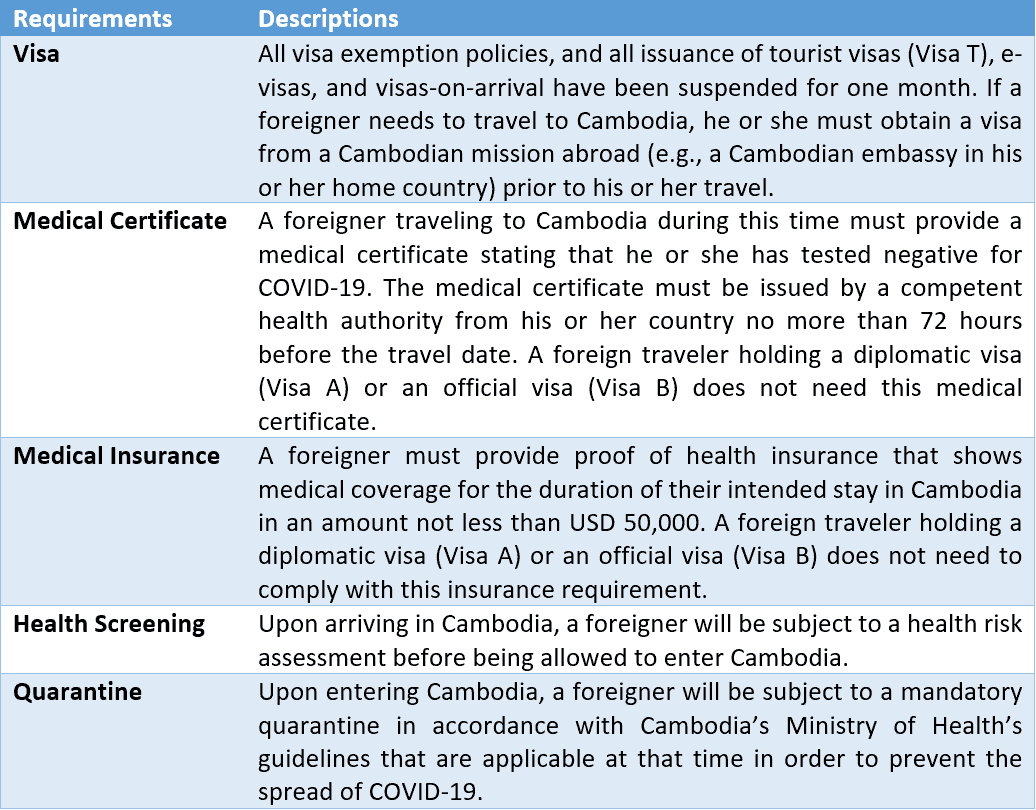
Cambodia’s Ministry of Foreign Affairs and International Cooperation notes that these requirements are temporary. The Cambodian government will review them regularly based on the current COVID-19 situation.

We would like to highlight that these travel requirements are in addition to the travel bans imposed earlier on travelers from the following six countries: France, Germany, Iran, Italy, Spain and the US as noted in our previous alert. These travel bans have been extended indefinitely until further notice, according to the Ministry of Foreign Affairs and International Cooperation’s letter on April 16, 2020.

RELATED INSIGHTS​ 

May 25, 2026
After several years of policy discussion and continued efforts led by the Ministry of Commerce (MOC) to relax the list of reserved businesses under the Foreign Business Act B.E. 2542 (1999) (FBA), the reform process has now reached a significant milestone. On May 12, 2026, the Thai cabinet approved in principle two draft subordinate legislative instruments aimed at delisting certain reserved business activities under the FBA and reducing licensing requirements for foreign business operators. These developments signal a renewed and concrete effort by the government to modernize Thailand’s business regulatory framework in order to attract foreign investment and boost Thailand’s competitiveness in the global market. Nine Businesses Set for FBA Delisting Below is a list of the nine businesses that are being targeted for delisting from the FBA’s restrictions. A draft ministerial regulation would delist the first eight reserved businesses, while a royal decree has been drafted to delist the ninth business: Telecommunications services (Type 1 license only, covering operators without their own telecommunications infrastructure), under the supervision of the Office of the National Broadcasting and Telecommunications Commission. Treasury center services subject to the Foreign Exchange Control Act B.E. 2485 and under the supervision of the Bank of Thailand. Securities-collateralized lending, pursuant to the laws governing securities and exchange and derivatives regulated by the Securities and Exchange Commission. Agency, dealer, advisory, or fund management services relating to derivatives where the underlying assets fall outside the scope of the Derivatives Act B.E. 2546 (2003) Intra-group shared services, including administrative, human resources, and IT functions Intra-group domestic debt guarantee services Leasing of partial space for installation of financial service machines and automatic vending machines for employee use Petroleum drilling services Trading of agricultural product derivatives through a futures exchange, with physical delivery or receipt of agricultural products at a futures exchange–designated
May 25, 2026
Thailand published new rules on May 1, 2026, establishing clear procedures for how the Anti-Money Laundering Office (AMLO) handles digital assets seized during criminal and money laundering investigations. Taking effect the following day, the Regulation of the Anti-Money Laundering Board on the Custody and Management of Seized or Frozen Assets (No. 3) B.E. 2569 applies to digital asset businesses, cryptocurrency holders, and anyone subject to asset seizure under Thailand’s anti-money laundering laws. For the first time, authorities now have a detailed roadmap for transferring seized digital property from private or foreign control into secure state custody. Digital asset businesses holding customer assets under investigation must be prepared to comply with these rules compelling repatriation of such assets in enforcement actions. Expanded Definition of Digital Assets The regulation defines digital assets to include not only those covered by Thailand’s existing digital asset business law but also any other property that can be stored using the same methods as digital assets. This broad formulation means the custody rules will apply to emerging blockchain-based assets and tokenized property that may not yet fall within the statutory definition of a digital asset business, giving authorities flexibility as the technology evolves. Mandatory Transfer to Domestic Custody When digital assets are held with service providers outside Thailand, AMLO will first attempt to transfer them to an account the office maintains with a licensed domestic digital asset business operator. If the domestic operator does not support that particular asset, the office will instead move the assets to its own cold wallet (offline, internet-isolated storage system). If neither option is feasible, the seizing official will report the situation to the Anti-Money Laundering Committee for alternative instructions. A similar hierarchy governs assets held in an accused party’s private wallet or by any third party that is not a
April 29, 2026
Is arbitration only as good as the arbitrator? Undoubtedly. Choosing an arbitrator is therefore one of the most pivotal decisions a party makes in the arbitration proceedings. In practice in Vietnam, many arbitration proceedings have been significantly prolonged because of multiple unsuccessful appointments arising from conflicts of interest, challenges by the opposing party, or subsequent unavailability. In other cases, additional expenses were incurred where appointed arbitrators were located far from the hearing venue or were unfamiliar with the arbitration language or applicable law. To preempt these issues and secure a more efficient and cost-effective appointment, this article proposes a practical, step-by-step approach to arbitrator selection. Step 1: Know Your Own Case At the outset, it is essential to develop a clear understanding of the dispute by addressing the following key considerations: Nature of the dispute: From which sector does it arise (e.g., construction, international trade, investment, banking and finance, technology, intellectual property)? Value and complexity: Is the dispute high or low in value? Does it involve multiple parties, multiple legal systems, or foreign elements? Is its crux related to multiple legal matters? Existing arbitration agreement: Does the agreement specify the seat, language, and governing law? If not, what would be appropriate considering the parties’ conduct and the applicable arbitration rules? Having clear answers to these questions in mind will help identify, from the outset, the core criteria for selecting an appropriate arbitrator. Step 2: Form Your Candidate Pool Based on the understanding developed in Step 1, a candidate pool should be formed through a structured and careful process: Researching Arbitrator Profiles At the initial stage, comprehensive research should be conducted via reliable sources to ensure both accuracy and diversity of candidates. Official sources, such as lists of arbitrators published by arbitral institutions, most notably the Vietnam International Arbitration Centre
April 29, 2026
Vietnam’s education sector is entering a new regulatory era. On December 10, 2025, the National Assembly adopted a series of new and amended laws in the field of education, including the 2025 Law on Vocational Education, the 2025 Law on Higher Education, and the amended Law on Education No. 123/2025/QH15 (Amended Law on Education). These laws together took effect on January 1, 2026, marking a significant reform of Vietnam’s legal framework governing the education sector. The legislative package introduces a new lawmaking approach under which foundational and principle-based provisions are codified in the Amended Law on Education, while the Law on Higher Education and the Law on Vocational Education serve as specialized statutes providing supplementary, sector-specific regulatory detail tailored to their respective subsectors. The Amended Law on Education fundamentally restructures how educational institutions are established, governed, and licensed, with direct implications for private investors, foreign-invested entities, and education service providers operating in Vietnam. Below are several highlights of the key changes under the amended law, especially in the private sector, that stakeholders should understand: Change in the National Education System In addition to primary education, lower secondary (junior high school) education is now compulsory in Vietnam. Accordingly, diplomas are no longer awarded upon completion of lower secondary school but only for upper education levels. The national education system is also expanded through the introduction of vocational high school as a new level of vocational education. Such reform creates additional learning pathways that not only enable learners to pursue both further education and participate in the labor market, but also better align education and training with socioeconomic development needs. New Hurdle for Joint Investors: Mandatory Corporate Entity Requirement Where two or more investors jointly establish an education institution, the investors are no longer permitted to directly establish such an institution.