
You are using an outdated browser and your browsing experience will not be optimal. Please update to the latest version of Microsoft Edge, Google Chrome or Mozilla Firefox. Install Microsoft Edge

February 17, 2021

Bank of Thailand Further Relaxes Foreign Exchange Controls for Outbound Investments

The Bank of Thailand (BOT) has amended foreign exchange (FX) controls, as part of its roadmap toward a “new Thai FX ecosystem,” to further relax limitations and restrictions on outbound investments remitted by investors in Thailand. This latest move follows a prior relaxation of foreign trading and exchange regulations in November 2019.

The new developments primarily relate to the thresholds for outbound investment, types of foreign investment products that investors may participate in, and foreign currency deposit accounts. These are detailed below.


Outbound Investment Thresholds

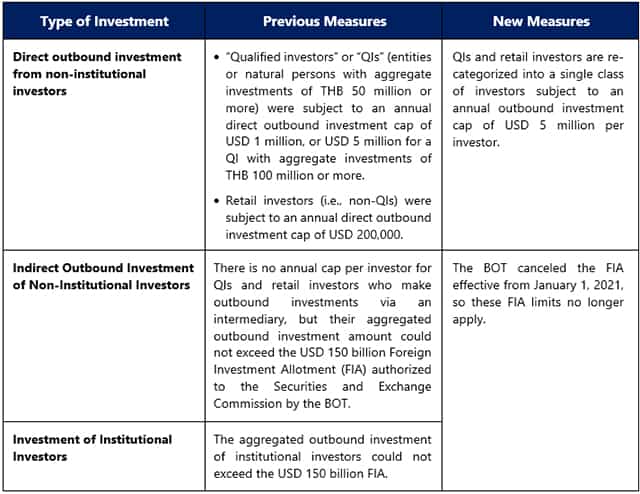
The new measures ease the individual and group limits for outbound investment as shown in the table below.
 

Types of Investment Products

The previous FX measures allowed investors to process FX transactions for investment in various types of inbound and outbound products; however, inbound products were limited to only debt instruments (e.g., bonds and structured notes) issued in foreign currency. The new FX measures expand the scope of products to include all types of investment products that reference foreign variables, such as foreign stocks, exchange traded funds, commodities, gold futures, and foreign indexes.

FX derivatives and other investment products (e.g., endowment life insurance, unit-linked life policies, and universal life insurance) are still open to outbound investment.


Foreign Currency Deposit (FCD) Accounts

The BOT also amended the requirements pertaining to foreign currency deposit (FCD) accounts. Previously, an FCD account for investment (i.e., portfolio foreign currency deposit) had to be separated from investors’ other FCD accounts. Separation of FCD accounts is no longer required, and a single FCD account can now be used for any transaction permitted by the BOT.


RELATED INSIGHTS​ 

June 18, 2026
Thailand’s Securities and Exchange Commission (SEC) has released a detailed draft notification expanding its oversight to cover the funding sources behind major shareholdings in licensed securities and digital asset business operators. Published on June 8, 2026, as Public Hearing Document No. 30/2569, the draft builds on funding-source principles introduced in an April hearing and on recently amended Ministry of Finance notifications issued in February 2026 that broadened the definition of major shareholder of licensed securities and digital asset business operators. A public comment period on the draft closes on June 23, 2026. An earlier version of the SEC’s proposal brought the issue of funding behind significant shareholdings within the SEC’s regulatory perimeter, signaling intent to look beyond shareholding to the persons and capital ultimately financing major shareholdings in licensed securities and digital asset business operators. The concern is that control may be exercised through financing arrangements rather than through equity ownership alone. The draft notification advances that initiative into a more detailed regulatory framework, as summarized below. Expanded Definition Captures Funding Sources Throughout Ownership Chains The draft regulation introduces a “material funding source” concept. A material funding source is the principal capital that enables a major shareholder to acquire its shareholding, without which the shareholding could not be obtained. Under the proposed rules, any person who provides such funding, whether directly to the major shareholder or indirectly through any tier of the ownership chain above the operator, is deemed a controller subject to SEC approval. The draft also captures any person acting as a conduit or intermediary in facilitating financial assistance to a major shareholder, deeming each of these persons to be a material funding source and aggregating it into the same control group as the ultimate funding source. The definition covers not only cash loans and equity investments,
June 9, 2026
On April 28, 2026, the Central Bank of Myanmar (CBM) issued Notification No. 18/2026 introducing the new Foreign Remittance Business Regulations. The new regulations apply to companies intending to operate foreign remittance businesses in Myanmar that are not licensed banks, non-bank financial institutions, or other financial institutions. The regulations supersede and replace the previous regulatory framework governing foreign remittance businesses under CBM Notification No. 21/2019. While the overall structure remains familiar, the new regulations introduce more detailed requirements for licensing, operations, reporting, and compliance, with a stronger focus on transparency and regulatory oversight. Broader Licensing Requirements Under the new regulations, applicants must submit detailed business plans describing the use of information technology and mobile platforms, along with clear plans for handling remittances from workers abroad and resolving customer complaints. Financial Thresholds and Reporting Requirements The baseline financial thresholds remain unchanged. Licensees must maintain a security deposit of MMK 100 million in an escrow account, along with a separate revolving fund dedicated solely to remittance operations. The new regulations introduce more structured reporting obligations. Licensees are now required to submit daily remittance transaction data by the next business day before noon, in addition to monthly and periodic reporting requirements. Foreign bank account statements must also be submitted regularly, and licensees must provide updates on business operations every six months. Strengthened AML and CFT Framework The new regulations place a greater emphasis on anti-money laundering (AML) and counter financing of terrorism (CFT), with tighter controls over management changes. Any changes in shareholding, share transfers, or the appointment of key management personnel such as the managing director require prior approval from the CBM. Licensing Fees and Validity The new regulations increase licensing costs, while maintaining the same validity period of three years. The new regulations provide more detailed grounds for suspension and
May 25, 2026
After several years of policy discussion and continued efforts led by the Ministry of Commerce (MOC) to relax the list of reserved businesses under the Foreign Business Act B.E. 2542 (1999) (FBA), the reform process has now reached a significant milestone. On May 12, 2026, the Thai cabinet approved in principle two draft subordinate legislative instruments aimed at delisting certain reserved business activities under the FBA and reducing licensing requirements for foreign business operators. These developments signal a renewed and concrete effort by the government to modernize Thailand’s business regulatory framework in order to attract foreign investment and boost Thailand’s competitiveness in the global market. Nine Businesses Set for FBA Delisting Below is a list of the nine businesses that are being targeted for delisting from the FBA’s restrictions. A draft ministerial regulation would delist the first eight reserved businesses, while a royal decree has been drafted to delist the ninth business: Telecommunications services (Type 1 license only, covering operators without their own telecommunications infrastructure), under the supervision of the Office of the National Broadcasting and Telecommunications Commission. Treasury center services subject to the Foreign Exchange Control Act B.E. 2485 and under the supervision of the Bank of Thailand. Securities-collateralized lending, pursuant to the laws governing securities and exchange and derivatives regulated by the Securities and Exchange Commission. Agency, dealer, advisory, or fund management services relating to derivatives where the underlying assets fall outside the scope of the Derivatives Act B.E. 2546 (2003) Intra-group shared services, including administrative, human resources, and IT functions Intra-group domestic debt guarantee services Leasing of partial space for installation of financial service machines and automatic vending machines for employee use Petroleum drilling services Trading of agricultural product derivatives through a futures exchange, with physical delivery or receipt of agricultural products at a futures exchange–designated
April 10, 2026
Following Thailand’s recent expansion of the “major shareholder” definition for securities and digital asset businesses, the Securities and Exchange Commission (SEC) launched a public hearing on April 7, 2026, on expanding the major shareholder definition further to cover funding sources behind share acquisitions in licensed securities and digital asset business operators. The public hearing will remain open for 15 days from the launch date, after which the proposed expansion is expected to take effect promptly so that operators can comply with both the earlier and additional requirements within the 180-day transitional period under the earlier regulations. Funding Sources Captured Under Control-Based Test Under the draft rules, persons who fund direct or indirect major shareholders’ acquisition of shares in a licensed operator would be deemed “controlling persons” and subject to SEC approval as major shareholders. This extends beyond traditional lenders to include guarantors, counterparties to derivatives or structured products, and any arrangement that results in a person being, directly or indirectly, a source of funding to a major shareholder. The SEC proposes to exempt three categories of funding arrangements from approval: Loans from Thai licensed financial institutions or BCBS (Basel Committee on Banking Supervision)-jurisdiction foreign banks; Margin loans for securities trading under Thai securities law; and Repurchase agreements under Thai securities law. Exemptions for Funding Sources of Government-Linked Entities The consultation proposes to stop look-through beyond the level of certain government-linked shareholders, including, without limitation, ministries, departments, bureaus, public organizations, independent agencies, and certain state enterprises. The SEC reasons that these entities’ mandates, duties, and funding sources are already subject to government oversight and audit, presenting minimal ownership-structure risk. Practical Implications Licensed securities and digital asset business operators should begin mapping their funding chains under the expanded definition in preparation for filing approval applications for any newly captured funding providers