
You are using an outdated browser and your browsing experience will not be optimal. Please update to the latest version of Microsoft Edge, Google Chrome or Mozilla Firefox. Install Microsoft Edge

February 17, 2021

Bank of Thailand Further Relaxes Foreign Exchange Controls for Outbound Investments

The Bank of Thailand (BOT) has amended foreign exchange (FX) controls, as part of its roadmap toward a “new Thai FX ecosystem,” to further relax limitations and restrictions on outbound investments remitted by investors in Thailand. This latest move follows a prior relaxation of foreign trading and exchange regulations in November 2019.

The new developments primarily relate to the thresholds for outbound investment, types of foreign investment products that investors may participate in, and foreign currency deposit accounts. These are detailed below.


Outbound Investment Thresholds

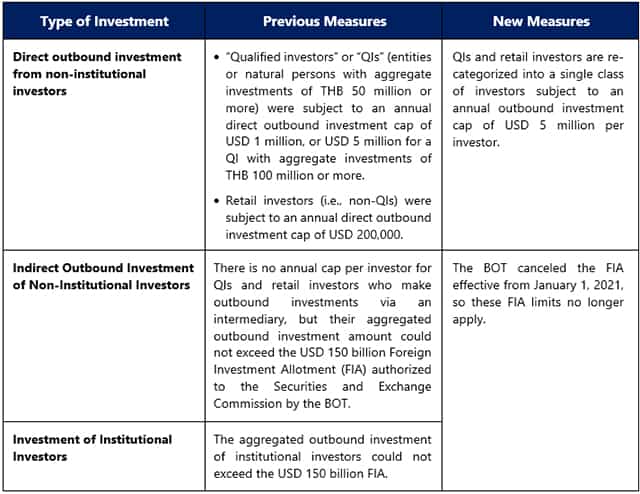
The new measures ease the individual and group limits for outbound investment as shown in the table below.
 

Types of Investment Products

The previous FX measures allowed investors to process FX transactions for investment in various types of inbound and outbound products; however, inbound products were limited to only debt instruments (e.g., bonds and structured notes) issued in foreign currency. The new FX measures expand the scope of products to include all types of investment products that reference foreign variables, such as foreign stocks, exchange traded funds, commodities, gold futures, and foreign indexes.

FX derivatives and other investment products (e.g., endowment life insurance, unit-linked life policies, and universal life insurance) are still open to outbound investment.


Foreign Currency Deposit (FCD) Accounts

The BOT also amended the requirements pertaining to foreign currency deposit (FCD) accounts. Previously, an FCD account for investment (i.e., portfolio foreign currency deposit) had to be separated from investors’ other FCD accounts. Separation of FCD accounts is no longer required, and a single FCD account can now be used for any transaction permitted by the BOT.


RELATED INSIGHTS​ 

April 3, 2026
Thailand’s Securities and Exchange Commission (SEC) has established a comprehensive governance framework for the use of artificial intelligence and machine learning (AI/ML) in the capital markets. The framework provides guidance to capital market business operators on understanding the risks associated with AI/ML implementation and adopting appropriate practices to build public confidence in Thailand’s capital markets. While the guidelines are principle-based rather than prescriptive, they reflect the SEC’s expectations for responsible AI/ML governance and are likely to inform supervisory activities and industry standards going forward. Scope The framework applies to capital market business operators supervised by the SEC. This includes, for example, securities and derivatives firms, asset management companies, mutual fund and private fund managers, investment advisors and investment consultants (including robo-advisory service providers), derivatives intermediaries, and other licensed intermediaries and market operators in the Thai capital markets that deploy AI/ML in their operations. Core Principles of the Guidelines The framework is presented as a best-practice manual rather than prescriptive regulation, providing guidance that regulated entities may apply to their AI/ML governance and risk management as appropriate. While currently nonbinding, the guidelines signal the SEC’s expectations for the sector, particularly in relation to other binding SEC regulations such as those covering IT risk management and market conduct. The guidelines name four core principles for AI/ML deployment: Fairness: Design and develop AI/ML with consideration for fairness, equality, and social diversity to prevent discrimination against individuals or groups. Legal and ethical compliance: Ensure AI/ML use aligns with applicable laws, ethical standards, and organizational values and policies. Accountability: Establish clear responsibility—both internally and externally—for AI/ML activities and outcomes. Transparency: Provide adequate disclosure to users about AI/ML use, including explainability of decisions and traceability of activities. AI/ML Best Practices The guidelines prescribe best practices across four stages of the AI/ML lifecycle, as described below.
March 16, 2026
Thailand’s Securities and Exchange Commission (SEC) has broadened the definition of institutional investors, expanded the types of qualifying investments, and updated financial qualification thresholds for various investor categories through a revised notification on the definitions of institutional investors, ultra-high net worth investors, and high net worth investors. The amended framework, which came into force on March 1, 2026, adds digital asset business operators, investment planners, and investment consultants to the roster of entities recognized as institutional investors, and broadens the definition of investment to account for digital tokens. Expanded Definition of Institutional Investors Under the SEC’s revised notification, the category of institutional investors now expressly includes digital asset business operators licensed under the Royal Decree on Digital Asset Businesses B.E. 2561 (2018). This addition recognizes the growing role of digital asset platforms and service providers in Thailand’s investment ecosystem and aligns the regulatory treatment of digital markets with that of traditional markets. The definition of institutional investors now also encompasses investment planners and investment consultants approved by the SEC. Previously, only SEC-approved investment analysts held this status; the expansion covers a broader scope of professionals who possess comparable expertise and experience in evaluating investment opportunities. Broadened Investment Definition The revised framework now defines investment to mean direct or indirect investment in a wider range of assets beyond deposits. Specifically, the definition covers: Securities under the Securities and Exchange Act Derivatives under the Derivatives Act Investment tokens offered to the public Government-issued digital tokens (G-tokens) as specified in a separate SEC notification This expansion ensures that financial status assessments reflect the full spectrum of an investor’s holdings, including emerging digital assets. Updated Financial Qualification Thresholds The amended SEC notification also provides updated qualification thresholds for angel investors, ultra-high net worth investors, and high net worth investors. While the core criteria
March 10, 2026
Thailand’s Ministry of Finance and Securities and Exchange Commission (SEC) have issued regulations broadening the criteria for determining who qualifies as a “major shareholder” of licensed securities and digital asset business operators. Under relevant SEC regulations, major shareholders of a regulated entity must obtain regulatory approval and undergo screening by the SEC. The revised framework introduces both shareholding-based and control-based tests to determine which shareholders require regulatory approval for a wider range of indirect ownership structures and de facto control. The Ministry of Finance notification took effect on February 21, 2026, while the SEC’s clarifying rules took effect on March 4, 2026. These changes aim to enhance transparency around beneficial ownership and strengthen regulatory oversight of entities operating in Thailand’s capital markets. Expanded Definition Under the revised framework, a “major shareholder” now includes persons who directly or indirectly hold more than 10% of the voting rights in a regulated company, as well as persons who exercise control over the regulated company or its shares. This system of two separate tests, based on both shareholding and control, differs from the prior regime, which focused primarily on shareholding thresholds and applied a more limited method for determining indirect shareholdings. The two tests (detailed below) operate independently of each other, and any person identified by either of the tests will be deemed a major shareholder. Shareholding-Based Test Broadens Indirect Ownership Attribution For the shareholding-based test, the SEC recognizes two existing methods for identifying indirect ownership, together with a new proportional attribution method. Any person captured under these methods, which are described below, will be regarded as a major shareholder of the regulated company and must obtain SEC approval as a major shareholder. First, the existing framework continues to apply to both first-tier and chain ownership structures. Approval is required for (1) first-tier
March 5, 2026
Amid increasing financial globalization, Vietnam’s establishment of an International Financial Center (IFC) represents a strategic initiative to attract high-quality foreign investment and enhance the country’s position in the global financial system. In support of this objective, a Specialized Court was introduced under Resolution No. 222/2025/QH15 as a dedicated dispute resolution mechanism within the IFC framework. The Specialized Court at the IFC was subsequently operationalized by Law on the Specialized Court No. 150/2025/QH15, effective from January 1, 2026. Organizational Structure of the Specialized Court The Specialized Court at the IFC is a court within the system of the People’s Courts, organized and operating in accordance with the Law on the Specialized Court, and vested with jurisdiction to adjudicate and resolve cases at the IFC. The Specialized Court is located in Ho Chi Minh City and comprises (i) a Court of First Instance; (ii) a Court of Appeal, and (iii) a supporting apparatus. Jurisdiction of the Specialized Court The jurisdiction of the Specialized Court at the IFC is strictly defined based on both (i) the subject matter of the cases and (ii) the membership status of the parties involved. Specifically, the Specialized Court has jurisdiction over (except for cases involving public interests or the interests of the state) the following: Disputes arising from investment and business activities. Requests for recognition and enforcement in Vietnam of judgments and decisions of foreign courts and foreign arbitral awards. Requests related to dispute resolution by arbitration. Other disputes directly related to investment and business activities (to be specified by the Supreme People’s Court). Additionally, at least one party in the case must be a member of the IFC. The IFC’s membership status is established through registration, recognition as a member, or the grant of a license for establishment and operation within the IFC. In the