You are using an outdated browser and your browsing experience will not be optimal. Please update to the latest version of Microsoft Edge, Google Chrome or Mozilla Firefox. Install Microsoft Edge

September 6, 2024

ASEAN: Big Changes on Vitamin and Mineral Limits for Health Supplements

Addressing technical barriers to trade is a key priority for the Association of Southeast Asian Nations (ASEAN) as part of trade facilitation in achieving the single market and production base under the ASEAN Economic Community directive agreed in 2015. The region has been undertaking positive steps toward standard harmonization in ASEAN priority sectors, integrating and bringing about regulatory convergence by taking into account the diversities that exist in the ten ASEAN member states.

Health supplements in ASEAN are under the responsibility of the Traditional Medicine and Health Supplement Product Working Group (TMHS PWG). One of the TMHS PWG’s outputs is the ASEAN Agreement on a Regulatory Framework for Health Supplements, which includes various technical requirements for health supplements that participating member states must adopt by adjusting their domestic regulations.

The key ingredients of these health supplements are vitamins and minerals. While all ASEAN countries allow the use of vitamins and minerals in health supplements, the amounts allowed for use vary, depending on the nutritional requirements deemed appropriate by each country.

Partly in response to these efforts for regional harmonization, there have been important changes to vitamin and mineral limits in certain ASEAN countries that are worth monitoring. Some of these are outlined below.

Thailand

In January 2024, the Thai Food and Drug Administration (TFDA) updated the Thai Recommended Daily Intake (Thai RDI) guidelines for the Thai population. Subsequently, the TFDA adjusted the vitamin and mineral limits in order to comply with the updated Thai RDI and to follow the ASEAN Agreement on a Regulatory Framework for Health Supplements.

The TFDA’s adjustment of vitamin and mineral limits for use in food supplements came in Notification of the Ministry of Public Health (No. 448) B.E. 2566 (2023) Re: Food Supplements (No. 5), which was published in the Government Gazette on January 4, 2024. It increased the maximum limits for certain vitamins and minerals (see breakdown below) up to the limits that had previously only been allowed in drugs. The minimum limits of vitamins and minerals for use in food supplements should be more than 15% of Thai RDIs, as set out in the Notification of the Ministry of Public Health (No. 445) B.E. 2566 (2023) Re: Nutrition Labels. This notification took effect on July 2, 2024.

Before that date, if a party wished to use more than 60 mg of Vitamin C or more than 2 mcg of Vitamin B12 in a health supplement, they would have needed to register the product as a medicine (not a health supplement) in Thailand. Now, health supplements are allowed to use 1,000 mg of vitamin C and 600 mcg of vitamin B12—a level that previously would have required registration as a medicine.

Health supplements are classified as a type of food in Thailand—this differs from some other countries, which may include health supplements in the medicine group. The registration process for health supplements is straightforward and takes a short time (about one to two months) to receive approval. On the other hand, drug registration is more complex and time-consuming. Health supplement companies widely agree that the time needed to receive license approval is one of the main obstacles for a business getting their products to market.

This change allows products that in the past had to be registered as medicines to now be accepted as health supplements in Thailand. This regulatory change will help promote the health supplement business in Thailand and ASEAN.

Indonesia

In Indonesia, the maximum limits for vitamins and minerals for use in health supplements were first updated by the Indonesian FDA (known as BPOM) with the issuance of BPOM Regulation No. 11 of 2020 concerning the Criteria and Procedure for Health Supplement Registration, which has since been revoked by BPOM Regulation No. 32 of 2022. There is currently a draft amendment to BPOM Regulation No. 32 of 2022 that has not yet been finalized. However, the draft amendment does not propose any changes to the current maximum limits for vitamins and minerals.

This shows how BPOM has been actively updating the regulatory framework on health supplements due to the large presence of health supplement products in Indonesia. Businesses in this sector therefore need to be sure of the latest requirements before registering their health supplement products in Indonesia.

Vietnam

In contrast to the changes seen in recent years in Indonesia and Thailand, Vietnam has not amended or drafted any amendments to domestic regulations related to the maximum levels of vitamins and minerals in health foods since 2014. The current maximum limits for vitamins and minerals in Vietnam are not matched to those in neighboring countries or to those in the ASEAN Agreement on a Regulatory Framework for Health Supplements. Nevertheless, Vietnam may consider revising the maximum limits at some point to comply with the ASEAN standards.

In Vietnam, health supplements are classified as food rather than medicine. Under Vietnam’s current regulations, the vitamin and mineral content in health supplements (calculated according to the manufacturer’s recommended daily dose) must not exceed the maximum intake threshold for vitamins and minerals prescribed in Circular 43/2014/TT-BYT.

If the maximum intake threshold is not specified, the related Codex regulations or those of relevant international organizations apply.

Breakdown

The following table summarizes the current maximum daily limits for vitamins and minerals in health supplements for adults in Thailand, Indonesia, and Vietnam. It also shows how the limits have changed compared to the previous regulations in each country.
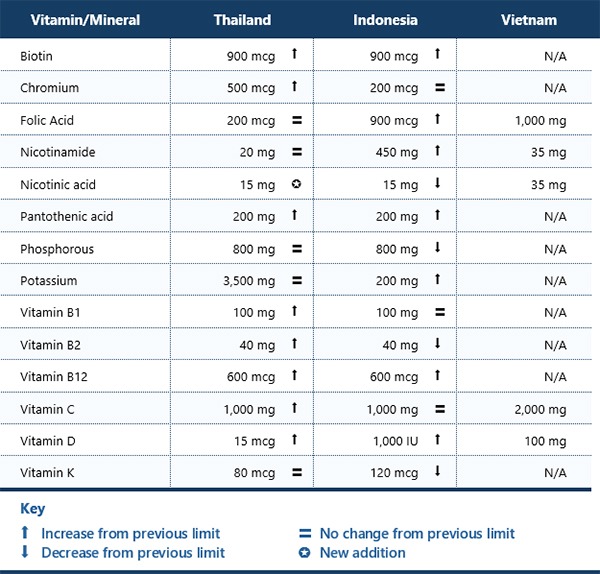
Where the limits are marked as not available, manufacturers may either follow the limitations under the ASEAN Agreement on a Regulatory Framework for Health Supplements or assume vitamins and mineral limits in health supplements based on generally accepted scientific data and taking into consideration, as appropriate, the varying degrees of sensitivity of different consumer groups.


RELATED INSIGHTS​ 

June 17, 2026
Thailand’s new labeling requirements for medical devices, which include for the first time a unique device identification (UDI) requirement for software as a medical device (SaMD), take effect on June 20, 2026. The Notification of the Ministry of Public Health regarding Criteria, Methods, and Conditions on Labeling and Instructions for Use for Medical Devices 2025, which replaces a similar notification from 2020, was published in the Government Gazette on December 22, 2025. To ensure clarity, modernity, and patient safety, the regulation requires domestic manufacturers and importers to provide labels and instructions for use (IFU) that are clearly legible, complete, and free of false or misleading claims. It also permits IFU to be provided in electronic format, such as via QR codes, websites, or other digital channels—directly relevant to SaMD, where physical labels are impractical and electronic presentation is the natural medium. The notification distinguishes two categories for labeling language. Home-use medical devices (for lay users outside healthcare facilities) must have labels and IFU in Thai. Professional-use medical devices may display labels and documentation in either Thai or English. This distinction is significant for SaMD developers: software intended for clinical professionals may use English-language interfaces and IFU, while consumer-facing health applications must provide Thai-language content. Labeling and UDI Requirements Labels and IFU must include, at a minimum: Product name and intended purpose Quantity or volume Name and address of domestic manufacturer or importer Thai FDA approval number Lot, version, or serial number Manufacturing date and expiry date For SaMD, the version number requirement is particularly relevant. The regulation also mandates display of a UDI code for SaMD in risk category 2 (moderate-risk), category 3 (moderate- to high-risk), and category 4 (high-risk), according to Thailand’s medical device risk classification system (which complies with the ASEAN Medical Device Directive and the EU
June 5, 2026
On May 25, 2026, Vietnam’s Ministry of Health issued Circular No. 16/2026/TT-BYT governing free-of-charge medicine support programs for medical establishments (Circular 16). Circular 16 will take effect on July 10, 2026, replacing Circular No. 31/2018/TT-BYT, which currently regulates the same subject matter. Circular 16 introduces several significant changes compared to the existing legal framework. Removal of Prior Approval Requirement Under the current regulations, free-of-charge medicine support programs are divided into two categories: (1) entirely free-of-charge provision of medicines for all types of drugs and (2) partially free-of-charge provision applicable only to brand-name drugs under patent protection or drugs whose generic products with identical active ingredients and dosage forms are available in Vietnam. Under the current regulations, partially free-of-charge programs are subject to mandatory registration with the competent authority, while entirely free-of-charge programs could be implemented without prior approval. A key reform under Circular 16 is that it stipulates only entirely free-of-charge medicine support programs applicable to all types of medicines, thereby eliminating the partially free-of-charge category. In addition, free-of-charge medicine support programs may be carried out solely based on a written agreement between the pharmaceutical company and the medical establishment, without any requirement for prior approval from competent authorities prior to implementation. Written Agreement Requirements Circular 16 requires the pharmaceutical company and medical establishment to enter into a written agreement in accordance with a prescribed template. This agreement must include the following compulsory information: Information on the supported medicines Form of support (entirely free-of-charge provision to patients) Quantity of medicines provided Target patient groups and applicable indications Duration of the program Rights and obligations of each party Transitional provisions on the protection of patients’ rights upon completion of the program The agreement may contain other contents as agreed by the parties, provided that these do not contradict applicable laws.
June 4, 2026
Indonesia’s Minister of Health has issued Decree No. HK.01.07/MENKES/301/2026 on the Affixation of Nutritional Labels and Health Information to Ready-to-Eat Processed Food Products. The decree came into force on April 14, 2026, and was issued to implement the Health Law and Minister of Health Regulation No. 3 of 2026 on Disease Control. The decree requires the inclusion of Nutri-Level labeling on the front-of-pack nutrition labeling (FOPNL) to indicate the product’s nutritional level based on the content of sugar, salt, and fat (“gula, garam dan lemak (GGL)”). Changes from 2024 Draft Regulation The Nutri-Level labeling was previously proposed in 2024 by the Indonesian FDA (BPOM) through a draft regulation concerning nutrition information. While the categories of Nutri-Level labeling remain the same in the issued decree, the content requirements of sugar, salt and fat in the decree are different from the earlier proposal introduced in the 2024 draft BPOM regulation. In addition, the decree has further specified that the content of fat in the Nutri-Level labeling is the content of saturated fat, not total fat as previously proposed in the 2024 draft. The decree requires Nutri-Level labeling to be implemented in beverage products, which is the same as previously proposed in the 2024 draft BPOM regulation. Other food products may gradually become subject to mandatory Nutri-Level labeling under future implementing regulations. Nutri-Level Labeling Food levels as shown by the Nutri-Level labeling are classified into four color-coded categories from A to D: Level A (lowest amount) in dark green Level B in light green Level C in yellow Level D (highest amount) in red The Nutri-Level labeling is represented by the following image. The requirements for each level for sugar, salt, and fat content, based on amounts per 100 milliliters of product in beverage form, are as follows. Nutri-Level information must be
May 29, 2026
Indonesia’s Food and Drug Authority (BPOM) has issued Regulation No. 7 of 2026 on Drug Promotion and Advertising, establishing an updated framework for promotional activities involving medicinal products in Indonesia. The regulation took effect on April 16, 2026, and supersedes BPOM Regulation No. 2 of 2021 on Drug Advertising Supervision. The new regulation maintains general principles for advertising content, including requirements that advertisements be objective, complete, and not misleading, as further detailed in its annex. It also confirms that advertisements for nonprescription drugs directed to the public must obtain prior approval from BPOM before publication and must be in Bahasa Indonesia. The regulation provides a more comprehensive framework governing how drug promotion is conducted, introducing several notable additions and changes, as described below. Procedure and Requirements for Drug Advertisement Approval To apply for a drug advertisement approval, applicants must create an online account through the dedicated portal SIAPIK. Advertisement approval is available only for registered drugs; unregistered drugs are not eligible for advertisement approval with BPOM. The application must include the advertisement design, along with a translation if the design contains any wording in a foreign language. The submission format varies by media type, requiring, for example, copies in the form of print advertisements for visual media, scripts for audio media, and storyboards for audiovisual media. For online media—including social media—submissions should include any captions, descriptions, and hashtags that form an integral part of the advertising material. The approval timeline takes approximately 3–4 months, as BPOM will generally request additional information or revisions during the verification and evaluation process. Applicants have 20 days to submit any such requested documents. BPOM may also conduct a reevaluation of advertisements that have already received approval, based on monitoring results or new information regarding the safety and quality of the advertised drug. This