You are using an outdated browser and your browsing experience will not be optimal. Please update to the latest version of Microsoft Edge, Google Chrome or Mozilla Firefox. Install Microsoft Edge

September 6, 2024

ASEAN: Big Changes on Vitamin and Mineral Limits for Health Supplements

Addressing technical barriers to trade is a key priority for the Association of Southeast Asian Nations (ASEAN) as part of trade facilitation in achieving the single market and production base under the ASEAN Economic Community directive agreed in 2015. The region has been undertaking positive steps toward standard harmonization in ASEAN priority sectors, integrating and bringing about regulatory convergence by taking into account the diversities that exist in the ten ASEAN member states.

Health supplements in ASEAN are under the responsibility of the Traditional Medicine and Health Supplement Product Working Group (TMHS PWG). One of the TMHS PWG’s outputs is the ASEAN Agreement on a Regulatory Framework for Health Supplements, which includes various technical requirements for health supplements that participating member states must adopt by adjusting their domestic regulations.

The key ingredients of these health supplements are vitamins and minerals. While all ASEAN countries allow the use of vitamins and minerals in health supplements, the amounts allowed for use vary, depending on the nutritional requirements deemed appropriate by each country.

Partly in response to these efforts for regional harmonization, there have been important changes to vitamin and mineral limits in certain ASEAN countries that are worth monitoring. Some of these are outlined below.

Thailand

In January 2024, the Thai Food and Drug Administration (TFDA) updated the Thai Recommended Daily Intake (Thai RDI) guidelines for the Thai population. Subsequently, the TFDA adjusted the vitamin and mineral limits in order to comply with the updated Thai RDI and to follow the ASEAN Agreement on a Regulatory Framework for Health Supplements.

The TFDA’s adjustment of vitamin and mineral limits for use in food supplements came in Notification of the Ministry of Public Health (No. 448) B.E. 2566 (2023) Re: Food Supplements (No. 5), which was published in the Government Gazette on January 4, 2024. It increased the maximum limits for certain vitamins and minerals (see breakdown below) up to the limits that had previously only been allowed in drugs. The minimum limits of vitamins and minerals for use in food supplements should be more than 15% of Thai RDIs, as set out in the Notification of the Ministry of Public Health (No. 445) B.E. 2566 (2023) Re: Nutrition Labels. This notification took effect on July 2, 2024.

Before that date, if a party wished to use more than 60 mg of Vitamin C or more than 2 mcg of Vitamin B12 in a health supplement, they would have needed to register the product as a medicine (not a health supplement) in Thailand. Now, health supplements are allowed to use 1,000 mg of vitamin C and 600 mcg of vitamin B12—a level that previously would have required registration as a medicine.

Health supplements are classified as a type of food in Thailand—this differs from some other countries, which may include health supplements in the medicine group. The registration process for health supplements is straightforward and takes a short time (about one to two months) to receive approval. On the other hand, drug registration is more complex and time-consuming. Health supplement companies widely agree that the time needed to receive license approval is one of the main obstacles for a business getting their products to market.

This change allows products that in the past had to be registered as medicines to now be accepted as health supplements in Thailand. This regulatory change will help promote the health supplement business in Thailand and ASEAN.

Indonesia

In Indonesia, the maximum limits for vitamins and minerals for use in health supplements were first updated by the Indonesian FDA (known as BPOM) with the issuance of BPOM Regulation No. 11 of 2020 concerning the Criteria and Procedure for Health Supplement Registration, which has since been revoked by BPOM Regulation No. 32 of 2022. There is currently a draft amendment to BPOM Regulation No. 32 of 2022 that has not yet been finalized. However, the draft amendment does not propose any changes to the current maximum limits for vitamins and minerals.

This shows how BPOM has been actively updating the regulatory framework on health supplements due to the large presence of health supplement products in Indonesia. Businesses in this sector therefore need to be sure of the latest requirements before registering their health supplement products in Indonesia.

Vietnam

In contrast to the changes seen in recent years in Indonesia and Thailand, Vietnam has not amended or drafted any amendments to domestic regulations related to the maximum levels of vitamins and minerals in health foods since 2014. The current maximum limits for vitamins and minerals in Vietnam are not matched to those in neighboring countries or to those in the ASEAN Agreement on a Regulatory Framework for Health Supplements. Nevertheless, Vietnam may consider revising the maximum limits at some point to comply with the ASEAN standards.

In Vietnam, health supplements are classified as food rather than medicine. Under Vietnam’s current regulations, the vitamin and mineral content in health supplements (calculated according to the manufacturer’s recommended daily dose) must not exceed the maximum intake threshold for vitamins and minerals prescribed in Circular 43/2014/TT-BYT.

If the maximum intake threshold is not specified, the related Codex regulations or those of relevant international organizations apply.

Breakdown

The following table summarizes the current maximum daily limits for vitamins and minerals in health supplements for adults in Thailand, Indonesia, and Vietnam. It also shows how the limits have changed compared to the previous regulations in each country.
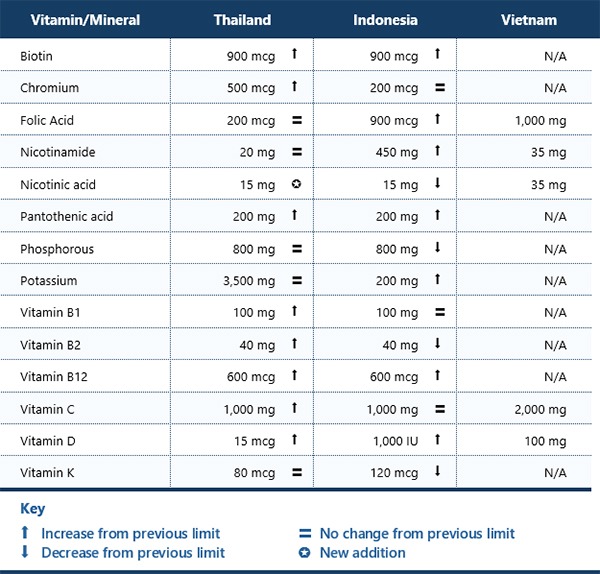
Where the limits are marked as not available, manufacturers may either follow the limitations under the ASEAN Agreement on a Regulatory Framework for Health Supplements or assume vitamins and mineral limits in health supplements based on generally accepted scientific data and taking into consideration, as appropriate, the varying degrees of sensitivity of different consumer groups.


RELATED INSIGHTS​ 

May 11, 2026
Vietnam’s legal framework governing chemicals has undergone significant reform, with the Law on Chemicals No. 69/2025/QH15 (Law on Chemicals 2025) taking effect on January 1, 2026. Together with a comprehensive set of implementing instruments issued in January 2026, including three decrees (No. 24/2026/ND‑CP, No. 25/2026/ND‑CP, and No. 26/2026/ND‑CP) and two circulars (No. 01/2026/TT‑BCT and No. 02/2026/TT‑BCT), the Law on Chemicals 2025 has significantly reshaped chemical registration and management requirements. Determining What Constitutes a “New Chemical” Among the most notable changes introduced under the Law on Chemicals 2025 are the rules governing the registration and management of new chemicals, which must be registered with the authority before being placed on the Vietnam market. Although the concept of new chemical registration was first introduced under the Law on Chemicals 2007, the corresponding registration mechanism has remained largely dormant in practice. Under the Law on Chemicals 2025, a “new chemical” is defined as a substance that is not yet included in Vietnam’s National Chemical Inventory and the list of foreign chemical inventories recognized by the competent Vietnamese authority (List of Foreign Chemicals). On a literal reading, the definition in the new law may suggest that a substance qualifies as a new chemical only if it is absent from both lists. Accordingly, a chemical present in either list should be treated as an existing chemical without the registration burden. However, a different interpretation emerges from Decree 26, which specifically requires registration of “new chemicals” even where such substances already appear in the List of Foreign Chemicals. This implies that inclusion in a recognized foreign inventory does not automatically exempt a substance from new chemical registration in Vietnam. This inconsistency between the statutory definition in the Law on Chemicals 2025 and the implementing provisions of Decree 26 creates significant interpretative and compliance challenges. At
April 29, 2026
Effective June 22, 2026, Thai Industrial Standards (TIS) for food contact paper and cooking paper will be enforced as mandatory for sale in the Thai market. This move has important implications for product licensing and tightens hygiene, labeling, and chemical-safety requirements for food-contact and cooking paper products. Thailand is strengthening its regulatory framework for paper-based culinary materials against a backdrop of accelerating global commitments to ESG and sustainability, as such materials—particularly those derived from natural or recycled fibers—have emerged as key alternatives to plastics in food preparation, cooking, and packaging applications. As a result, regulators worldwide are tightening controls to ensure that sustainability initiatives do not compromise consumer safety, particularly regarding the potential migration of chemical substances into food. Regulatory Framework: Voluntary vs. Mandatory Standards Standards under the TIS regime are generally classified into two categories. Voluntary standards allow manufacturers or importers to apply for a product license and affix the TIS mark to demonstrate product quality and build consumer confidence, but compliance is not legally required. Mandatory standards, by contrast, require manufacturers and importers to obtain a product license and affix the TIS mark before placing products on the Thai market, and noncompliant products cannot be legally sold. Previously, the TIS standards for food contact paper (TIS 2948-2562) and cooking paper (TIS 3438-2022) fell under the voluntary standard regime, meaning that obtaining a TIS license and displaying the TIS mark was optional. However, due to the increasing use of paper in food preparation and cooking, the Thai Industrial Standards Institute has determined that upgrading these standards to mandatory status is necessary to enhance consumer safety. As a result, all paper intended for food contact or cooking purposes must now obtain a TIS product license prior to sale in Thailand. Scope of the Standards The primary distinction between the
April 22, 2026
A new decree in Vietnam brings significant implementation clarity to the country’s existing extended producer responsibility (EPR) legal framework. An EPR mechanism was first codified in Vietnam in the 2020 Law on Environmental Protection amid ongoing challenges surrounding the collection and treatment of product and packaging waste. The mechanism was progressively detailed through Decree No. 08/2022/ND‑CP and its successive amendments, but the regulatory framework remained insufficiently developed, notably in terms of support mechanisms for waste collection, recycling, and treatment. The newly launched regulations in Decree No. 110/2026/ND-CP (Decree 110), issued on April 1, 2026, and taking effect on May 25, 2026, stipulate fully and clearly the responsibility of manufacturers and importers to recycle products and packaging and to treat waste. Some key provisions of Decree 110 for manufacturers, importers, and related stakeholders are presented below. Subjects of EPR The Law on Environmental Protection assigns responsibility to manufacturers and importers for product and packaging recycling (under Article 54) or waste collection and treatment (under Article 55), depending on the type of products and packaging they produce or import. Decree 110 elaborates on these EPR provisions by specifying the responsible entities and listing out the types of products and packaging subject to recycling and waste treatment responsibilities. Decree 110 clarifies the responsible entities in special cases, such as when products under the same brand are made by multiple manufacturers, when there is a contract manufacturing or entrusted import relationship, and when the manufacturer or importer is part of a corporate group. Notably, exemptions may be applied in some scenarios, such as for manufacturers and importers of products and packaging exclusively for export, temporary import and re-export, or research and testing purposes, as well as for entities with annual revenue from related products not exceeding VND 30 billion. Recycling Responsibilities Decree 110
March 30, 2026
In response to an emerging crisis on food safety, the government of Vietnam promulgated Decree No. 46/2026/ND-CP (Decree 46) on January 26, 2026, and Resolution No. 66.13/2026/NQ-CP (Resolution 66.13) on January 27, 2026, setting out a number of substantive changes to the procedure and strict requirements for the declaration, registration, and importation of food products. Both instruments took effect upon issuance. However, shortly after they entered into force, food businesses encountered significant implementation challenges, particularly with respect to state inspection procedures at the customs clearance stage for imported products. In response, the government issued Resolution No. 09/2026/NQ-CP (Resolution 09) on February 4, 2026, temporarily suspending Decree 46 and Resolution 66.13 until a new effective date of April 16, 2026. Continued Suspension of Implementation of Decree 46 and Resolution 66.13 After considering feedback gathered by the Ministry of Health from food businesses and other stakeholders during the suspension period, the Vietnam Government Office issued a notice on March 20, 2026, agreeing to extend the suspension until the issuance of an amended Law on Food Safety and its guiding decree. Following this notice, on March 22, 2026, the Ministry of Health prepared a draft resolution to implement the notice and replace Resolution 09. Under the draft resolution, the effectiveness of Decree 46 and Resolution No. 66.13 would continue to be suspended until the amended Law on Food Safety takes effect, except for the provisions under Resolution 66.13 allowing flexibility in documents evidencing product efficacy, which would take effect on April 16, 2026, and remain effective until the Law on Food Safety is replaced (but not later than February 28, 2027). Accordingly, for products subject to the registration declaration procedure, such as health supplements, efficacy may be substantiated by either (i) scientific evidence supporting the declared function and effects of the product