
You are using an outdated browser and your browsing experience will not be optimal. Please update to the latest version of Microsoft Edge, Google Chrome or Mozilla Firefox. Install Microsoft Edge

August 29, 2018

A Novel Approach to Evaluating the Similarity of Trademarks in Thailand

Informed Counsel

The Court of Appeal for Specialized Cases (Specialized Appeal Court) was established in October 2016 to review all appeals against the judgments of the five specialized first instance courts in Thailand, including the Central Intellectual Property and International Trade Court (IP&IT Court). Most, if not all, judges of the Specialized Appeal Court, who are responsible for reviewing IP-related appeals, have had experience working as judges at the IP&IT Court and can be expected to be well versed in IP law and practices. They are capable of providing fair, practical, and sometimes novel judgments, as illustrated in a recent case involving how similarity of trademarks should be evaluated.

Opposition of Similar Trademarks

In June 2009, a Thai company filed an application for registration of the trademark MOBIL-AG & Device, Application No. 734360, for use with goods in Class 1, namely chemical fertilizers. This application was subsequently published in a trade gazette in September 2012. As the applicant’s mark is closely similar to the well-known registered trademarks of Exxon Mobil Corporation (“ExxonMobil”), ExxonMobil filed an opposition petition against this application with the Trademark Office in December 2012 under Section 13 of the Trademark Act, among others. The opposition was based on several prior registered trademarks of ExxonMobil, particularly:

  1. Trademark Registration No. Kor. 63198, registered for use with goods in Class 4, including lubricant oil, kerosene, gasoline, diesel; and
  2. Trademark Registration No. Kor. 99756, registered for use with goods in Class 5, including antiseptics in plants and pesticides.

The marks are shown in the table below.
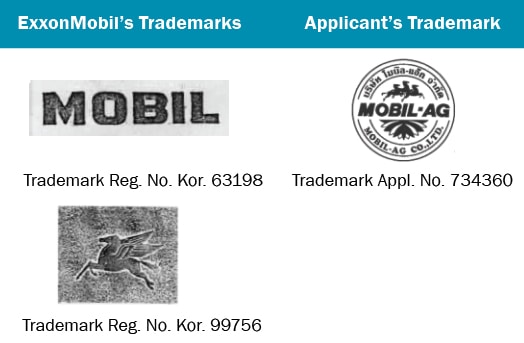
Even though the Trademark Office Registrar found that the applicant’s trademark and ExxonMobil’s trademark MOBIL, Reg. No. Kor. 63198, are similar, the registrar unfortunately dismissed the opposition because it found that both marks are for use with goods in different classes and that the lists of goods were not of the same character.     

ExxonMobil then appealed the decision to the Board of Trademarks, which dismissed the appeal based on the same reasons. ExxonMobil therefore further appealed the decision by filing a lawsuit with the IP&IT Court.

IP&IT Court’s Judgment

In January 2017, after reviewing the evidence and statements of witnesses produced by both parties, the IP&IT Court rendered judgment dismissing the lawsuit. The IP&IT Court found that (1) the appearances and pronunciations of both parties’ marks were different; (2) the classifications of the goods of both parties’ marks were different; and (3) the lists of goods of both parties’ marks were not related. The court therefore ruled that the applicant’s mark was not prohibited from registration under Section 13 of the Trademark Act. Disappointed with the judgment, ExxonMobil instructed Tilleke & Gibbins to appeal the IP&IT Court judgment to the Specialized Appeal Court.

Specialized Appeal Court’s Judgment   

On October 11, 2017, the Specialized Appeal Court rendered judgment finding that the applicant’s Trademark Application No. 734360 is similar enough to ExxonMobil’s Trademark Registration Nos. Kor. 99756 and Kor. 63198 so as to cause confusion among the public.

Even though both parties’ marks are for use with goods of different classes, the lists of goods were found to have the same character. Accordingly, the applicant’s Trademark Application No. 734360 is not registrable under Section 13 of the Trademark Act. The Specialized Appeal Court therefore reversed the judgment of the IP&IT Court and ordered that the prior decisions of the Trademark Registrar and the Board of Trademarks be withdrawn.

It is interesting to note that the Specialized Appeal Court not only addressed the similarity of both parties’ marks, element by element, but also discussed the origin of the word “MOBIL.” Particularly, it stated that this word is not Thai, but foreign. If this foreign word has not been used until it has a comparative meaning in Thai, there would be limitations for general consumers to recognize and remember it. Most importantly, “MOBIL” does not have a meaning in the dictionary and ExxonMobil’s witness confirmed that the word has been used as a trademark since 1906 and has been registered worldwide. It can therefore be concluded that the applicant used the same word as that of ExxonMobil as a part of its trademark.

Moreover, in the appeal, in addition to the similarity issue, ExxonMobil argued that its registered trademarks are well known, and the applicant, who was well aware of ExxonMobil’s well-known mark, applied for registration of a similar mark in bad faith. Even though the Specialized Appeal Court did not discuss or rule on the well-known and bad faith issues, it is obvious that these arguments were taken into consideration when evaluating the similarity between both parties’ marks. 

The ruling has positive implications for future similar cases in Thailand as it implies that, in deciding whether an applicant’s trademark is prohibited from registration under Section 13 of the Trademark Act, the Specialized Appeal Court will take into consideration the fame of the prior registered trademark and the bad faith of the applicant. This approach should help in deterring any bad faith applicant from imitating other parties’ well-known trademarks or applying for registration of such imitation trademarks.

RELATED INSIGHTS​ 

August 20, 2026
Vietnam’s Law on Bankruptcy and Rehabilitation No. 142/2025/QH15, passed by the National Assembly on December 11, 2025, does something many regional counterparts do not yet attempt: it instructs parties and arbitral tribunals on exactly what happens to an arbitration once a debtor becomes insolvent. Together with the Law on Commercial Arbitration No. 54/2010/QH12, the new law improves upon what used to be an uncertain area of practice, now providing an explicit, mandatory sequence of procedures. Suspension and Termination of Arbitration Proceedings Under article 40(2) of the law, once a Vietnamese court accepts a bankruptcy petition, any arbitration that concerns the debtor’s financial obligations must be temporarily suspended as soon as the tribunal receives the court’s notification. If the court subsequently issues a decision commencing bankruptcy proceedings, article 59(2) takes a further step: the suspended arbitration is terminated outright, and the underlying case file is transferred to the court handling the insolvency for resolution. The two provisions work as a sequence: first suspension, then termination and transfer, rather than as independent triggers. Meanwhile, article 60(4) reinforces this effect by vesting the bankruptcy court with exclusive jurisdiction over all claims against the debtor from the date the petition is accepted. Notably, this mechanism operates automatically, without the need for the insolvency court to issue a separate anti-arbitration order. The tribunal simply suspends or terminates the proceeding by operation of law once notified; however, Vietnamese law currently provides no procedure by which a party can apply to the insolvency court for permission to continue the arbitration despite the statutory effect. Practitioners with a Vietnamese counterparty in arbitration should treat notification of a bankruptcy filing as something to flag to the tribunal immediately since continuing to arbitrate a claim that has become subject to article 40(2) or 59(2) risks producing an award vulnerable
August 20, 2026
Thai law contains no provision that speaks directly to what happens to an arbitration when one of the parties becomes insolvent. The interaction between arbitration and insolvency is derived instead from the general operation of two separately drafted laws: the Bankruptcy Act B.E. 2483 (1940) and the Arbitration Act B.E. 2545 (2002). Because Thai courts have had few opportunities to interpret how these two statutes apply together, the practical answer to many questions, such as who represents an insolvent party in arbitration, whether an award will be enforced, and what happens to a foreign proceeding, depends on inference from general principles of insolvency, arbitration, and procedural law rather than on settled rules. Liquidation and Restructuring The Bankruptcy Act governs both liquidation, which winds up a debtor’s affairs, and restructuring (rehabilitation), which aims to preserve a business. The consequences for arbitration differ accordingly. In liquidation, the debtor’s assets vest in the official receiver, who alone can conduct or continue any arbitration affecting the estate; the debtor loses the authority to act on its own behalf. In restructuring, the plan preparer or administrator takes over that role, but there is more room for the debtor to remain involved, since the objective of rehabilitation is to keep the business operational. Restructuring carries an automatic stay that takes effect once the Bankruptcy Court accepts the restructuring petition. This stay can halt an arbitration regardless of where it is seated. In contrast, liquidation does not work through a stay; instead, the debtor’s loss of authority over its own assets and disputes is what constrains the arbitration. Neither proceeding provides a party a formal route to apply for permission to continue arbitrating—the Bankruptcy Act contains no such mechanism—though in restructuring cases the Bankruptcy Court may allow proceedings to continue where doing so will not prejudice
August 20, 2026
As part of its membership in Lex Mundi, Tilleke & Gibbins has released the latest edition of its Guide to Doing Business in Thailand, providing an overview of the legal, regulatory, and commercial considerations for companies establishing or expanding operations in Thailand. The 2026 edition offers practical insight into the country’s business environment, investment framework, and operational requirements. The guide covers a wide range of topics relevant to foreign and domestic investors, including: Investment incentives and promotion schemes Financial facilities and banking regulations Exchange controls and money transfers Import and export regulations Business structures and incorporation options Requirements for establishing a business Operational and compliance considerations Business cessation and insolvency procedures Employment and labor laws Taxation Immigration and visa requirements Prepared by Tilleke & Gibbins lawyers across multiple practice areas, the publication outlines key aspects of doing business in Thailand, including foreign investment restrictions, regulatory compliance obligations, corporate structures, employment requirements, and recent legal and economic developments affecting investors. The publication forms part of Lex Mundi’s Country Guides series, a global collection of jurisdiction-specific reference materials prepared by member firms around the world. Together, these guides help companies evaluate opportunities, compare regulatory environments, and plan international business activities across multiple markets. The full Guide to Doing Business in Thailand 2026 is available through the button below.
August 19, 2026
Arbitration clauses and national court jurisdiction have long existed in a delicate equilibrium, and nowhere is that equilibrium tested more often than in the drafting of multitier dispute resolution clauses. Such clauses—requiring negotiation before arbitration—are ubiquitous in international construction contracts, and they frequently employ permissive vocabulary at the arbitration tier. The formulation “either party may submit the dispute to arbitration” is intended to signal that either side is entitled to initiate proceedings. Yet it is periodically seized upon by claimants who prefer national courts, on the theory that “may” preserves a parallel right to litigate. Each apex-court pronouncement on this question is therefore significant for drafting practice and forum predictability. In 2019, the Thai Supreme Court delivered Thailand’s clearest answer to date (Judgment No. 3427/2562). Reversing an appellate court decision, the Supreme Court held that permissive wording at the point of commencement does not dilute the parties’ antecedent agreement to withdraw their disputes from the courts—doing so in regard to an International Chamber of Commerce (ICC) arbitration clause seated in Singapore, a configuration typical of foreign-invested projects in Thailand. This article examines the court’s reasoning, situates the decision within comparative jurisprudence, and draws out its practical lessons for parties and drafters operating in the Thai market. Background of the Dispute The dispute arose from a subcontract for civil engineering and architectural works concluded on September 25, 2014. Clause 19 of the subcontract governed dispute resolution. Clause 19.1 required the parties, at the request of either, to seek to resolve any dispute “in connection with, arising out of, or relating to” the subcontract through mutual consultation within sixty days of written notice. According to clause 19.2.1, if the dispute could not be resolved within that period, “either party may submit the dispute to arbitration,” to be conducted under the ICC