
You are using an outdated browser and your browsing experience will not be optimal. Please update to the latest version of Microsoft Edge, Google Chrome or Mozilla Firefox. Install Microsoft Edge

May 24, 2018

Landmark Victory in Design Patent Infringement Case

Informed Counsel

Tilleke & Gibbins is the main external counsel for intellectual property (IP) enforcement work for Honda Access Corporation, a developer, manufacturer, and seller of automotive and motorcycle parts and accessories, and a subsidiary of Honda Motor Co., Ltd. Our firm recently assisted the client in several related design patent infringement matters, which culminated in a civil suit filed with Thailand’s Central Intellectual Property and International Trade (IP&IT) Court against infringing Thai companies. Through the combined efforts of our IP litigation and enforcement lawyers, and our in-house investigation team, we secured a resounding victory for our client in the IP&IT Court in November 2017. In its landmark ruling, the Court awarded our client the largest civil lawsuit compensation amount to date for a design patent infringement case in Thailand at THB 68.65 million (about USD 2.11 million), plus interest, and attorney and court fees.

Previously, Honda Access Corporation claimed rights on four protected design patents for genuine spoilers, used in one of their parent company’s highly popular CITY 2014 model automobile, which were being infringed upon through similar products that were being manufactured and distributed for sale in the Thai market by several infringing companies. The automobile model for which the accessories were made is a valuable commercial product that is consistently ranked first in sales in its market segment in Thailand.
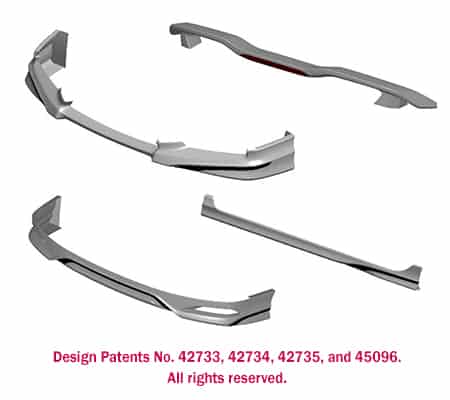
As an initial remedy, the Tilleke & Gibbins IP enforcement team sent warning letters to the infringers. Since the infringer did not respond or cease its infringement, we then proceeded with the case through the IP&IT Court, and successfully obtained a preliminary team, in collaboration with the execution officers, to inspect and seize the infringing goods at all locations that they could be found.

To execute the Court order, our firm’s in-house investigation team conducted an investigation to determine the location of the warehouse and/or factory of such infringing goods, and was able to lead authorities to seize 1,280 infringing car accessories at a warehouse. Later, the company that claimed to own the seized products filed a motion asking to join in the case, with the Court granting the motion and allowing the company to join as an interpleader. The preliminary measure that our team obtained enabled our client to disrupt the infringers’ activities without waiting for the entire time-consuming litigation process.

At the same time, our IP litigation team filed a civil lawsuit with the IP&IT Court requesting damages, including all of Honda Access Corporation’s legal and execution fees, from the infringers. After completion of the hearing of witnesses and waiting for judgment on the merits of the case, our client found that the defendants were still distributing their infringing goods in Thailand through another company. In response to this offense, our firm requested and obtained a preliminary injunction from the IP&IT Court to order the infringers to cease further manufacturing and distribution operations.

In considering the sound arguments and case presented by our lawyers, the substantial evidence gathered by our in-house investigation team, and the defendants’ continued infringement and seeming disregard for the law, the Court rendered a judgment in our client’s favor in November 2017 by deciding that the defendants had indeed infringed on our client’s design patents.

In the landmark ruling, the Court awarded Honda Access Corporation the largest civil lawsuit compensation amount to date for a design patent infringement case in Thailand at THB 68.65 million (about USD 2.11 million), plus 7.5 percent interest per year from September 2016 until the completion of the defendants’ and interpleader’s payments. The Court also ordered the defendants and interpleader to pay our client’s court fees and THB 500,000 (about USD 15,400) in attorney fees.

The Court further ruled that all infringing car accessories in the possession of the defendants and interpleader must be seized and destroyed, with the infringers paying for the destruction. The case marks one of the rare instances in Thai court proceedings in which court officials visited the infringers’ premises to inspect the seized products first-hand.

Tilleke & Gibbins’ efforts not only achieved a landmark ruling for Honda Access Corporation, but also prevented infringers from continuing to manufacture and distribute their design-infringing products, helping to protect our client’s genuine accessories and their strong market position in Thailand, as well as serving as a deterrent against other potential infringers in the future.

RELATED INSIGHTS​ 

September 14, 2026
Myanmar’s first-to-file trademark registration regime under the Trademark Law 2019—which became fully operational in April 2023—provides mark owners with enhanced legal protection compared with the country’s former system. Correspondingly, the current system imposes more rigorous statutory requirements for obtaining, maintaining, and enforcing rights in marks. In this first-to-file trademark registration system, however, evidence of use remains particularly significant, as it may establish acquired distinctiveness, support a claim that a mark is well-known, and strengthen the owner’s position in both registration and enforcement proceedings. Accordingly, it can be said that this framework is underpinned by three key concepts: distinctiveness, well-known status, and, importantly, use of the trademark. Trademark Distinctiveness Under the Trademark Law, signs that lack distinctiveness are generally ineligible for mark protection. These signs include generic terms, basic shapes, unstylized single letters or numerals, and signs that merely describe the kind, quality, quantity, intended purpose, value, geographical origin, production time, or other characteristics of the relevant goods or services. However, a mark that would otherwise be refused on distinctiveness or descriptiveness grounds may be registrable if it has acquired distinctiveness through its use prior to the filing date. To show this, the applicant must demonstrate that the mark became distinctive to relevant consumers through continuous, exclusive, and good-faith use in trade within Myanmar. The burden of proving acquired distinctiveness rests with the mark owner. Accordingly, sufficient evidence demonstrating both use of the mark and the level of consumer recognition attained should be prepared in advance. Well-Known Mark Criteria Myanmar’s Trademark Rules, which govern the substantive examination of mark registration applications, establish criteria for determining well-known marks, aligned with international standards. Where an applicant claims well-known status—whether to overcome a refusal on relative grounds or to oppose a third party’s registration—the registrar will assess the claim based on the following
September 14, 2026
On August 23, 2026, Vietnam’s National Assembly passed Law No. 11/2026/QH16, amending the country’s Customs Law with effect from March 1, 2027. The amendments represent a substantial reform of Vietnam’s customs-based intellectual property enforcement regime. The reforms come amid considerable external pressure. In its 2026 Special 301 review, the US Trade Representative (USTR) designated Vietnam a “priority foreign country,” citing widespread counterfeiting, weak border enforcement, limited ex officio customs powers, and the absence of controls over goods in transit. Vietnam’s legislative response signals a commitment to bringing its border enforcement practices into line with international expectations. For IP rights holders operating in or through Vietnam, the amended law introduces several tools that substantially strengthen enforcement options at the border. Closing the Transit Gap One of the most consequential amendments is the extension of IP-related customs enforcement to goods in transit. Previously, Vietnam’s customs regime applied IP controls only to goods being imported or exported, a gap the USTR had specifically identified as enabling infringing goods to pass through Vietnamese ports with impunity. Vietnam’s geographic position as a logistics hub for Southeast Asia means that substantial volumes of goods transit its ports and free-trade zones. Extending enforcement to cover these shipments brings Vietnam closer to the standard set by the EU’s customs enforcement regulation and addresses a longstanding concern of multinational brand owners whose goods are frequently counterfeited in the region. Strengthened Suspension and Ex Officio Powers The amended law introduces a dual-track suspension mechanism (Article 73(2)). Customs authorities will suspend clearance upon request by an IP rights holder (or authorized representative) who provides evidence of IP ownership, evidence of infringement, and a financial guarantee. Customs can now proactively suspend clearance on an ex officio basis if, during inspection and monitoring, they discover “clear grounds” to suspect that imported, exported,
September 7, 2026
Indonesia’s Constitutional Court (Mahkamah Konstitusi) has reinstated a key provision limiting pharmaceutical patent protection, signaling a renewed commitment to balancing patent rights with public access to medicines. In its ruling to Case No. 255/PUU-XXIII/2025, the court partially granted a petition for judicial review of Law No. 65 of 2024, which had amended the country’s Patent Law, and ordered the restoration of a provision that had excluded certain pharmaceutical inventions from patentability. The decision took effect immediately upon its pronouncement at the court’s plenary session on August 28, 2026. Background The petition challenged the removal of article 4(f) from Law No. 13 of 2016 concerning Patents (Patent Law), as amended by Law No. 65 of 2024. Article 4(f) had excluded from patentability certain inventions relating to new uses of known substances. The petitioners argued that removing this provision would open the door to patent protection for second medical use inventions and facilitate patent evergreening—practices that can extend exclusivity periods, delay generic market entry, and reduce public access to affordable medicines. The petitioners included several patient advocacy and public-interest organizations: the Indonesian Dialysis Patients Community Association, the Indonesian Association of Drug Abuse Victims (PKNI), the Indonesian Pulmonary Hypertension Foundation (YHPI), the Rekat Peduli Indonesia Foundation, and the Indonesian Positive Women’s Association (IPPI), along with the Indonesia for Global Justice Association and four individual petitioners. The petitioners also challenged the constitutionality of the phrase “interested party” in article 70(1) of the Patent Law, arguing that it should be construed expressly to clarify who has standing to appeal a decision to grant a patent before the Board of Patent Appeal, and to allow a broader range of parties—such as patent holders, licensees, consumer organizations, prosecutors, aggrieved third parties, and others who may suffer direct or indirect harm from the grant of a patent—to
September 2, 2026
Thailand and China have a longstanding and significant trade relationship, which increasingly extends to e-commerce and digitally enabled supply chains. While these channels create new opportunities for businesses to reach consumers across borders, their growth also brings greater exposure to intellectual property (IP) infringement across jurisdictions and online platforms. Effective cooperation between the two countries’ enforcement authorities has therefore become increasingly important. To strengthen cooperation in this area, Thailand and China signed a memorandum of understanding (MOU) on IP enforcement in Beijing on July 20, 2026, during the Thai prime minister’s official visit to China. Officially titled “Memorandum of Understanding Between the State Administration for Market Regulation of the People’s Republic of China and the Ministry of Commerce of the Kingdom of Thailand on Cooperation in the Field of Intellectual Property Enforcement,” the MOU forms part of a broader bilateral agenda covering industrial and supply chains, participation by micro, small, and medium-sized enterprises (MSMEs), cooperation associated with the ASEAN–China Free Trade Area 3.0, and progress on the registration of Thai geographical indications in China. The MOU establishes a bilateral framework for cooperation and coordination in five broad areas: Strengthening dialogue in IP enforcement; Enhancing information sharing; Facilitating the enforcement of IP rights in cases arising in the parties’ domestic markets and on online platforms, in accordance with their respective domestic laws; Promoting cooperation in IP enforcement training and human resource development; and Undertaking other cooperation activities agreed upon by both sides. The Department of Intellectual Property (DIP) will serve as the principal coordinating agency for Thailand, while the Bureau of Law Enforcement and Inspection in China’s State Administration for Market Regulation (SAMR) will serve in that role for China. The framework is particularly relevant to the growth of e-commerce, as it covers infringement in the domestic markets and on