
You are using an outdated browser and your browsing experience will not be optimal. Please update to the latest version of Microsoft Edge, Google Chrome or Mozilla Firefox. Install Microsoft Edge

May 24, 2018

Landmark Victory in Design Patent Infringement Case

Informed Counsel

Tilleke & Gibbins is the main external counsel for intellectual property (IP) enforcement work for Honda Access Corporation, a developer, manufacturer, and seller of automotive and motorcycle parts and accessories, and a subsidiary of Honda Motor Co., Ltd. Our firm recently assisted the client in several related design patent infringement matters, which culminated in a civil suit filed with Thailand’s Central Intellectual Property and International Trade (IP&IT) Court against infringing Thai companies. Through the combined efforts of our IP litigation and enforcement lawyers, and our in-house investigation team, we secured a resounding victory for our client in the IP&IT Court in November 2017. In its landmark ruling, the Court awarded our client the largest civil lawsuit compensation amount to date for a design patent infringement case in Thailand at THB 68.65 million (about USD 2.11 million), plus interest, and attorney and court fees.

Previously, Honda Access Corporation claimed rights on four protected design patents for genuine spoilers, used in one of their parent company’s highly popular CITY 2014 model automobile, which were being infringed upon through similar products that were being manufactured and distributed for sale in the Thai market by several infringing companies. The automobile model for which the accessories were made is a valuable commercial product that is consistently ranked first in sales in its market segment in Thailand.
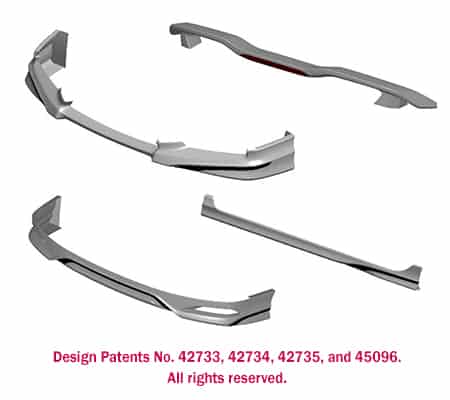
As an initial remedy, the Tilleke & Gibbins IP enforcement team sent warning letters to the infringers. Since the infringer did not respond or cease its infringement, we then proceeded with the case through the IP&IT Court, and successfully obtained a preliminary team, in collaboration with the execution officers, to inspect and seize the infringing goods at all locations that they could be found.

To execute the Court order, our firm’s in-house investigation team conducted an investigation to determine the location of the warehouse and/or factory of such infringing goods, and was able to lead authorities to seize 1,280 infringing car accessories at a warehouse. Later, the company that claimed to own the seized products filed a motion asking to join in the case, with the Court granting the motion and allowing the company to join as an interpleader. The preliminary measure that our team obtained enabled our client to disrupt the infringers’ activities without waiting for the entire time-consuming litigation process.

At the same time, our IP litigation team filed a civil lawsuit with the IP&IT Court requesting damages, including all of Honda Access Corporation’s legal and execution fees, from the infringers. After completion of the hearing of witnesses and waiting for judgment on the merits of the case, our client found that the defendants were still distributing their infringing goods in Thailand through another company. In response to this offense, our firm requested and obtained a preliminary injunction from the IP&IT Court to order the infringers to cease further manufacturing and distribution operations.

In considering the sound arguments and case presented by our lawyers, the substantial evidence gathered by our in-house investigation team, and the defendants’ continued infringement and seeming disregard for the law, the Court rendered a judgment in our client’s favor in November 2017 by deciding that the defendants had indeed infringed on our client’s design patents.

In the landmark ruling, the Court awarded Honda Access Corporation the largest civil lawsuit compensation amount to date for a design patent infringement case in Thailand at THB 68.65 million (about USD 2.11 million), plus 7.5 percent interest per year from September 2016 until the completion of the defendants’ and interpleader’s payments. The Court also ordered the defendants and interpleader to pay our client’s court fees and THB 500,000 (about USD 15,400) in attorney fees.

The Court further ruled that all infringing car accessories in the possession of the defendants and interpleader must be seized and destroyed, with the infringers paying for the destruction. The case marks one of the rare instances in Thai court proceedings in which court officials visited the infringers’ premises to inspect the seized products first-hand.

Tilleke & Gibbins’ efforts not only achieved a landmark ruling for Honda Access Corporation, but also prevented infringers from continuing to manufacture and distribute their design-infringing products, helping to protect our client’s genuine accessories and their strong market position in Thailand, as well as serving as a deterrent against other potential infringers in the future.

RELATED INSIGHTS​ 

August 4, 2026
Intellectual property (IP) protection sometimes hinges on fame and recognition. However, this alone will not always be sufficient to overcome an IP dispute when it involves contractual obligations or registered rights. Below are five cases from around the world that tackle some of the basic issues in IP registration, ownership, commercialization, and enforcement. 1. USA: Taylor Swift Trademark Application Refused Taylor Swift recently filed a trademark application to register “The Life of a Showgirl,” which is the title of her 12th studio album. When examining a trademark application, the examiner considers various factors before deciding whether it should be registered. One of these factors is whether there is a likelihood of confusion (i.e., would a regular consumer mistake the origin of the trademark). In Taylor Swift’s case, the US Patent and Trademark Office (USPTO) decided that that there would be a risk of confusion. This decision was based on the existing registered trademark, “Confessions of a Showgirl,” owned by Maren Wade, which was registered in 2015. The USPTO refused Taylor Swift’s application based on the shared key distinctive element “of a showgirl,” the lack of sufficient distinguishing terms, the marks being used in overlapping markets (entertainment and performances), and because consumers may assume a common commercial source. Maren Wade then filed a lawsuit in California against Taylor Swift and her affiliated companies, arguing that Taylor Swfit’s branding is confusingly similar in structure, wording, and overall commercial impression to her registered mark. She is also drawing on the USPTO’s refusal of Taylor Swift’s application to support her argument of a likelihood of confusion. A judgment has not yet been reached in this case, but it serves as an important reminder of the importance of satisfying the essential elements required for IP registration. 2. Australia: Katy Perry v. Katie Perry In
July 27, 2026
Vietnam’s new E-Commerce Law, which took effect on 1 July 2026 along with its implementing Decree No. 248/2026/ND-CP (Decree 248), marks a significant development in the country’s approach to online intellectual property (IP) enforcement, reflecting a clear shift from a reactive model of intermediary liability to one that expects platforms to play a more active role in preventing infringement. From notice-and-takedown to platform responsibility The most significant change introduced by the E-Commerce Law is the transformation of the legal role of e-commerce platforms. The existing safe harbor provisions under the IP Law and the copyright notice-and-takedown regime established by Decree 17/2023/ND-CP (Decree 17) largely required intermediaries to act only after receiving notice of infringement. Once infringing content had been removed, the platform’s legal obligation was generally considered fulfilled. The new legislation adopts a fundamentally different approach. Article 17 of the E-Commerce Law requires intermediary platforms to screen information relating to goods and services before publication in order to prevent listings involving counterfeit or IP-infringing goods, and goods of unknown origin. Rather than relying exclusively on complaints from rights holders, platforms are now expected to implement preventive measures before infringing listings become publicly available. Decree 248 further requires platforms to update keyword filters based on recommendations issued by competent authorities. These filtering mechanisms are intended to prevent prohibited listings from appearing on the platform and represent a further move away from a purely complaint-driven enforcement model. The legislation also introduces Vietnam’s first statutory stay-down obligation. Under the E-Commerce Law and Decree 248, major digital platforms must maintain automated systems capable of reviewing, warning against, and removing unlawful listings while also implementing measures to prevent repeat violations, defined under Decree 248 as conduct that has previously been identified and handled by the platform, but continues to recur. This obligation addresses one
July 27, 2026
Tilleke & Gibbins’ intellectual property specialists have authored the Thailand chapter of Trade Secrets 2026 from Chambers and Partners. This global guide examines the legal frameworks governing trade secret protection, enforcement, and litigation across jurisdictions worldwide. The Thailand chapter provides a comprehensive overview of the country’s legal regime for protecting confidential business information, covering the legal framework, trade secret misappropriation, litigation procedures, remedies, and dispute resolution. Some topics covered include: Protectable trade secrets Reasonable measures to maintain secrecy Employee confidentiality Trade secret licensing Civil and criminal remedies Litigation procedures and injunctions Damages and other remedies Mediation and arbitration The guide also examines practical issues relating to safeguarding trade secrets, defending against allegations of misappropriation, and managing trade secret disputes in Thailand. Chambers and Partners’ Global Practice Guides provide in-house counsel with authoritative commentary on practical legal issues affecting business, enabling readers to compare legislation and procedures across multiple jurisdictions. The Thailand chapter of Trade Secrets 2026 is available as a PDF through the button below. The full guide can be accessed for free on the Chambers and Partners website.
July 27, 2026
In March 2025, Thailand’s Central Intellectual Property and International Trade Court (IP&IT Court) issued a landmark judgment in favor of Luckin Coffee, China’s leading retail coffee chain. The judgment marked a significant turnaround following earlier trademark litigation involving Luckin Coffee from 2021 to 2023 that had generated widespread public attention and raised questions about the protection available to legitimate foreign brand owners in Thailand. In a significant subsequent development, Thailand’s Court of Appeal for Specialized Cases has now affirmed the IP&IT Court’s judgment in its entirety. The appellate decision brings clarity to one of Thailand’s most closely watched trademark disputes. Significantly, this is the first case in Thailand to formally recognize the trademark squatting principle. The Court of Appeal confirmed that Luckin Coffee has a better right to the disputed mark and ordered cancellation of the defendants’ trademark registration—a key application of the “better right” doctrine. The court also upheld the substantial damages awarded at first instance, providing important guidance on assessing harm from systematic trademark squatting. Award-Winning Judgment Affirmed in Its Entirety The significance of the first-instance judgment extended beyond the outcome for Luckin Coffee. The IP&IT Court judgment was subsequently recognized in the IP&IT Court’s Distinguished Judgment Awards in 2025, reflecting the complexity, novelty, and legal significance of the issues considered in the case. The defendants nevertheless appealed the judgment, challenging several key aspects of the IP&IT Court’s decision. Luckin Coffee continued to entrust Tilleke & Gibbins as their sole attorney to pursue the case at the appellate level. After considering the defendants’ appeal and Luckin Coffee’s submissions in response, the Court of Appeal affirmed the first-instance judgment in its entirety. The judgment was announced on July 8, 2026. Better Right to the Marks The Court of Appeal confirmed Luckin Coffee’s superior rights. The orders include cancellation