You are using an outdated browser and your browsing experience will not be optimal. Please update to the latest version of Microsoft Edge, Google Chrome or Mozilla Firefox. Install Microsoft Edge

September 5, 2019

Update on Thailand’s “Delisting” of Marijuana and Hemp from the Scope of Category 5 Narcotics

On Friday August 30, 2019, a Notification of the Thai Ministry of Public Health (“MOPH Notification”) was published in the Government Gazette. The MOPH Notification went into effect on August 31, 2019, one day after its publication.

This MOPH Notification outlines another Thai Government initiative in connection with the free cannabis policy, this time carving out further aspects of marijuana and hemp use from the stringent regulations under the Narcotics Act.

Marijuana is described in the MOPH Notification as plants of the cannabis genus, including all parts of a marijuana plant and the substances or chemicals found in a marijuana plant. Hemp is defined as plants falling within Cannabis sativa L. Subsp. sativa, including all parts of a hemp plant.

In fact, marijuana and hemp are not entirely “delisted” from the classification of Category 5 Narcotics as identified in the Narcotics Act. While these plants are still listed as Narcotics, the MOPH Notification serves to prescribe “exceptions”, meaning aspects and particulars of marijuana and hemp related products that are not considered Narcotics.

The new exceptions are summarized below.

For both marijuana and hemp

(1) Marijuana or hemp stalks, stem cores, and fibers are excepted, if dried. The products made of such dry parts are excepted, as well.

(2) Cannabidiol (CBD) extracted from marijuana or hemp is excepted if having at least 99% purity and no more than 0.01 percent by weight of tetrahydrocannabinol (THC).

(3) Extracts of marijuana or hemp having CBD as the main constituent and no more than 0.2% by weight of THC, which are considered “drugs” as per the Drug Act, or Herbal Products as identified in the Herbal Products Act.

For hemp only

(4) Hemp seeds or hemp seed oil, which are considered Food as identified in the Food Act.

(5) Hemp seed oil or hemp seed extracts, which are considered Cosmetics as identified in the Cosmetics Act.

In other words, hemp products according to the above descriptions may now be classified as Medicinal Drugs, Herbal Products, Food, or Cosmetics under their respective regulations. Marijuana may now be classified as Medicinal Drugs or Herbal Products only.

It should be noted that during the first five years under the MOPH Notification of August 30, 2019, the exceptions per (3) – (5) above apply only to domestic production by a licensee under the respective laws. This means the importation of products that would otherwise fall within those exceptions would still be regulated by the Narcotics Act—highlighting the Thai Government’s agenda in protecting Thai business operators.

According to the Thai Ministry of Public Health’s public conference held on September 2, 2019, the exception per (2) above for high-purity extracts (99% or higher of CBD; 0.01% or lower of THC) are intended to cover laboratory-grade standard extracts. For the (3) – (5) exceptions, the Thai FDA will later issue further rules under the Drug Act, the Herbal Products Act, the Cosmetics Act, or the Food Act to specifically accommodate the use of marijuana and hemp extracts in the respective products.

Moreover, amendments to the previous Industrial Hemp Regulation of 2016 are in the pipeline. The purpose of these amendments are to include non-public entities as parties having standing to apply for industrial hemp licenses.

Abridged Translation of the MOPH Notification
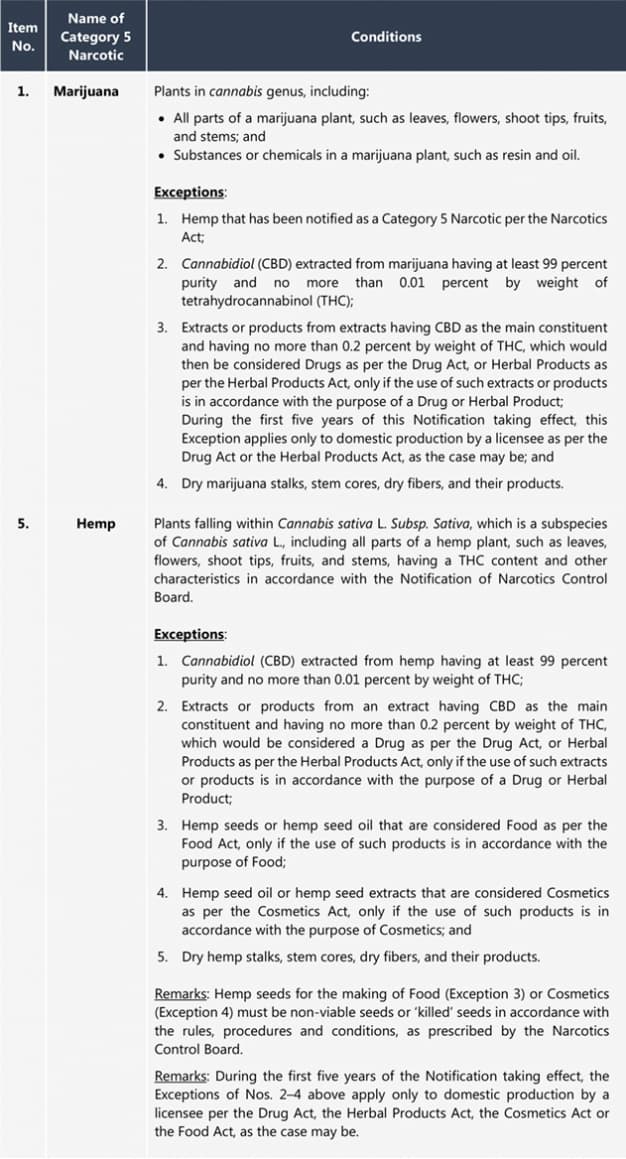
Remarks: The present MOPH Notification (2019) does not affect Items Nos. 2–4 on this list, which were prescribed by the previous MOPH Notification of 2018. Said unaffected items are:

No. 2:    Kratom (Mitragyna speciose);

No. 3:    Opium poppies (Papaver somniferum L. and Papaver bracteatum Lindl.); and

No. 4:    Psilocybin mushrooms.

Details about the above Nos. 2–4 are omitted from this update.

RELATED INSIGHTS​ 

September 9, 2026
On August 5, 2026, the Consumer Case Division of Thailand’s Civil Court rendered a judgment in a case involving a beauty clinic that advertised acne scar treatments using claims that the clinic was operated by a specialist physician and that the treatment, allegedly involving stem cell technology, could permanently remove acne scars. The plaintiff brought a claim against both the physician-owner and the clinic company, alleging that the advertisements were false and induced her to purchase the treatment. The court found that the clinic was liable for the false representations and that the physician-owner, as both the authorized director of the company and the medical practitioner who provided treatment, was jointly responsible. Although the plaintiff could not fully prove all damages claimed, the court awarded compensation of THB 20,000, together with interest. While the judgment arose from a consumer protection dispute, it serves as a valuable reminder that medical facility advertisements in Thailand are regulated and may expose clinics and healthcare providers not only to regulatory enforcement but also to civil liability from patients who rely on misleading promotional claims. Regulatory Framework Governing Medical Facility Advertisements Medical facility advertising in Thailand is governed by the Medical Facility Act B.E. 2541 (1998), as amended by the Medical Facility Act (No. 4) B.E. 2559 (2016). The principal secondary legislation is the Department of Health Service Support (DoHSS) Notification Re: Rules, Procedures, Conditions, and Fees for an Advertisement or Publication Concerning a Medical Facility, which came into force on November 25, 2019. Under this notification, “advertising” includes any act, by any means, that causes members of the public to see, hear, or otherwise become aware of a message, sound, or image for the commercial benefit of a medical facility. This broad definition covers not only traditional media but also clinic websites, social
September 9, 2026
On June 30, 2026, Indonesia’s National Agency of Drug and Food Control (BPOM) issued BPOM Regulation No. 11 of 2026 on Food Packaging, which expands the list of approved food-contact substances and recognizes a broader range of permissible functions for those substances. The new regulation, which revokes BPOM Regulation No. 20 of 2019, reflects developments in packaging technology and materials science. Although the new regulation provides more advantages to business actors by adding more food contact substances to the approved list for use in food packaging, there are more stringent rules and restrictions for testing. One of the most significant changes is a comprehensive migration-testing framework that sets out requirements for packaging materials, testing conditions, food simulants, and specific migration limits. Overall and Specific Migration Under BPOM Regulation No. 20 of 2019, migration requirements were primarily set out within the lists of approved food-contact substances and packaging materials. BPOM Regulation No. 11 of 2026 instead expressly requires packaging materials that come into direct contact with food to meet both overall and specific migration limits. These are defined as follows: Overall migration: The total quantity of all substances that migrate from the packaging, regardless of whether the substances are hazardous or nonhazardous to health. Specific migration: The quantity of a particular identified substance known to be hazardous to health that migrates from the packaging. Stricter Limits on Heavy Metals The overall migration limit for plastic packaging remains unchanged under both regulations at 60 mg/kg or 10 mg/dm². However, the new regulation introduces significant changes to the regulation of heavy metals. Under the 2019 regulation, four heavy metals—lead, cadmium, chromium VI, and mercury—were subject to a single combined limit of 1 mg/kg. The 2026 regulation, however, requires each heavy metal to meet its own individual specific migration limit, adds arsenic as
September 7, 2026
Indonesia’s Constitutional Court (Mahkamah Konstitusi) has reinstated a key provision limiting pharmaceutical patent protection, signaling a renewed commitment to balancing patent rights with public access to medicines. In its ruling to Case No. 255/PUU-XXIII/2025, the court partially granted a petition for judicial review of Law No. 65 of 2024, which had amended the country’s Patent Law, and ordered the restoration of a provision that had excluded certain pharmaceutical inventions from patentability. The decision took effect immediately upon its pronouncement at the court’s plenary session on August 28, 2026. Background The petition challenged the removal of article 4(f) from Law No. 13 of 2016 concerning Patents (Patent Law), as amended by Law No. 65 of 2024. Article 4(f) had excluded from patentability certain inventions relating to new uses of known substances. The petitioners argued that removing this provision would open the door to patent protection for second medical use inventions and facilitate patent evergreening—practices that can extend exclusivity periods, delay generic market entry, and reduce public access to affordable medicines. The petitioners included several patient advocacy and public-interest organizations: the Indonesian Dialysis Patients Community Association, the Indonesian Association of Drug Abuse Victims (PKNI), the Indonesian Pulmonary Hypertension Foundation (YHPI), the Rekat Peduli Indonesia Foundation, and the Indonesian Positive Women’s Association (IPPI), along with the Indonesia for Global Justice Association and four individual petitioners. The petitioners also challenged the constitutionality of the phrase “interested party” in article 70(1) of the Patent Law, arguing that it should be construed expressly to clarify who has standing to appeal a decision to grant a patent before the Board of Patent Appeal, and to allow a broader range of parties—such as patent holders, licensees, consumer organizations, prosecutors, aggrieved third parties, and others who may suffer direct or indirect harm from the grant of a patent—to
September 4, 2026
Blind boxes and collectibles have become increasingly popular, driven by the excitement of not knowing which character or design will be revealed until the package is opened. While most visible in the art toy market, the same concept is also used in the food industry. Confectionery, snacks, and other food products are sometimes sold with toys, character figures, cards, or other collectibles. A package might, for example, contain one of ten possible characters, with consumers knowing that an item is included but not which one they will receive. Some collections may also feature rare or “secret” items. For food businesses, however, adding a randomized toy or collectible involves more than a marketing decision. The food, the nonfood item, and the randomized mechanism may each raise different regulatory considerations in Thailand. Thai FDA Requirements for Nonfood Objects Packaged with Food The main food regulatory consideration is Ministry of Public Health Notification No. 310 B.E. 2551 (2008), which regulates food packaged together with things or objects that are not food. Under Notification No. 310, certain nonfood objects may be packaged together with food where they fall within specified exceptions, including objects that serve the following purposes: Maintaining the quality or standard of the food, such as a desiccant or oxygen absorber; Serving as a seasoning or as part of food preparation, such as chili powder sachets or seasoning sachets contained in instant noodle packages; or Functioning as an eating or food-preparation utensil, such as a spoon or fork included with instant noodles. Other nonfood objects that do not fall within these categories generally should not be placed inside the food container together with the food. Where a toy, collectible, or other nonfood object is intended to be sold together with a food product, businesses should therefore carefully consider the nature of