
You are using an outdated browser and your browsing experience will not be optimal. Please update to the latest version of Microsoft Edge, Google Chrome or Mozilla Firefox. Install Microsoft Edge

December 24, 2019

Vietnam’s Regional Minimum Wages to Increase

Taylor Vinters – International Employment Law Update

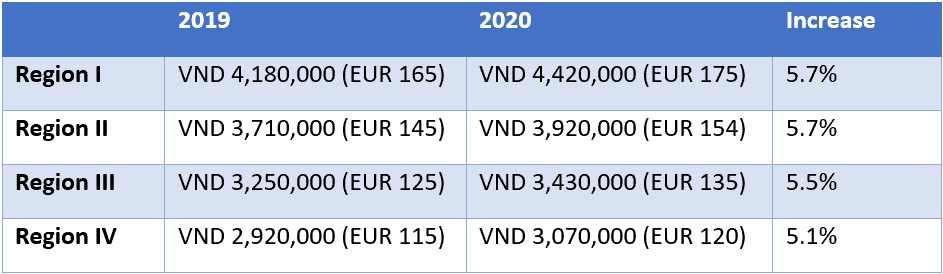
On January 1, 2020, region-based minimum wages for non-state employees in Vietnam will increase by an average of 5.5%. The increase was passed by Vietnam’s National Wage Council on July 11, 2019, and approved by the prime minister on November 17 of the same year.

As the cost of living varies dramatically throughout Vietnam, the government divides the country into four salary regions for the purpose of issuing minimum wages, reflecting the economic realities of the urban/rural divide and other developmental factors. The increase in the minimum wage for 2020 is summarised in the table below.

Monthly minimum wage by region:
  • Companies are not permitted to pay unskilled employees monthly wages which are lower than the relevant minimum wage. Wages paid to employees who have undergone vocational training should be at least 7% higher than the minimum salary, according to the country’s Ministry of Labor, Invalids and Social Affairs.Region I includes the urban and suburban districts of Hanoi and Hai Phong in the north, and the urban and suburban districts of Ho Chi Minh City and its neighboring provinces of Dong Nai, Binh Duong, and Ba Ria – Vung Tau in the south.
  • Region II includes the outskirts of Hanoi and Ho Chi Minh City, as well as other large and medium-sized cities throughout Vietnam, such as Da Nang, Nha Trang, and Can Tho.
  • Region III includes smaller provincial cities and suburban districts.
  • Region IV includes all remaining areas, including the least developed and sparsely populated rural and mountainous regions of Vietnam.

Comment

Employers with employees in each of the four regions mentioned above should be aware of these changes and ensure that they are complying with them by paying their employees the minimum wage for that region. Contract and payroll reviews are therefore recommended to ensure compliance.

RELATED INSIGHTS​ 

March 13, 2025
The recent freeze on US foreign aid has led to the suspension of billions of dollars in foreign assistance as well as widespread layoffs at contracting organizations around the world. Under this situation, USAID-funded offices in all jurisdictions, including Cambodia, may face the challenge of determining whether they need to lay off their employees. Employers in Cambodia may take different steps in response to this and other instances of sudden financial stress in order to manage their workforce in accordance with Cambodian laws and regulations. Suspension Cambodia’s Labor Law allows employers to suspend employment contracts due to a major economic or material issue or any unexpected difficulty that results in the suspension of operations. To impose this employment contract suspension, the employer must initially submit a suspension request to the Ministry of Labor and Vocational Training (MLVT), detailing the reasons for the requested suspension. If the reasons are deemed valid and the request is approved, the suspension period cannot exceed two months. During the suspension period, the employer must continue providing accommodation for employees if this benefit is already being provided. In some circumstances, the suspension period can be extended if necessary (as happened during the COVID-19 pandemic). However, financial difficulties alone may not be a valid reason for extension. The decision is at the discretion of the MLVT labor inspectors on a case-by-case basis. Therefore, given the uncertain timeline of financial difficulties that may significantly impact the employer’s budget, suspending employment contracts might be ineffective. Mass Layoffs Under Cambodia’s Labor Law, mass layoffs due to a significant reduction in an establishment’s operation or an internal reorganization foreseen by the employer are permissible. The layoff order must be based on professional qualifications, seniority period, and family burdens of the employees. The first employees to be laid off must be
February 25, 2025
On February 4, 2025, Thailand’s Board of Investment (BOI) issued Announcement No. Por. 3/2568, introducing updated qualifications, criteria, and conditions for long-term resident (LTR) visas. The updated requirements took effect immediately upon issuance of the announcement. The LTR program is intended to stimulate the economy and attract high-potential foreign nationals to Thailand, and these latest updates aim to expand access to a wider range of experts, investors, and executives to reinforce Thailand’s foreign talent pool and enhance its competitiveness. The recent updates primarily affect three categories under the LTR visa program: work-from-Thailand professionals, wealthy global citizens, and high-skilled professionals, as detailed below. Work-from-Thailand Professionals The updated LTR visa program includes some changes to the eligibility criteria for visa applicants in the work-from-Thailand professionals category: The revenue requirement for visa applicants’ employers is now USD 50 million over a three-year period, down from USD 150 million previously. Eligible foreign employers now include wholly owned subsidiaries of: companies listed on any stock exchange in any country; or private companies that have been in operation for at least three years and have generated a combined revenue of at least USD 50 million over the past three years. There are no longer work experience requirements. The other requirements remain the same. Wealthy Global Citizens For the wealthy global citizens category, the latest updates remove the requirement to have an annual personal income of USD 80,000, while the other criteria remain. Highly Skilled Professionals For the highly skilled professionals category, the latest updates expand eligibility to include lecturers in vocational or higher education, and remove work experience requirements. Other categories The updated LTR visa program does not introduce any changes for the wealthy pensioners category. However, the announcement does expand the scope of eligible dependents of LTR visa holders to cover parents and a
February 7, 2025
Vietnam’s political system is currently undergoing a significant reorganization to streamline government operations and improve efficiency. In this regard, Plan 141/KH-BCDTKNQ18, issued on December 6, 2024, provided guidelines on the restructuring of existing ministries, ministerial-level agencies, and government-affiliated agencies. Accordingly, the number of ministries is being reduced from 18 to 14 through mergers and consolidations and the establishment of a new Ministry of Ethnic and Religious Affairs. The number of ministerial-level agencies is being reduced to three, and government-affiliated agencies to five. Similar streamlining is happening at provincial levels. The newly consolidated state agencies will assume all functions, rights, and responsibilities of the merged entities, and will continue handling all ongoing matters previously handled by the former agencies. Some examples of these changes include the following: The Ministry of Science and Technology (MOST) will oversee telecommunications, IT applications, cybersecurity, e-transactions, and national digital transformation, which had previously been managed by the Ministry of Information and Communications (MIC). MOST will also be responsible for issuing licenses related to these areas, such as licenses for G1 online game services and telecommunication services. The Ministry of Culture, Sports, and Tourism will assume the responsibility of press management, previously under the MIC. The Ministry of Finance will assume state management functions related to investment, previously handled by the Ministry of Planning and Investment. Provincial Departments of Finance will issue Investment Registration Certificates and Enterprise Registration Certificates, a responsibility previously held by the Departments of Planning and Investment. The Ministry of Home Affairs will oversee labor and employment matters. Provincial Departments of Home Affairs will be authorized to issue work permits and will be the designated authorities for companies to register their internal labor regulations. Advantages for Businesses The restructuring aims to simplify regulations and expedite licensing processes. By reducing the number of agencies
January 2, 2025
On December 27, 2024, a new minimum daily wage rate in Thailand was published in the Government Gazette, taking effect on January 1, 2025. With these changes, the minimum daily wage in 2025 ranges from THB 337 to THB 400, up from the previous THB 330 to THB 370, depending on the province. For most provinces, these rates reflect an increase of THB 7 per day, except for the following provinces and districts, which have increases of THB 9–55 per day: Bangkok Chon Buri Hat Yai District in Songkhla Ko Samui District in Surat Thani Mueang Chiang Mai District in Chiang Mai Nakhon Pathom Nonthaburi Pathum Thani Phuket Rayong Samut Prakan Samut Sakhon The full table of minimum daily wage rates is below. For more details on the new minimum wages, or any aspect of labor and employment in Thailand, please contact Pimvimol (June) Vipamaneerut at [email protected], Ketnut Pukahuta at [email protected], Dusita Khanijou at [email protected], or Chomanut Arif at [email protected].