
You are using an outdated browser and your browsing experience will not be optimal. Please update to the latest version of Microsoft Edge, Google Chrome or Mozilla Firefox. Install Microsoft Edge

December 24, 2019

Vietnam’s Regional Minimum Wages to Increase

Taylor Vinters – International Employment Law Update

On January 1, 2020, region-based minimum wages for non-state employees in Vietnam will increase by an average of 5.5%. The increase was passed by Vietnam’s National Wage Council on July 11, 2019, and approved by the prime minister on November 17 of the same year.

As the cost of living varies dramatically throughout Vietnam, the government divides the country into four salary regions for the purpose of issuing minimum wages, reflecting the economic realities of the urban/rural divide and other developmental factors. The increase in the minimum wage for 2020 is summarised in the table below.

Monthly minimum wage by region:
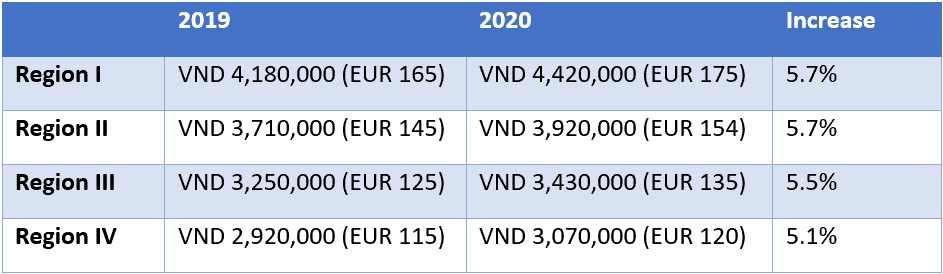
  • Companies are not permitted to pay unskilled employees monthly wages which are lower than the relevant minimum wage. Wages paid to employees who have undergone vocational training should be at least 7% higher than the minimum salary, according to the country’s Ministry of Labor, Invalids and Social Affairs.Region I includes the urban and suburban districts of Hanoi and Hai Phong in the north, and the urban and suburban districts of Ho Chi Minh City and its neighboring provinces of Dong Nai, Binh Duong, and Ba Ria – Vung Tau in the south.
  • Region II includes the outskirts of Hanoi and Ho Chi Minh City, as well as other large and medium-sized cities throughout Vietnam, such as Da Nang, Nha Trang, and Can Tho.
  • Region III includes smaller provincial cities and suburban districts.
  • Region IV includes all remaining areas, including the least developed and sparsely populated rural and mountainous regions of Vietnam.

Comment

Employers with employees in each of the four regions mentioned above should be aware of these changes and ensure that they are complying with them by paying their employees the minimum wage for that region. Contract and payroll reviews are therefore recommended to ensure compliance.

RELATED INSIGHTS​ 

December 27, 2024
Thailand has issued a series of regulations implementing the Employee Welfare Fund, which was established under the Labour Protection Act B.E. 2541 (1998) (LPA) but had remained unimplemented since the law’s enactment. The Employee Welfare Fund provides financial support to employees in cases such as termination of employment, death, and other circumstances as specified by the Employee Welfare Fund Committee. Under the LPA, employers with more than ten employees are required to register their employees with the Employee Welfare Fund if they do not offer employees a provident fund or comparable assistance for employment termination or death. With the new regulations detailed below, employers are now able to comply fully with this requirement. Implementation Timeline and Details On November 15, 2024, the Royal Decree Determining the Period for Starting the Collection of Savings and Contributions to the Employee Welfare Fund was officially enacted and published in the Government Gazette. According to this royal decree, contributions to the Employee Welfare Fund will commence on October 1, 2025. Two ministerial decrees followed on November 22, 2024—one setting the withholding and contribution rates, and the other outlining minimum levels of financial assistance due in cases of employment termination or death. The Ministerial Notification Specifying the Rate of Savings and Contributions stipulates the required rates for contributions to the Employee Welfare Fund and establishes a five-year initial period with reduced contribution rates. From October 1, 2025, to September 30, 2030, employers and employees are each required to contribute 0.25% of wages to the Employee Welfare Fund. Starting October 1, 2030, employers and employees will each be required to contribute 0.5% of wages. The Ministerial Notification Specifying Criteria and Procedures for Employers to Provide Assistance in Cases of Employment Termination or Death establishes the guidelines employers must follow when offering financial assistance to employees
December 9, 2024
Attorneys at Tilleke & Gibbins in Phnom Penh have contributed the Cambodia chapter to Labor and Employment Disputes 2024, a comprehensive guide from Lexology Panoramic to labor and employment dispute resolution in various jurisdictions around the world. The Cambodia chapter covers the following topics: Pre-action considerations: Key requirements, third-party funding, contingency fee arrangements Issuing a claim: Forum, territorial jurisdiction, standing, commencing claims, fees, service Defendants and legal personality: Types of claims, time limits, counterclaims Case management: Procedure, rules, amendments to claims, adding parties to proceedings, consolidating proceedings Class and collective actions: Special considerations Evidence: Witnesses, tactical considerations Interim relief: Availability, requirements Trial: Hearings conduct and typical time frames, confidentiality and public access, media reporting Elements of successful claims and burden of proof Alternative dispute resolution: Available types, requirements and expectations Enforcement: Collective employment and labor rights, enforcement of collective rights, standing Remedies and enforcement: Available remedies, assessing compensation, enforcement mechanisms Appeals: Appeal procedure and time frames, other means of challenge Update and trends: Recent cases and developments, technology developments, other issues The Cambodia chapter was authored by associates Mealtey Oeurn, Saryda Ou, Chanvisal Lok; and Jay Cohen, partner and director of the firm’s operations in Cambodia. Tilleke & Gibbins also contributed the Vietnam and Thailand chapters to Labor and Employment Disputes 2024. The full Cambodia chapter is available below as a PDF.
December 4, 2024
Thailand Legal Basics, a valuable primer for foreign investors, explores all aspects of living and doing business in Thailand. Written by specialists at Tilleke & Gibbins in Bangkok, it is the only comprehensive English-language guide to the Thai legal system with a focus on the concerns of foreign business and investment.
October 1, 2024
Three of Tilleke & Gibbins’ labor and employment specialists in Vietnam have contributed the Vietnam chapter to the newly issued Labor and Employment Disputes 2024, a comprehensive guide from Lexology Panoramic to labor and employment dispute resolution in various jurisdictions around the world. The Vietnam chapter covers the following topics: Pre-action considerations: Key requirements, third-party funding, contingency fee arrangements Issuing a claim: Forum, territorial jurisdiction, standing, commencing claims, fees, service Defendants and legal personality: Types of claims, time limits, counterclaims Case management: Procedure, rules, amendments to claims, adding parties to proceedings, consolidating proceedings Class and collective actions: Special considerations Evidence: Witnesses, tactical considerations Interim relief: Availability, requirements Trial: Hearings conduct and typical time frames, confidentiality and public access, media reporting Elements of successful claims and burden of proof Alternative dispute resolution: Available types, requirements and expectations Enforcement: Collective employment and labor rights, enforcement of collective rights, standing Remedies and enforcement: Available remedies, assessing compensation, enforcement mechanisms Appeals: Appeal procedure and time frames, other means of challenge Update and trends: Recent cases and developments, technology developments, other issues The Vietnam chapter was authored by Truc Thi Thanh, Linh Ngoc Nguyen, and Kien Trung Trinh. Tilleke & Gibbins also contributed the Cambodia and Thailand chapters to Labor and Employment Disputes 2024.