
You are using an outdated browser and your browsing experience will not be optimal. Please update to the latest version of Microsoft Edge, Google Chrome or Mozilla Firefox. Install Microsoft Edge

December 24, 2019

Vietnam’s Regional Minimum Wages to Increase

Taylor Vinters – International Employment Law Update

On January 1, 2020, region-based minimum wages for non-state employees in Vietnam will increase by an average of 5.5%. The increase was passed by Vietnam’s National Wage Council on July 11, 2019, and approved by the prime minister on November 17 of the same year.

As the cost of living varies dramatically throughout Vietnam, the government divides the country into four salary regions for the purpose of issuing minimum wages, reflecting the economic realities of the urban/rural divide and other developmental factors. The increase in the minimum wage for 2020 is summarised in the table below.

Monthly minimum wage by region:
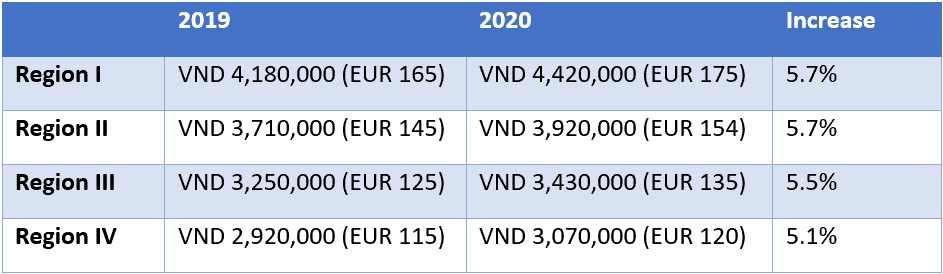
  • Companies are not permitted to pay unskilled employees monthly wages which are lower than the relevant minimum wage. Wages paid to employees who have undergone vocational training should be at least 7% higher than the minimum salary, according to the country’s Ministry of Labor, Invalids and Social Affairs.Region I includes the urban and suburban districts of Hanoi and Hai Phong in the north, and the urban and suburban districts of Ho Chi Minh City and its neighboring provinces of Dong Nai, Binh Duong, and Ba Ria – Vung Tau in the south.
  • Region II includes the outskirts of Hanoi and Ho Chi Minh City, as well as other large and medium-sized cities throughout Vietnam, such as Da Nang, Nha Trang, and Can Tho.
  • Region III includes smaller provincial cities and suburban districts.
  • Region IV includes all remaining areas, including the least developed and sparsely populated rural and mountainous regions of Vietnam.

Comment

Employers with employees in each of the four regions mentioned above should be aware of these changes and ensure that they are complying with them by paying their employees the minimum wage for that region. Contract and payroll reviews are therefore recommended to ensure compliance.

RELATED INSIGHTS​ 

May 9, 2025
On May 6, 2025, Cambodia’s Ministry of Labour and Vocational Training (MLVT) issued Prakas No. 113/25, introducing new obligations for enterprise owners and directors regarding the use and maintenance of enterprise payroll books. Under this prakas, enterprise owners or directors are required to: Utilize and maintain the enterprise payroll book in accordance with the official template provided by the MLVT. Make the enterprise payroll book available to labor inspectors for annotations related to compliance with labor laws and regulations. Review and adjust (if necessary) internal practices based on any findings, recommendations, and restrictions issued by labor inspectors during inspections. The official enterprise payroll book template can be downloaded via the ministry’s Labor Automated Central Management System (LACMS). Additional requirements include: Retention of supporting documents related to the payroll book at the enterprise’s head office to facilitate inspections. Preservation of completed payroll books for a minimum of three years after their closure. Downloading a new payroll book from the LACMS once the current one is fully used. Labor inspectors are authorized to conduct inspections of the payroll book and related documentation at any time. Noncompliance with the provisions of Prakas No. 113/25 may result in significant monetary penalties, as stipulated in Cambodia’s Labour Law. This prakas also repeals Prakas No. 268, dated October 11, 2001, and any provisions in related regulations that conflict with Prakas No. 113/25. All enterprises are strongly advised to comply with the new requirements and begin using the updated enterprise payroll book template from the LACMS to avoid potential penalties.
May 2, 2025
Attorneys from Tilleke & Gibbins have updated the latest edition of Doing Business in Thailand, a Q&A-style guide from Thomson Reuters Practical Law that offers an overview of key legal considerations for companies operating in jurisdictions worldwide. The contribution outlines the country’s legal and regulatory framework for foreign investment and business operations and reflects the latest legislative developments. The chapter addresses the following core topics: Legal system: Structure of the courts and the codified nature of Thai law. Foreign investment: Business restrictions under the Foreign Business Act, sector-specific regulations, exchange control rules, and investment incentives. Business vehicles: Overview of partnerships, private and public limited companies, and other legal entities. Employment: Labor protections, employment contracts, foreign worker requirements, and termination procedures. Tax: Corporate and personal income tax, indirect taxes, and tax obligations for residents and non-residents. Intellectual property: Registration and enforcement of patents, trademarks, designs, and copyrights. Data protection: Key provisions of the Personal Data Protection Act and related compliance obligations. Competition law: Regulatory framework under the Trade Competition Act. Anti-bribery and corruption: Relevant legislation and enforcement mechanisms. E-commerce and digital business: Legal regime for online transactions and digital platforms. Marketing and advertising: Consumer protection laws and regulations affecting advertising and marketing practices. Product regulation and liability: Safety standards, liability regimes, and roles of enforcement authorities. Practical Law, a legal reference resource from Thomson Reuters, publishes a range of guides for hundreds of jurisdictions and practice areas. The insurance and reinsurance guide is a valuable resource for legal practitioners, covering numerous jurisdictions worldwide. To view the latest version of the guide, please visit the Practical Law website and enroll in the free Practical Law trial to gain full access.
April 22, 2025
Thailand’s Immigration Bureau has announced the launch of the Thailand Digital Arrival Card (TDAC) as part of ongoing efforts to improve entry procedures and streamline immigration processing. Effective May 1, 2025, all foreign nationals with any type of visa entering Thailand by any means will be required to complete the TDAC online prior to arrival. This requirement does not apply to individuals transiting or transferring through Thailand without passing through immigration control, or to those entering with a border pass. Foreign nationals planning to enter Thailand must complete and submit their TDAC within the three days prior to their arrival date. The form, which collects passport information, personal details, travel information (e.g., flight number), Thai accommodation information, and a health declaration—can be filled out in English online at https://tdac.immigration.go.th. Once the form is submitted, an acknowledgment will be sent to the email address entered on the form. This acknowledgment must be presented at the immigration checkpoint in Thailand along with travel documents for verification. The Thai government strongly encourages all foreign passport holders to complete the TDAC ahead of their departure to prevent any entry delays or issues at the checkpoint.
April 18, 2025
On March 31, 2025, Cambodia’s Ministry of Labour and Vocational Training (MLVT) issued Notification 009/25, which grants an extension for the renewal of foreign workers’ work permits and employment books in 2025. This extension is to ensure that those who have not yet applied for the renewal of their work permits are provided with sufficient time to complete the application process, as there have been delays in the submission of work permit extension requests. The new deadline for the submission of renewal applications for work permits and employment books is April 30, 2025. Applications and renewals must be processed via the MLVT’s online Foreign Workforce Centralized Management System before the specified deadline. Failure to extend the validity of work permits and employment books for foreign workers before the deadline may result in significant monetary penalties for both employers and foreign nationals. All foreign workers should renew their work permits and employment books within the extended deadline to ensure continued validity for working in Cambodia.