You are using an outdated browser and your browsing experience will not be optimal. Please update to the latest version of Microsoft Edge, Google Chrome or Mozilla Firefox. Install Microsoft Edge

May 19, 2023

Vietnam Approves New Power Development Plan

On May 15, 2023, Vietnam’s Deputy Prime Minister Tran Hong Ha signed Decision No. 500 of the Prime Minister approving the National Power Development Plan for the period 2021-2030, with a vision to 2050 (“PDP VIII”), following extensive public consultations and multiple rounds of review since the first draft version was circulated in 2021. The plan was approved in the context that in the past few years, a number of large power projects have been behind schedule for operation, while new projects have not been able to be implemented due to waiting for additional planning.

PDP VIII is the master plan for the development of the power source and transmission grid at 220kV or higher; services in renewable energy and new energy in Vietnam; and works connecting the power grids of Vietnam and neighboring countries.

We set out below some quick updates regarding PDP VIII.

1. Development Targets

Key development targets are summarized in the table below:
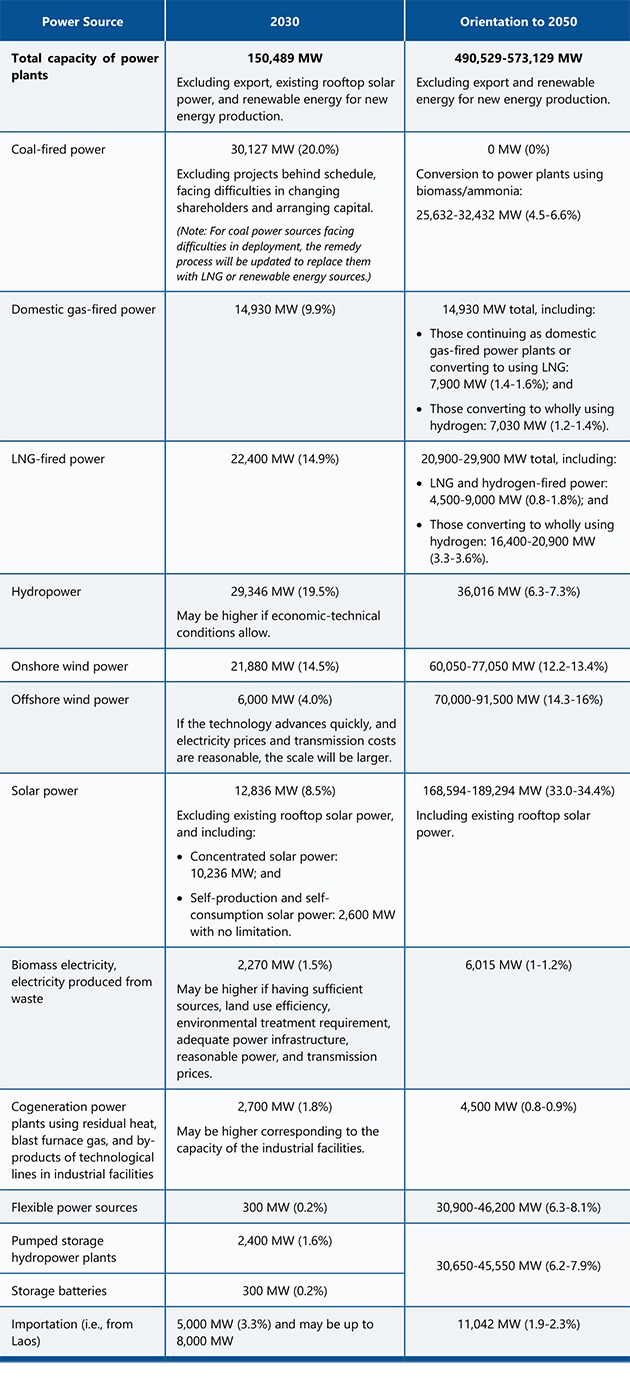
Investors in coal, domestic gas, and LNG projects may need to have a conversion plan ready given the 2050 targets to convert to other sources of energy.

2. Solar Projects

A list of 27 solar power projects that were planned for the period of 2021-2030 but which have not been assigned to investors are not allowed to be deployed but can be considered after 2030, except in the case of deployment in the form of self-production and self-consumption (Appendix IV). These projects represent 4,136.25 MW of capacity that will be left on the sidelines until 2030.

3. Hydropower Projects

A list of 14 potential hydropower projects can be considered if economic and technical conditions allow for more hydropower development (Appendix III). These projects represent 1,244 MW of capacity that can be added to the hydropower targets for 2030.

4. Projects Prioritized for Investment

Certain important projects will be prioritized for investment (Appendix II), including:

  • 13 LNG-fired power projects are expected to be completed by 2030, and two projects by 2035.
  • Six coal-fired power projects are expected to be completed by 2030.
  • Five coal-fired power projects are behind schedule, facing difficulties in changing shareholders and arranging capital. These projects are expected to be completed by 2030.
  • Four cogeneration power sources and power sources using residual heat, blast furnace gas, and by-products of technological lines in industrial facilities are expected to be completed by 2030, and three projects by 2035.
  • 10 domestic gas-fired power projects are expected to be completed by 2030.
  • 25 medium and large hydropower sources are expected to be completed by 2030.
  • Two pumped storage hydropower plants are expected to be completed by 2030, and two plants by 2035.

5. Electricity Importation

Vietnam will build out 500kV and 220kV transmission lines connecting to Laos to import electricity from power plants in Laos according to the memorandum of understanding signed between the two governments.

6. Total Investment Capital

For the period 2021-2030, the total investment capital for power sources and grid systems is targeted to be USD 134.7 billion, in which investment capital for power sources will be USD 119.8 billion (averaging USD 12 billion per year), and for grid systems will be USD 14.9 billion (averaging USD 1.5 billion per year).

For the period 2031-2050, the total investment capital for power sources and grid systems is targeted to be USD 399.2-523.1 billion, in which investment capital for power sources will be USD 364.4-511.2 billion (averaging USD 18.2-24.2 billion per year), and for grid systems will be USD 34.8-38.6 billion (averaging USD 1.7-1.9 billion per year).

7. Next Steps

The Ministry of Industry and Trade will submit the Implementation Plan for PDP VIII to the Prime Minister in June 2023 and formulate and submit to the government the amended Law on Electricity and the new Law on Renewable Energy for submission to the National Assembly in 2024. PDP VIII also specifies that a direct power purchase agreement (DPPA) pilot program will be issued but is silent on the timeline.

For more details on PDP VIII, or on any aspect relating to Vietnam’s energy sector, please contact Tram Ngoc Bich Nguyen at [email protected], Duong Duy Nguyen at [email protected], or Duc Minh Pham at [email protected].

RELATED INSIGHTS​ 

April 10, 2025
On March 3, 2025, the government of Vietnam issued Decree No. 57/2025/ND-CP, regulating the direct power purchase agreement (DPPA) mechanism between renewable energy generators and large electricity consumers (“Decree 57”). Decree 57 took immediate effect and replaces Decree No. 80/2024/ND-CP on the same subject. The new regulations enable investors to kickstart their investment plans for DPPAs in Vietnam. Below are the key changes and provisions of Decree 57. Participants in On-Grid DPPAs Decree 57 expands the eligibility criteria for participating in DPPAs via the national grid (on-grid DPPAs): Sellers: In addition to wind and solar power generators, biomass energy generators with a capacity of 10 MW or more can now participate. Buyers: Electric vehicle charging businesses are now eligible to participate, broadening the scope beyond just production businesses. Large Electricity Consumers Instead of setting definite criteria at the government decree level, Decree 57 defines large electricity consumers based on average electricity consumption as set out in wholesale electricity market regulations to be issued by the Ministry of Industry and Trade (MOIT). Although the threshold for DPPA participation remains for now at 200,000 kWh per month, Decree 57 will allow the MOIT to adjust this threshold as deemed necessary. Decree 57 also provides specific guidance for large electricity consumers based on their consumption period. To participate in both private off-grid DPPA (selling electricity directly via a grid system separate from the national grid) and on-grid DPPA models, large electricity consumers must meet the minimum threshold for electricity consumption set by the MOIT under the Vietnam wholesale electricity market regulations (“Minimum Consumption Threshold”). Consumers with a consumption history of at least 12 months must have already met the Minimum Consumption Threshold at the time of registration or notification, while those whose consumption period is less than 12 months must commit to
March 21, 2025
Thailand is continuing on its path toward comprehensive legislation to address climate change. In November 2024, the country’s Ministry of Natural Resources and Environment (MNRE) launched a public hearing on a new draft Climate Change Act following revisions made after an earlier hearing on a previous draft of the act. The revised version strengthens Thailand’s climate policy framework by introducing the Carbon Border Adjustment Mechanism (CBAM), modeled after the EU’s system of the same name. The new draft also restructures the planned Emissions Trading Scheme (ETS) and enhances carbon-tax provisions. These initiatives aim to minimize carbon leakage, promote fair competition for domestic industries, and encourage lower greenhouse gas (GHG) emissions. As of March 2025, the Department of Climate Change and Environment, under the MNRE, is awaiting the Ministry of Finance’s input on the draft act’s establishment of the Climate Fund, a fund to support business innovation in responding to climate change. After incorporating this feedback, the department will submit the refined draft for cabinet approval, expected in 2025. The legislation will then undergo Council of State review, with implementation expected in 2026. Key Provisions The draft Climate Change Act contains a number of provisions that will affect businesses. Some of the most relevant are discussed below. Mandatory ETS The ETS is a mandatory mechanism designed to control GHG emissions by setting emissions caps for designated industries in alignment with national targets. Under this system, businesses receive emissions allowances allocated through free allocation or auctions. This scheme incentivizes emissions reductions by allowing businesses that emit less than their allocated allowances to sell their surplus allowances. The specific business sectors covered by the ETS have not yet been identified in the draft act, as details are expected to be in subordinate legislation. However, it is anticipated that the sectors will align
March 11, 2025
The Vietnamese government is in the process of amending the Law on Atomic Energy, originally issued in 2008, to harmonize with several newly enacted laws, establish a comprehensive regulatory framework governing nuclear energy in Vietnam, and serve as a legal basis to foster the implementation of ongoing and future nuclear projects in the country. The Ministry of Science and Technology has been assigned to lead the drafting of the amended Law on Atomic Energy. The second draft of the amended law (the “Draft”) was released in late February 2025 for public consultation to gather feedback from the community and stakeholders. Key Points The Draft introduces new regulations to ensure high standards of safe and secure use of nuclear materials, radioactive sources, medical and industrial irradiation, mining and processing of radioactive ores, and radioactive waste management, as well as requirements for enhancing capacity to prepare for and respond to radiation incidents and nuclear incidents. In addition, the Draft emphasizes environmental protection, public health in nuclear energy projects, and support for development and advancing nuclear technology capabilities in Vietnam together with enhancing international cooperation in this field. Below are some key points of the Draft: Approval and licensing requirements for nuclear facilities: The Draft requires investors or owners of nuclear facilities to obtain several permits and approvals as regulated by the government before implementation of construction or operation. Reporting obligations: In addition to periodic reports on operations, safety measures, and compliance with regulations, nuclear facilities are required to make, maintain, and update a number of their regular records related to radiation and nuclear safety for ad hoc reports when required by the competent authorities. In this respect, any incidents or deviations from standard procedures must be reported immediately to the relevant authorities. Training and certification: Personnel working in nuclear facilities as
February 21, 2025
As Vietnam continues its government restructuring, including the merging of several key ministries, the country is signaling that mergers of provinces could be next. Conclusion 126-KL/TW of the Politburo and Secretariat, issued on February 14, 2025, sets out several tasks for continuing to streamline the political system in 2025, notably including, among others, the following: Elimination of intermediate administrative levels, and mergers of provincial units: The Government Party Committee is tasked with researching and planning for the elimination of intermediate administrative levels (district levels); reorganizing the commune level with structures, functions, duties, powers, and responsibilities aligned with the new organizational model; and proposing the merging of some provincial administrative units. A report to the Politburo is required by Q3 2025. Reorganization of police structure: The Central Public Security Party Committee is tasked with leading and coordinating the implementation of a three-tier police organization, eliminating the district-level police. Judicial system reforms: The Central Party Committees of the Supreme People’s Court and the Supreme People’s Procuracy are tasked with researching and advising on the organizational model for courts and procuracies, and proposing amendments and supplements to relevant party mechanisms and state laws, with the aim of eliminating the district level. A report to the Politburo is required by Q2 2025. Implications of Merging Provinces The merging of provinces could bring positive impacts as well as new challenges. The expected benefits include: Administrative efficiency and cost saving: Reducing the number of administrative units could lead to more efficient governance and decision-making processes, as well as lower administrative costs due to fewer government offices and personnel. Economic development: Larger administrative areas can benefit from better allocation of resources and infrastructure development. Larger provinces may also attract more investment due to increased economic potential and market size. Improved service delivery: Public services could improve