You are using an outdated browser and your browsing experience will not be optimal. Please update to the latest version of Microsoft Edge, Google Chrome or Mozilla Firefox. Install Microsoft Edge

May 19, 2023

Vietnam Approves New Power Development Plan

On May 15, 2023, Vietnam’s Deputy Prime Minister Tran Hong Ha signed Decision No. 500 of the Prime Minister approving the National Power Development Plan for the period 2021-2030, with a vision to 2050 (“PDP VIII”), following extensive public consultations and multiple rounds of review since the first draft version was circulated in 2021. The plan was approved in the context that in the past few years, a number of large power projects have been behind schedule for operation, while new projects have not been able to be implemented due to waiting for additional planning.

PDP VIII is the master plan for the development of the power source and transmission grid at 220kV or higher; services in renewable energy and new energy in Vietnam; and works connecting the power grids of Vietnam and neighboring countries.

We set out below some quick updates regarding PDP VIII.

1. Development Targets

Key development targets are summarized in the table below:
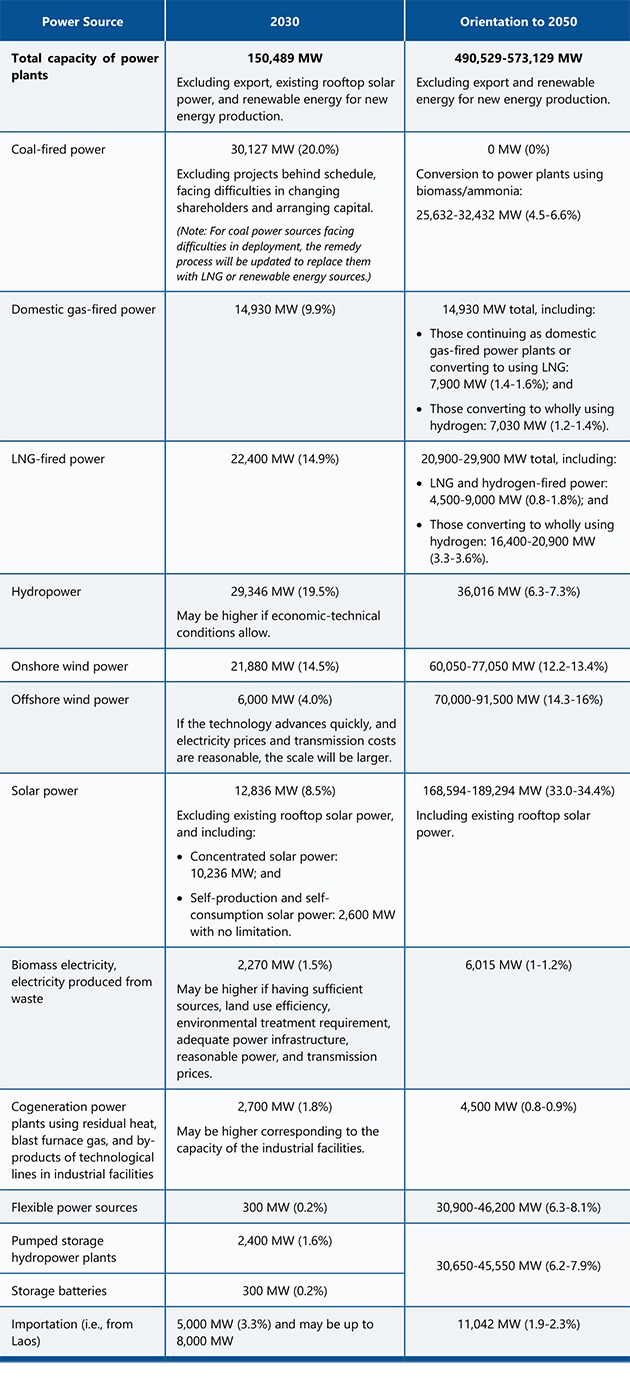
Investors in coal, domestic gas, and LNG projects may need to have a conversion plan ready given the 2050 targets to convert to other sources of energy.

2. Solar Projects

A list of 27 solar power projects that were planned for the period of 2021-2030 but which have not been assigned to investors are not allowed to be deployed but can be considered after 2030, except in the case of deployment in the form of self-production and self-consumption (Appendix IV). These projects represent 4,136.25 MW of capacity that will be left on the sidelines until 2030.

3. Hydropower Projects

A list of 14 potential hydropower projects can be considered if economic and technical conditions allow for more hydropower development (Appendix III). These projects represent 1,244 MW of capacity that can be added to the hydropower targets for 2030.

4. Projects Prioritized for Investment

Certain important projects will be prioritized for investment (Appendix II), including:

  • 13 LNG-fired power projects are expected to be completed by 2030, and two projects by 2035.
  • Six coal-fired power projects are expected to be completed by 2030.
  • Five coal-fired power projects are behind schedule, facing difficulties in changing shareholders and arranging capital. These projects are expected to be completed by 2030.
  • Four cogeneration power sources and power sources using residual heat, blast furnace gas, and by-products of technological lines in industrial facilities are expected to be completed by 2030, and three projects by 2035.
  • 10 domestic gas-fired power projects are expected to be completed by 2030.
  • 25 medium and large hydropower sources are expected to be completed by 2030.
  • Two pumped storage hydropower plants are expected to be completed by 2030, and two plants by 2035.

5. Electricity Importation

Vietnam will build out 500kV and 220kV transmission lines connecting to Laos to import electricity from power plants in Laos according to the memorandum of understanding signed between the two governments.

6. Total Investment Capital

For the period 2021-2030, the total investment capital for power sources and grid systems is targeted to be USD 134.7 billion, in which investment capital for power sources will be USD 119.8 billion (averaging USD 12 billion per year), and for grid systems will be USD 14.9 billion (averaging USD 1.5 billion per year).

For the period 2031-2050, the total investment capital for power sources and grid systems is targeted to be USD 399.2-523.1 billion, in which investment capital for power sources will be USD 364.4-511.2 billion (averaging USD 18.2-24.2 billion per year), and for grid systems will be USD 34.8-38.6 billion (averaging USD 1.7-1.9 billion per year).

7. Next Steps

The Ministry of Industry and Trade will submit the Implementation Plan for PDP VIII to the Prime Minister in June 2023 and formulate and submit to the government the amended Law on Electricity and the new Law on Renewable Energy for submission to the National Assembly in 2024. PDP VIII also specifies that a direct power purchase agreement (DPPA) pilot program will be issued but is silent on the timeline.

For more details on PDP VIII, or on any aspect relating to Vietnam’s energy sector, please contact Tram Ngoc Bich Nguyen at [email protected], Duong Duy Nguyen at [email protected], or Duc Minh Pham at [email protected].

RELATED INSIGHTS​ 

February 11, 2025
On January 24, 2025, the prime minister of Vietnam issued Decision No. 232/QD-TTg, approving the proposal for establishment and development of a carbon market in Vietnam. The decision establishes a compliance mechanism for greenhouse gas (GHG) emitters and creates opportunities for investors interested in carbon trading in Vietnam. Market Development Roadmap Decision 232 establishes a phased approach to developing Vietnam’s carbon market, with the following ambitious milestones: Before June 2025 (preparation period): The legal framework for trading of emissions quotas and carbon credits and a carbon-credit offset exchange mechanism will be developed, along with the necessary infrastructure for organization and operation of the carbon-credit market. From June 2025 to the end of December 2028 (pilot period): A pilot domestic carbon exchange will be launched, with continued legal refinements. From 2029 (official launch period): The carbon market will be fully operational. Carbon Market Structure and Trading Mechanisms Vietnam’s carbon market will function as a centralized, government-regulated exchange, trading two main assets: GHG emissions quotas (allowances) allocated to regulated emitters, which can be traded or auctioned; and Carbon credits generated from domestic and international projects that are certified for trading. The carbon credits generated from international projects include those originating from international exchange or offset-crediting mechanisms such as the Clean Development Mechanism (CDM), the Joint Credit Mechanism (JCM), and Article 6 of the Paris Agreement. The National Registration System for GHG emissions quotas and carbon credits will be primarily developed and operated by the Ministry of Natural Resources and Environment. Transactions of GHG emissions quotas and carbon credits will occur on the domestic carbon exchange, managed by the Hanoi Stock Exchange, and will follow a centralized process where verified quotas and credits receive unique domestic codes for trading and participants must have depository accounts. The Vietnam Securities Depository and Clearing Corporation
January 27, 2025
Thailand’s Ministry of Energy (MOE) has announced the launch of the 25th bidding round for petroleum exploration and production. This round offers nine greenfield onshore blocks—seven in northeastern Thailand and two in central Thailand—encompassing over 33,000 km². The bids can be submitted from July 1 to July 16, 2025. The sizes and locations of these blocks are: Northeast Thailand Block L1/66: 3,223.51 km² (Khon Kaen, Nong Bua Lam Phu, Udon Thani) Block L2/66: 3,917.03 km² (Kalasin, Sakon Nakhon, Udon Thani) Block L3/66: 3,918.22 km² (Kalasin, Khon Kaen, Maha Sarakham, Udon Thani) Block L4/66: 3,656.65 km² (Amnat Charoen, Mukdahan, Nakhon Phanom, Yasothon) Block L5/66: 3,436.01 km² (Chaiyaphum, Khon Kaen, Nakhon Ratchasima) Block L7/66: 3,438.51 km² (Buri Ram, Maha Sarakham, Nakhon Ratchasima, Roi Et, Surin, Khon Kaen) Block L9/66: 3,885.44 km² (Nakhon Ratchasima) Central Thailand Block L6/66: 3,966.86 km² (Chaiyaphum, Lop Buri, Phetchabun) Block L8/66: 3,957.41 km² (Kanchanaburi, Nakhon Pathom, Ratchaburi, Suphan Buri) Bidding Process Interested companies must submit their bids to the Department of Mineral Fuels (DMF) between July 1 and July 16, 2025. Bids should include: Application form (ChorThor/Por1) Proof of eligibility: Corporate documentation, audited financial statements, and proof of resources Technical and commercial proposals: Exploration plans, geological surveys, financial and work commitments, and special benefits such as signing bonuses of at least USD 100,000. There is a nonrefundable THB 50,000 application fee per block, and applicants must provide a bid bond of THB 3 million per block via an unconditional bank guarantee from a commercial bank with branches in Thailand, valid for at least one year from the bidding submission date. The guarantee will be returned to unsuccessful bidders upon request and to successful bidders upon the signing of the concession agreement. Eligibility Bidders must meet the following main eligibility criteria: Bidders must be limited companies with the following qualifications: The company must have the objective of
January 23, 2025
In 2023, compliance inspections by Vietnam’s Government Inspectorate identified several violations of policies and laws in the management and implementation of planning and investment in renewable energy projects. Since then, many renewable energy enterprises and projects have encountered significant operational challenges. In December 2024, the Ministry of Industry and Trade (MOIT) issued two reports, Report 321/BC-BCT and Report 345/BC-BCT, to implement the 2023 Inspection Conclusion of the Government Inspectorate and address obstacles faced by renewable energy enterprises, Investors in renewable energy projects in Vietnam should carefully consider the potential impacts of proposed solutions in these reports. The reports re-emphasize the types of violations related to renewable energy projects identified in the Inspection Conclusion, with a significant expansion in the number of affected projects. Key violations include: (i) misapplication of FIT (feed-in tariff) incentives; (ii) recognition of COD (commercial operation date) and receipt of FIT prices without written approval of construction acceptance; (iii) overlap with mineral planning, irrigation planning, national defense land use, or other restricted land uses; (iv) incomplete land procedures and documentation; and (v) installation of rooftop solar on agricultural and forestry land used for farming and aquaculture models. Further, these reports mention the government’s solutions to resolve difficulties for renewable energy projects, which include: Allowing additional planning where projects do not violate national security. Allowing rectification of projects’ violations in land and construction process as per law. For projects violating planning on minerals, irrigation, or defense, socio-economic efficiency will be assessed for adjustments or integration. Adjusting electricity prices and recovering incorrect FIT prices for projects not meeting conditions. Requiring rooftop solar projects on non-farming land to comply with regulations or, if land violations occur, FIT prices will be revoked, and electricity prices must be redetermined and recovered. For items (iv) and (v), the authority will issue regulations
January 14, 2025
Thailand’s Department of Industrial Works (DIW) has issued a new regulation (Ministerial Regulation Re: Designation of Type, Kind, and Size of Factories (No. 3) B.E. 2567 (2024)), which removes the factory license requirement for electricity generation from solar energy installations on rooftops, roof decks, or any part of a building used for residential or other purposes, regardless of capacity. The new rules took effect on December 28, 2024. Under the previous regulations, solar rooftop installations had to seek approval from the DIW if their capacity exceeded 1,000 kW (1 MW), which added time and administrative costs when adopting renewable energy solutions. Benefits and Further Compliance The updated regulation benefits industrial operators by facilitating faster installation times and lower costs, as solar rooftops can now be installed without the need for prior approval of a factory license from the DIW. Operators can now more easily contribute to environmental sustainability and carbon reduction efforts. Despite the lifting of the factory licensing requirement, other compliance obligations, such as an energy business license (or exemption from an energy business license), a controlled energy production license, and a construction permit, may still apply. Reason for the Change Removing the classification of rooftop or building-installed solar power plants as factories aligns with Thailand’s renewable energy goals and reduces regulatory burdens for industrial operators. Additionally, it supports the achievement of energy policies aligned with the UN’s Sustainable Development Goals and Thailand’s international commitments to reduce greenhouse gas emissions through the participation of all sectors. For further details on how this change affects business operations or to explore strategies for renewable energy implementation, please contact Supasit Boonsanong at [email protected], Charuwan Charoonchitsathian at [email protected], or Phareeya Yongpanich at [email protected].