You are using an outdated browser and your browsing experience will not be optimal. Please update to the latest version of Microsoft Edge, Google Chrome or Mozilla Firefox. Install Microsoft Edge

December 31, 2021

VAT Reduced to 7% under Amendments to Lao Tax Laws

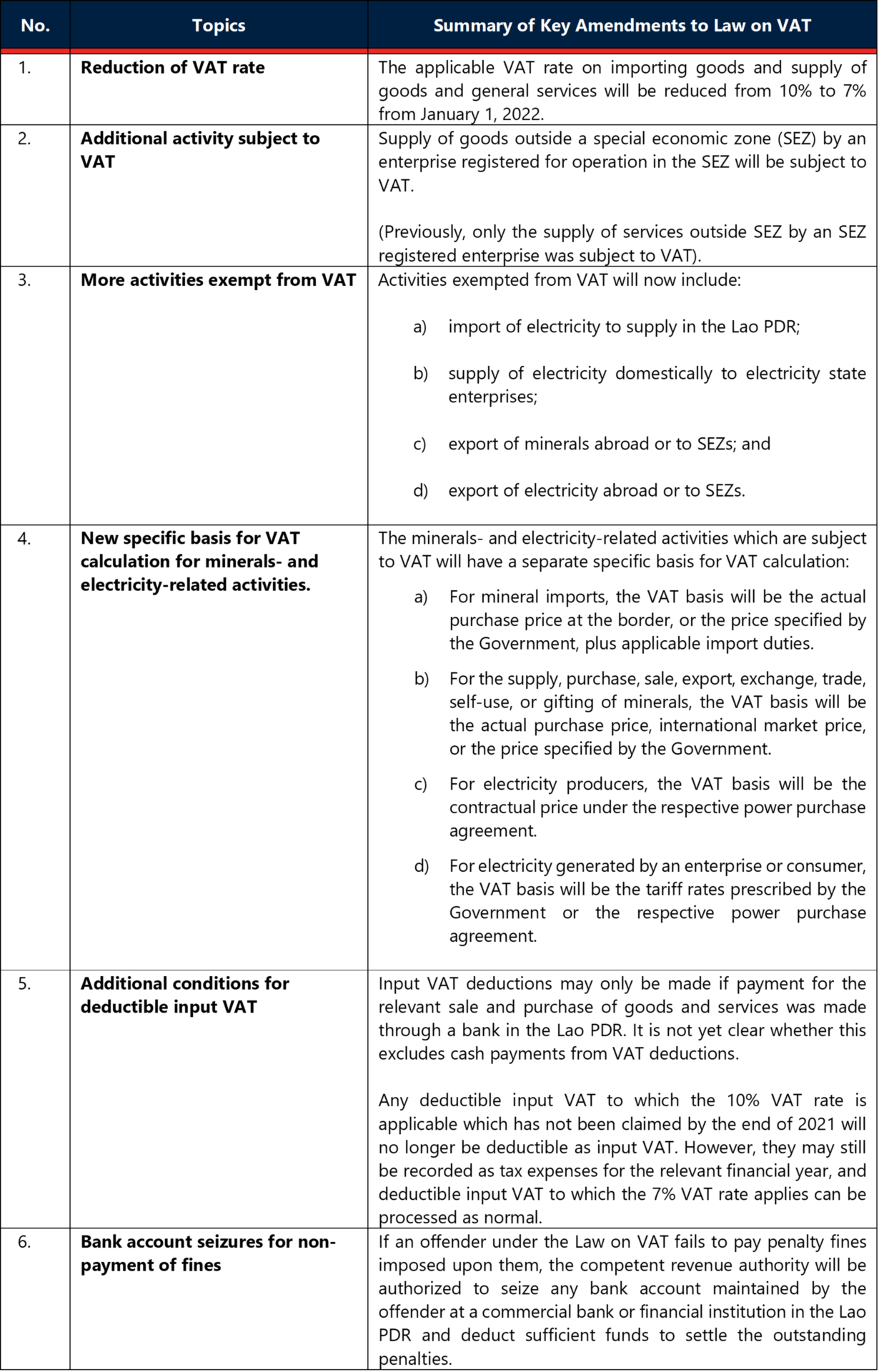
In the last week of December, 2021, the Ministry of Justice published the Law Amending Certain Provisions of the Laws on Tax No. 01/NA, dated August 7, 2021, in the Government Gazette. The Law will come into force on January 1, 2022.

The most notable amendments relate to Value Added Tax (VAT), which are summarized below.

The new law also makes changes to the laws on tax management, income tax, and excise tax, which Tilleke & Gibbins will provide updates on in due course.

RELATED INSIGHTS​ 

April 10, 2025
After making revisions to the initial draft notification released in November 2024, Thailand’s Electronic Transactions Development Agency (ETDA) has released an updated draft Notification on Additional Obligations for Digital Platform Service Operators of Online Marketplaces for Goods with Specific Characteristics under Section 18(2) of the Royal Decree on the Operation of Digital Platform Service Businesses Subject to Prior Notification B.E. 2565 (2022) B.E. … . A focus group session was also held to gather feedback from business operators. Below is a summary of key provisions in the new draft. Unchanged Items Some key concerns that remain unchanged from the previous version of the draft notification include the following: Offshore business operators running online marketplaces that act as intermediaries for the sale or exchange of goods and provide facility services for the sale of goods (referred to as “specific marketplace operators” in the draft) are required to establish a local entity in Thailand. However, the criteria for determining which operators are specific marketplace operators are still under discussion due to feedback from business operators. Specific marketplace operators must submit a compliance report to the ETDA along with their annual report each year. Specific marketplace operators must verify that “business users” (e.g., merchants) provide complete details about goods in accordance with product standardization requirements. Removed Obligations The updated draft notification has removed specific marketplace operators’ obligations to: Conduct Identity Assurance Level 2 (IAL2) verification of business users before onboarding them on their platforms. Submit a registry of business users’ information to the ETDA. Retain business users’ information for a specified retention period. Implement measures to filter reviews of products subject to specific standards. Revisions Key revisions made to the draft notification include the following: The effective date has been extended to 120 days after the notification’s publication in the Government Gazette,
April 10, 2025
On March 3, 2025, the government of Vietnam issued Decree No. 57/2025/ND-CP, regulating the direct power purchase agreement (DPPA) mechanism between renewable energy generators and large electricity consumers (“Decree 57”). Decree 57 took immediate effect and replaces Decree No. 80/2024/ND-CP on the same subject. The new regulations enable investors to kickstart their investment plans for DPPAs in Vietnam. Below are the key changes and provisions of Decree 57. Participants in On-Grid DPPAs Decree 57 expands the eligibility criteria for participating in DPPAs via the national grid (on-grid DPPAs): Sellers: In addition to wind and solar power generators, biomass energy generators with a capacity of 10 MW or more can now participate. Buyers: Electric vehicle charging businesses are now eligible to participate, broadening the scope beyond just production businesses. Large Electricity Consumers Instead of setting definite criteria at the government decree level, Decree 57 defines large electricity consumers based on average electricity consumption as set out in wholesale electricity market regulations to be issued by the Ministry of Industry and Trade (MOIT). Although the threshold for DPPA participation remains for now at 200,000 kWh per month, Decree 57 will allow the MOIT to adjust this threshold as deemed necessary. Decree 57 also provides specific guidance for large electricity consumers based on their consumption period. To participate in both private off-grid DPPA (selling electricity directly via a grid system separate from the national grid) and on-grid DPPA models, large electricity consumers must meet the minimum threshold for electricity consumption set by the MOIT under the Vietnam wholesale electricity market regulations (“Minimum Consumption Threshold”). Consumers with a consumption history of at least 12 months must have already met the Minimum Consumption Threshold at the time of registration or notification, while those whose consumption period is less than 12 months must commit to
March 21, 2025
Thailand is continuing on its path toward comprehensive legislation to address climate change. In November 2024, the country’s Ministry of Natural Resources and Environment (MNRE) launched a public hearing on a new draft Climate Change Act following revisions made after an earlier hearing on a previous draft of the act. The revised version strengthens Thailand’s climate policy framework by introducing the Carbon Border Adjustment Mechanism (CBAM), modeled after the EU’s system of the same name. The new draft also restructures the planned Emissions Trading Scheme (ETS) and enhances carbon-tax provisions. These initiatives aim to minimize carbon leakage, promote fair competition for domestic industries, and encourage lower greenhouse gas (GHG) emissions. As of March 2025, the Department of Climate Change and Environment, under the MNRE, is awaiting the Ministry of Finance’s input on the draft act’s establishment of the Climate Fund, a fund to support business innovation in responding to climate change. After incorporating this feedback, the department will submit the refined draft for cabinet approval, expected in 2025. The legislation will then undergo Council of State review, with implementation expected in 2026. Key Provisions The draft Climate Change Act contains a number of provisions that will affect businesses. Some of the most relevant are discussed below. Mandatory ETS The ETS is a mandatory mechanism designed to control GHG emissions by setting emissions caps for designated industries in alignment with national targets. Under this system, businesses receive emissions allowances allocated through free allocation or auctions. This scheme incentivizes emissions reductions by allowing businesses that emit less than their allocated allowances to sell their surplus allowances. The specific business sectors covered by the ETS have not yet been identified in the draft act, as details are expected to be in subordinate legislation. However, it is anticipated that the sectors will align
March 11, 2025
The Vietnamese government is in the process of amending the Law on Atomic Energy, originally issued in 2008, to harmonize with several newly enacted laws, establish a comprehensive regulatory framework governing nuclear energy in Vietnam, and serve as a legal basis to foster the implementation of ongoing and future nuclear projects in the country. The Ministry of Science and Technology has been assigned to lead the drafting of the amended Law on Atomic Energy. The second draft of the amended law (the “Draft”) was released in late February 2025 for public consultation to gather feedback from the community and stakeholders. Key Points The Draft introduces new regulations to ensure high standards of safe and secure use of nuclear materials, radioactive sources, medical and industrial irradiation, mining and processing of radioactive ores, and radioactive waste management, as well as requirements for enhancing capacity to prepare for and respond to radiation incidents and nuclear incidents. In addition, the Draft emphasizes environmental protection, public health in nuclear energy projects, and support for development and advancing nuclear technology capabilities in Vietnam together with enhancing international cooperation in this field. Below are some key points of the Draft: Approval and licensing requirements for nuclear facilities: The Draft requires investors or owners of nuclear facilities to obtain several permits and approvals as regulated by the government before implementation of construction or operation. Reporting obligations: In addition to periodic reports on operations, safety measures, and compliance with regulations, nuclear facilities are required to make, maintain, and update a number of their regular records related to radiation and nuclear safety for ad hoc reports when required by the competent authorities. In this respect, any incidents or deviations from standard procedures must be reported immediately to the relevant authorities. Training and certification: Personnel working in nuclear facilities as