You are using an outdated browser and your browsing experience will not be optimal. Please update to the latest version of Microsoft Edge, Google Chrome or Mozilla Firefox. Install Microsoft Edge

December 31, 2021

VAT Reduced to 7% under Amendments to Lao Tax Laws

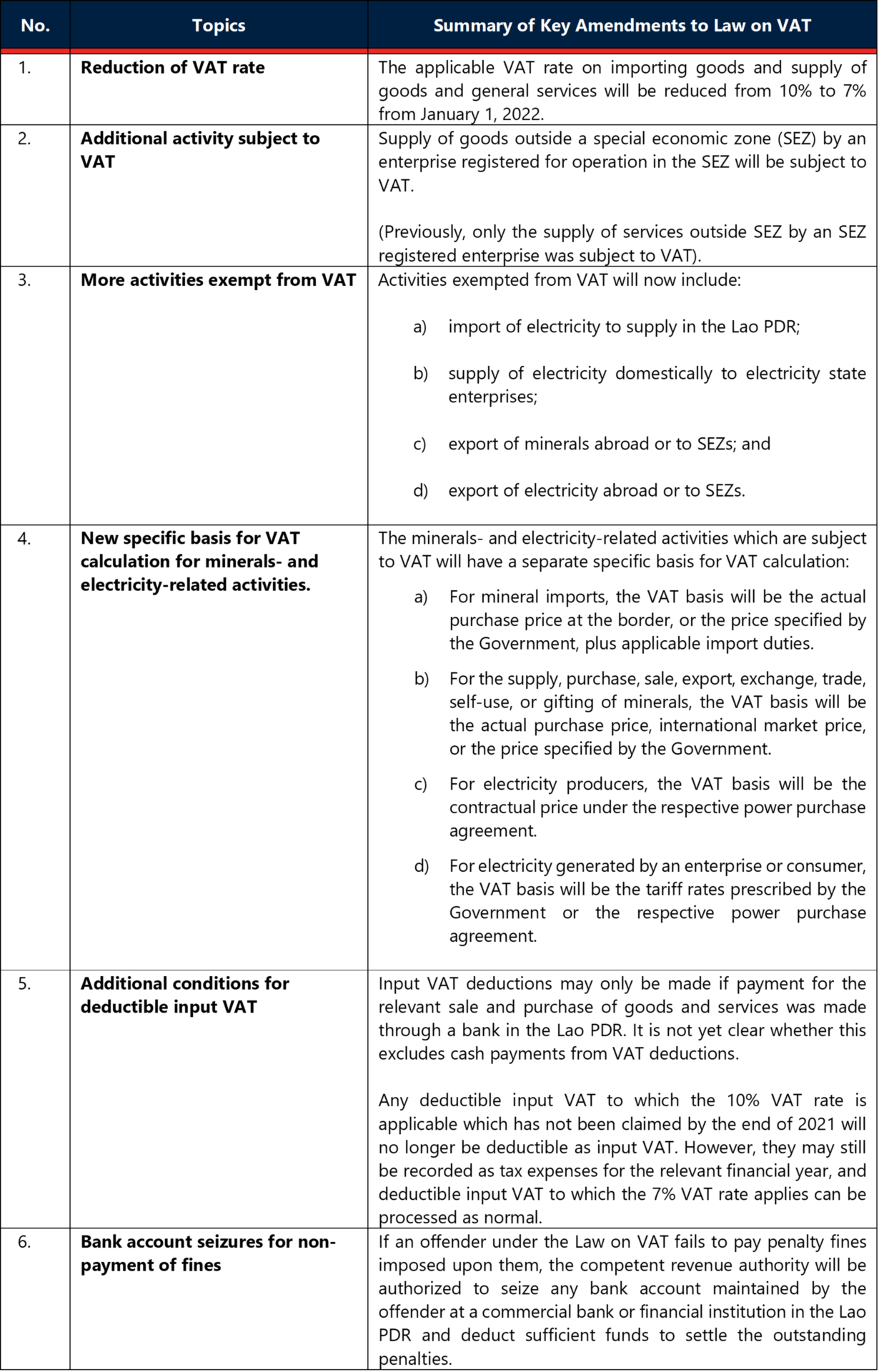
In the last week of December, 2021, the Ministry of Justice published the Law Amending Certain Provisions of the Laws on Tax No. 01/NA, dated August 7, 2021, in the Government Gazette. The Law will come into force on January 1, 2022.

The most notable amendments relate to Value Added Tax (VAT), which are summarized below.

The new law also makes changes to the laws on tax management, income tax, and excise tax, which Tilleke & Gibbins will provide updates on in due course.

RELATED INSIGHTS​ 

March 11, 2025
The Vietnamese government is in the process of amending the Law on Atomic Energy, originally issued in 2008, to harmonize with several newly enacted laws, establish a comprehensive regulatory framework governing nuclear energy in Vietnam, and serve as a legal basis to foster the implementation of ongoing and future nuclear projects in the country. The Ministry of Science and Technology has been assigned to lead the drafting of the amended Law on Atomic Energy. The second draft of the amended law (the “Draft”) was released in late February 2025 for public consultation to gather feedback from the community and stakeholders. Key Points The Draft introduces new regulations to ensure high standards of safe and secure use of nuclear materials, radioactive sources, medical and industrial irradiation, mining and processing of radioactive ores, and radioactive waste management, as well as requirements for enhancing capacity to prepare for and respond to radiation incidents and nuclear incidents. In addition, the Draft emphasizes environmental protection, public health in nuclear energy projects, and support for development and advancing nuclear technology capabilities in Vietnam together with enhancing international cooperation in this field. Below are some key points of the Draft: Approval and licensing requirements for nuclear facilities: The Draft requires investors or owners of nuclear facilities to obtain several permits and approvals as regulated by the government before implementation of construction or operation. Reporting obligations: In addition to periodic reports on operations, safety measures, and compliance with regulations, nuclear facilities are required to make, maintain, and update a number of their regular records related to radiation and nuclear safety for ad hoc reports when required by the competent authorities. In this respect, any incidents or deviations from standard procedures must be reported immediately to the relevant authorities. Training and certification: Personnel working in nuclear facilities as

February 23, 2025
On January 6, 2025, the government of Vietnam issued Decree No. 05/2025/ND-CP amending and supplementing Decree No. 08/2022/ND-CP detailing the Law on Environmental Protection (“Decree 05”). Decree 05 came into effect immediately upon issuance and provides several changes to the regulations governing extended producer responsibility (“EPR”) for applicable manufacturers and importers, outlining their obligations concerning the recycling and treatment of discarded products and packages. (See our previous article on Vietnam’s EPR regulations here.) Outlined below are some critical amendments in Decree 05. Entities Subject to EPR Regulations Previously, Decree 08 limited the responsibility for recycling to manufacturers and importers of products and packaging specified in statutory lists. Decree 05 expands this scope by also including entities responsible for the quality and labeling of the regulated products and goods in Vietnam. Decree 05 inherits the regulations from Decree 08 that manufacturers and importers, if they produce and import products and packaging as stipulated by law, must fulfill their responsibility to recycle or support waste treatment activities. However, Decree 05 amends the lists of products/packaging that must be recycled or undergo waste treatment, and new products/packaging and recycling methods. Notably, rechargeable batteries (including those used in vehicles or for electrical and electronic devices) have been added to the list of regulated products and self-propelled vehicles and construction machinery have been removed from the list. Decree 05 also not only streamlines the recycling methods required for each type of product/packaging, but also removes the minimum requirement on the mass of products/packaging that must be recovered when recycling. Manufacturers and importers now have more flexibility in selecting recycling methods that are more suitable for actual recycling conditions in Vietnam. Decree 05 has revised the cases of exemption from recycling and waste treatment obligations, clarifying that both packaging manufacturers and importers with annual product
February 21, 2025
As Vietnam continues its government restructuring, including the merging of several key ministries, the country is signaling that mergers of provinces could be next. Conclusion 126-KL/TW of the Politburo and Secretariat, issued on February 14, 2025, sets out several tasks for continuing to streamline the political system in 2025, notably including, among others, the following: Elimination of intermediate administrative levels, and mergers of provincial units: The Government Party Committee is tasked with researching and planning for the elimination of intermediate administrative levels (district levels); reorganizing the commune level with structures, functions, duties, powers, and responsibilities aligned with the new organizational model; and proposing the merging of some provincial administrative units. A report to the Politburo is required by Q3 2025. Reorganization of police structure: The Central Public Security Party Committee is tasked with leading and coordinating the implementation of a three-tier police organization, eliminating the district-level police. Judicial system reforms: The Central Party Committees of the Supreme People’s Court and the Supreme People’s Procuracy are tasked with researching and advising on the organizational model for courts and procuracies, and proposing amendments and supplements to relevant party mechanisms and state laws, with the aim of eliminating the district level. A report to the Politburo is required by Q2 2025. Implications of Merging Provinces The merging of provinces could bring positive impacts as well as new challenges. The expected benefits include: Administrative efficiency and cost saving: Reducing the number of administrative units could lead to more efficient governance and decision-making processes, as well as lower administrative costs due to fewer government offices and personnel. Economic development: Larger administrative areas can benefit from better allocation of resources and infrastructure development. Larger provinces may also attract more investment due to increased economic potential and market size. Improved service delivery: Public services could improve
February 11, 2025
On January 24, 2025, the prime minister of Vietnam issued Decision No. 232/QD-TTg, approving the proposal for establishment and development of a carbon market in Vietnam. The decision establishes a compliance mechanism for greenhouse gas (GHG) emitters and creates opportunities for investors interested in carbon trading in Vietnam. Market Development Roadmap Decision 232 establishes a phased approach to developing Vietnam’s carbon market, with the following ambitious milestones: Before June 2025 (preparation period): The legal framework for trading of emissions quotas and carbon credits and a carbon-credit offset exchange mechanism will be developed, along with the necessary infrastructure for organization and operation of the carbon-credit market. From June 2025 to the end of December 2028 (pilot period): A pilot domestic carbon exchange will be launched, with continued legal refinements. From 2029 (official launch period): The carbon market will be fully operational. Carbon Market Structure and Trading Mechanisms Vietnam’s carbon market will function as a centralized, government-regulated exchange, trading two main assets: GHG emissions quotas (allowances) allocated to regulated emitters, which can be traded or auctioned; and Carbon credits generated from domestic and international projects that are certified for trading. The carbon credits generated from international projects include those originating from international exchange or offset-crediting mechanisms such as the Clean Development Mechanism (CDM), the Joint Credit Mechanism (JCM), and Article 6 of the Paris Agreement. The National Registration System for GHG emissions quotas and carbon credits will be primarily developed and operated by the Ministry of Natural Resources and Environment. Transactions of GHG emissions quotas and carbon credits will occur on the domestic carbon exchange, managed by the Hanoi Stock Exchange, and will follow a centralized process where verified quotas and credits receive unique domestic codes for trading and participants must have depository accounts. The Vietnam Securities Depository and Clearing Corporation