
You are using an outdated browser and your browsing experience will not be optimal. Please update to the latest version of Microsoft Edge, Google Chrome or Mozilla Firefox. Install Microsoft Edge

June 5, 2019

Updates on Thailand’s Trademark Registration Practices

Informed Counsel

The current version of Thailand’s Trademark Act came into force on July 28, 2016. The most recent amendments to the trademark laws introduced multiple-class filings, registration of international trademarks, new methods to calculate official fees, and the acceptance of sound marks. What did not change were the formality requirements and the general examination practices of the Thai Trademark Office. Nevertheless, we have recently come across certain issues that require increased scrutiny from trademark owners.

Priority Claiming   

As Thailand is a party to the Paris Convention, a trademark owner’s right to claim the priority date of a trademark application in a foreign country and then file an application for the same trademark in Thailand within six months of that date has remained unchanged. However, we recently learned that a number of priority claim requests have been rejected by the Trademark Office, which was not an issue we had encountered in the past.    

It would be no surprise if the rejection of the priority claim was the result of a failure to submit the required documents, or if it was due to the material differences in the applied marks in the priority applications. This issue caught our attention because the rejections seemed to target word marks filed in plain block letters. It appears that the Trademark Office has been rejecting priority claim requests for all word marks that were filed using even slightly different fonts from those used by the trademarks appearing in the priority applications.   

Examples of such marks that would be rejected in a priority claim might be as follows.
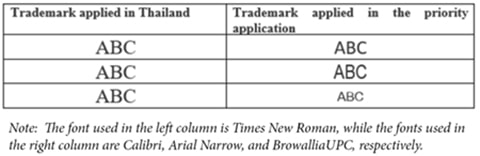
We disagree with this type of rejection and approached the Trademark Office to explain that the marks, as claimed, consist of standard characters, without claiming any particular font style, size, or color. Thus, minor differences between font styles should not be cited as the main reason for rejecting priority claim requests.   

However, we later found that the cause of rejection stems from the Trademark Office’s Internal Guidelines dated 2016, which require that the marks, as claimed, must be identical to the marks in the Thai applications. In particular, for word marks the fonts must be identical. The Internal Guidelines state the criteria for claiming a priority date from a foreign application as follows:

  • Priority application must be stated in the Kor 10 form.
  • The trademark must be the same as set out in the foreign priority application. In this respect, the Registrars are required to examine the primary visual similarities of the marks; e.g., word marks must be in identical fonts.
  • In cases where the trademarks in the foreign applications are in color and the Thai applications contain different colors, the marks are deemed to be the same, except in case of a “group of colors” type of mark.
  • If trademarks applied in foreign applications are Series Marks, and one of the marks in the Series is identical to the trademark applied in Thailand, the two marks are deemed to be the same.
  • The descriptions of goods or services in foreign applications must cover the goods or services listed in the Thai applications.
  • A copy of the priority application must be submitted.
  • Statements certifying that the priority application has never been rejected, withdrawn, or abandoned must be submitted. Such statements must be certified by the trademark owners or their authorized representatives, either within or outside of Thailand.

The Trademark Office’s Internal Guidelines have not been publicly announced, but these Internal Guidelines seem to be used as the basis for rejection of priority claim requests in many cases. Therefore, trademark owners are urged to be aware of this issue and to ensure that when a priority claim is requested, the applicant must strictly comply with these Internal Guidelines.

Multiple-Class Filings   

Since the enactment of the new Trademark Act in 2016, we have always advised our clients who prefer to file multiple-class trademark applications that a problem in one class would delay the whole application, as divisional applications are not allowed in Thailand. This advice remains valid, and we would now like to emphasize that not only will a problem in one class delay the whole application, but it could also result in the rejection of the whole application.   

When a multiple-class trademark application is rejected, the application is rejected in its entirety. The applicant has to appeal with respect to the whole application, even though arguments for some classes may be stronger than other classes, and the Board of Trademarks will issue its decision with respect to the whole application rather than rejecting certain classes and allowing other classes to remain.    

In other words, even if a trademark is descriptive only of certain classes of goods or services, when the Registrar rejects the mark, they usually reject the whole application. Additionally, when the Board of Trademarks issues its decision in an appeal, such decision will target the whole application. We have not yet received a decision by the Board whereby the Board allows only some of the non-affected classes in a multiple-class application to proceed to registration. The Board tends to either accept or reject the application in its entirety, despite there being no official objections targeting some of the classes.    

With this trend of rejecting whole multiple-class applications without allowing divisional applications, trademark owners should consider their risks and may opt to file single-class trademark applications if they anticipate that there might be problem in some but not all classes. On the other hand, if trademark owners anticipate rejection in all classes, filing multiple-class applications would save costs since the appeal for all classes could be filed at the same time.    

We will be closely monitoring these slight and sometimes undisclosed changes in the Trademark Office’s practices, which can have substantial effects on applicants, and will continue to provide timely updates on the trademark registration process in Thailand.

RELATED INSIGHTS​ 

August 6, 2026
Introduction: A Trademark Paradox in Sustainable Packaging Walk into any Thai supermarket, and the label-free water bottle is no longer a novelty. Thailand’s packaging market, valued at approximately USD 15.68 billion in 2025, is shifting toward minimalist, plastic-light designs as ESG pressures reshape how brands present their products. The country generated roughly 5.68 million tons of plastic waste in 2021, with a recycling rate of only 19 percent, and regulators are now considering rules that would allow label-free bottled water relying on embossing, laser printing, or QR codes instead of wrap-around labels. As packaging itself becomes the brand identifier, a paradox emerges: designs built to say the least often struggle hardest for protection under Thai intellectual property law. The Trademark Barrier: When Shape Is Not Enough Section 7, paragraph 2(10) of the Thai Trademark Act deems a shape distinctive only if it is not the natural form of the goods, is not necessary to achieve a technical result, and does not add value to the goods. The Department of Intellectual Property’s 2022 examination guidelines apply this test conservatively, as the following examples illustrate. A plain water bottle relying on subtle contours to signal its brand is typically read as just another bottle, not a source identifier. Acquired distinctiveness offers a theoretical escape route, but it demands extensive evidence of sales, advertising, and consumer recognition—an especially heavy burden for new entrants whose minimalist packaging has not yet achieved market prominence. The result is a structural bias against precisely the design innovation that sustainability goals are meant to encourage. Design Patents: A Partial, Imperfect Substitute Design patent protection, covering a product’s shape, configuration, or ornamentation, appears to offer an alternative route. In practice, it is constrained by the same forces driving the minimalist trend. Because many brands converge on similar solutions—clear
August 4, 2026
Intellectual property (IP) protection sometimes hinges on fame and recognition. However, this alone will not always be sufficient to overcome an IP dispute when it involves contractual obligations or registered rights. Below are five cases from around the world that tackle some of the basic issues in IP registration, ownership, commercialization, and enforcement. 1. USA: Taylor Swift Trademark Application Refused Taylor Swift recently filed a trademark application to register “The Life of a Showgirl,” which is the title of her 12th studio album. When examining a trademark application, the examiner considers various factors before deciding whether it should be registered. One of these factors is whether there is a likelihood of confusion (i.e., would a regular consumer mistake the origin of the trademark). In Taylor Swift’s case, the US Patent and Trademark Office (USPTO) decided that that there would be a risk of confusion. This decision was based on the existing registered trademark, “Confessions of a Showgirl,” owned by Maren Wade, which was registered in 2015. The USPTO refused Taylor Swift’s application based on the shared key distinctive element “of a showgirl,” the lack of sufficient distinguishing terms, the marks being used in overlapping markets (entertainment and performances), and because consumers may assume a common commercial source. Maren Wade then filed a lawsuit in California against Taylor Swift and her affiliated companies, arguing that Taylor Swfit’s branding is confusingly similar in structure, wording, and overall commercial impression to her registered mark. She is also drawing on the USPTO’s refusal of Taylor Swift’s application to support her argument of a likelihood of confusion. A judgment has not yet been reached in this case, but it serves as an important reminder of the importance of satisfying the essential elements required for IP registration. 2. Australia: Katy Perry v. Katie Perry In
July 27, 2026
Vietnam’s new E-Commerce Law, which took effect on 1 July 2026 along with its implementing Decree No. 248/2026/ND-CP (Decree 248), marks a significant development in the country’s approach to online intellectual property (IP) enforcement, reflecting a clear shift from a reactive model of intermediary liability to one that expects platforms to play a more active role in preventing infringement. From notice-and-takedown to platform responsibility The most significant change introduced by the E-Commerce Law is the transformation of the legal role of e-commerce platforms. The existing safe harbor provisions under the IP Law and the copyright notice-and-takedown regime established by Decree 17/2023/ND-CP (Decree 17) largely required intermediaries to act only after receiving notice of infringement. Once infringing content had been removed, the platform’s legal obligation was generally considered fulfilled. The new legislation adopts a fundamentally different approach. Article 17 of the E-Commerce Law requires intermediary platforms to screen information relating to goods and services before publication in order to prevent listings involving counterfeit or IP-infringing goods, and goods of unknown origin. Rather than relying exclusively on complaints from rights holders, platforms are now expected to implement preventive measures before infringing listings become publicly available. Decree 248 further requires platforms to update keyword filters based on recommendations issued by competent authorities. These filtering mechanisms are intended to prevent prohibited listings from appearing on the platform and represent a further move away from a purely complaint-driven enforcement model. The legislation also introduces Vietnam’s first statutory stay-down obligation. Under the E-Commerce Law and Decree 248, major digital platforms must maintain automated systems capable of reviewing, warning against, and removing unlawful listings while also implementing measures to prevent repeat violations, defined under Decree 248 as conduct that has previously been identified and handled by the platform, but continues to recur. This obligation addresses one
July 27, 2026
Tilleke & Gibbins’ intellectual property specialists have authored the Thailand chapter of Trade Secrets 2026 from Chambers and Partners. This global guide examines the legal frameworks governing trade secret protection, enforcement, and litigation across jurisdictions worldwide. The Thailand chapter provides a comprehensive overview of the country’s legal regime for protecting confidential business information, covering the legal framework, trade secret misappropriation, litigation procedures, remedies, and dispute resolution. Some topics covered include: Protectable trade secrets Reasonable measures to maintain secrecy Employee confidentiality Trade secret licensing Civil and criminal remedies Litigation procedures and injunctions Damages and other remedies Mediation and arbitration The guide also examines practical issues relating to safeguarding trade secrets, defending against allegations of misappropriation, and managing trade secret disputes in Thailand. Chambers and Partners’ Global Practice Guides provide in-house counsel with authoritative commentary on practical legal issues affecting business, enabling readers to compare legislation and procedures across multiple jurisdictions. The Thailand chapter of Trade Secrets 2026 is available as a PDF through the button below. The full guide can be accessed for free on the Chambers and Partners website.