
You are using an outdated browser and your browsing experience will not be optimal. Please update to the latest version of Microsoft Edge, Google Chrome or Mozilla Firefox. Install Microsoft Edge

June 5, 2019

Updates on Thailand’s Trademark Registration Practices

Informed Counsel

The current version of Thailand’s Trademark Act came into force on July 28, 2016. The most recent amendments to the trademark laws introduced multiple-class filings, registration of international trademarks, new methods to calculate official fees, and the acceptance of sound marks. What did not change were the formality requirements and the general examination practices of the Thai Trademark Office. Nevertheless, we have recently come across certain issues that require increased scrutiny from trademark owners.

Priority Claiming   

As Thailand is a party to the Paris Convention, a trademark owner’s right to claim the priority date of a trademark application in a foreign country and then file an application for the same trademark in Thailand within six months of that date has remained unchanged. However, we recently learned that a number of priority claim requests have been rejected by the Trademark Office, which was not an issue we had encountered in the past.    

It would be no surprise if the rejection of the priority claim was the result of a failure to submit the required documents, or if it was due to the material differences in the applied marks in the priority applications. This issue caught our attention because the rejections seemed to target word marks filed in plain block letters. It appears that the Trademark Office has been rejecting priority claim requests for all word marks that were filed using even slightly different fonts from those used by the trademarks appearing in the priority applications.   

Examples of such marks that would be rejected in a priority claim might be as follows.
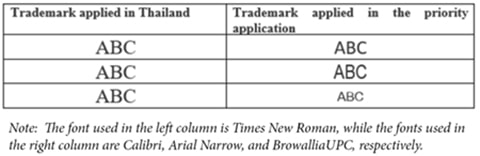
We disagree with this type of rejection and approached the Trademark Office to explain that the marks, as claimed, consist of standard characters, without claiming any particular font style, size, or color. Thus, minor differences between font styles should not be cited as the main reason for rejecting priority claim requests.   

However, we later found that the cause of rejection stems from the Trademark Office’s Internal Guidelines dated 2016, which require that the marks, as claimed, must be identical to the marks in the Thai applications. In particular, for word marks the fonts must be identical. The Internal Guidelines state the criteria for claiming a priority date from a foreign application as follows:

  • Priority application must be stated in the Kor 10 form.
  • The trademark must be the same as set out in the foreign priority application. In this respect, the Registrars are required to examine the primary visual similarities of the marks; e.g., word marks must be in identical fonts.
  • In cases where the trademarks in the foreign applications are in color and the Thai applications contain different colors, the marks are deemed to be the same, except in case of a “group of colors” type of mark.
  • If trademarks applied in foreign applications are Series Marks, and one of the marks in the Series is identical to the trademark applied in Thailand, the two marks are deemed to be the same.
  • The descriptions of goods or services in foreign applications must cover the goods or services listed in the Thai applications.
  • A copy of the priority application must be submitted.
  • Statements certifying that the priority application has never been rejected, withdrawn, or abandoned must be submitted. Such statements must be certified by the trademark owners or their authorized representatives, either within or outside of Thailand.

The Trademark Office’s Internal Guidelines have not been publicly announced, but these Internal Guidelines seem to be used as the basis for rejection of priority claim requests in many cases. Therefore, trademark owners are urged to be aware of this issue and to ensure that when a priority claim is requested, the applicant must strictly comply with these Internal Guidelines.

Multiple-Class Filings   

Since the enactment of the new Trademark Act in 2016, we have always advised our clients who prefer to file multiple-class trademark applications that a problem in one class would delay the whole application, as divisional applications are not allowed in Thailand. This advice remains valid, and we would now like to emphasize that not only will a problem in one class delay the whole application, but it could also result in the rejection of the whole application.   

When a multiple-class trademark application is rejected, the application is rejected in its entirety. The applicant has to appeal with respect to the whole application, even though arguments for some classes may be stronger than other classes, and the Board of Trademarks will issue its decision with respect to the whole application rather than rejecting certain classes and allowing other classes to remain.    

In other words, even if a trademark is descriptive only of certain classes of goods or services, when the Registrar rejects the mark, they usually reject the whole application. Additionally, when the Board of Trademarks issues its decision in an appeal, such decision will target the whole application. We have not yet received a decision by the Board whereby the Board allows only some of the non-affected classes in a multiple-class application to proceed to registration. The Board tends to either accept or reject the application in its entirety, despite there being no official objections targeting some of the classes.    

With this trend of rejecting whole multiple-class applications without allowing divisional applications, trademark owners should consider their risks and may opt to file single-class trademark applications if they anticipate that there might be problem in some but not all classes. On the other hand, if trademark owners anticipate rejection in all classes, filing multiple-class applications would save costs since the appeal for all classes could be filed at the same time.    

We will be closely monitoring these slight and sometimes undisclosed changes in the Trademark Office’s practices, which can have substantial effects on applicants, and will continue to provide timely updates on the trademark registration process in Thailand.

RELATED INSIGHTS​ 

July 27, 2026
In March 2025, Thailand’s Central Intellectual Property and International Trade Court (IP&IT Court) issued a landmark judgment in favor of Luckin Coffee, China’s leading retail coffee chain. The judgment marked a significant turnaround following earlier trademark litigation involving Luckin Coffee from 2021 to 2023 that had generated widespread public attention and raised questions about the protection available to legitimate foreign brand owners in Thailand. In a significant subsequent development, Thailand’s Court of Appeal for Specialized Cases has now affirmed the IP&IT Court’s judgment in its entirety. The appellate decision brings clarity to one of Thailand’s most closely watched trademark disputes. Significantly, this is the first case in Thailand to formally recognize the trademark squatting principle. The Court of Appeal confirmed that Luckin Coffee has a better right to the disputed mark and ordered cancellation of the defendants’ trademark registration—a key application of the “better right” doctrine. The court also upheld the substantial damages awarded at first instance, providing important guidance on assessing harm from systematic trademark squatting. Award-Winning Judgment Affirmed in Its Entirety The significance of the first-instance judgment extended beyond the outcome for Luckin Coffee. The IP&IT Court judgment was subsequently recognized in the IP&IT Court’s Distinguished Judgment Awards in 2025, reflecting the complexity, novelty, and legal significance of the issues considered in the case. The defendants nevertheless appealed the judgment, challenging several key aspects of the IP&IT Court’s decision. Luckin Coffee continued to entrust Tilleke & Gibbins as their sole attorney to pursue the case at the appellate level. After considering the defendants’ appeal and Luckin Coffee’s submissions in response, the Court of Appeal affirmed the first-instance judgment in its entirety. The judgment was announced on July 8, 2026. Better Right to the Marks The Court of Appeal confirmed Luckin Coffee’s superior rights. The orders include cancellation
July 24, 2026
As food innovation continues to accelerate, manufacturers are increasingly introducing ingredients derived from new sources, produced using novel technologies, or lacking a significant history of human consumption. While these innovations create new opportunities for the food industry, they also raise important questions regarding consumer safety. For this reason, many jurisdictions, including Thailand, the European Union, Australia and New Zealand, Canada, and Singapore, require a premarket safety assessment for novel food ingredients before they can be placed on the market. The objective of this assessment is to ensure that each ingredient is safe for its intended use and level of consumption, does not present toxicological, allergenic, microbiological, or nutritional concerns, and will not mislead consumers. Scientific authorities typically evaluate the ingredient’s identity, manufacturing process, composition, specifications, anticipated dietary exposure, toxicological information, nutritional impact, and history of use before determining whether it can be marketed. Against this background, the Thai Food and Drug Administration (FDA) recently took an important step toward improving regulatory transparency by publishing, for the first time, a consolidated public list of substances that have successfully completed the Thai FDA’s safety assessment process, including substances determined to be novel foods and those determined not to fall within the novel food category. The list identifies the approved substances, the corresponding manufacturers or importers, approval dates, and the approved conditions of use. Although the publication does not change the existing legal framework governing novel food approvals, it provides businesses with greater visibility into the Thai FDA’s regulatory precedents and the types of substances that have previously been accepted through the safety assessment process. The full announcement is available on the Thai FDA’s website. As the list is now publicly available, it also provides useful insight into the types of substances that have successfully completed the Thai FDA’s safety assessment process.
July 24, 2026
Indonesia has updated its fee framework for intellectual property (IP)-related government services, with implications for IP owners, licensees, lenders, digital platforms, and businesses operating in the country. Government Regulation No. 30 of 2026 on Types and Tariffs of Non-Tax State Revenue Applicable to the Ministry of Law (GR 30/2026) was promulgated on July 2, 2026, and will take effect on August 1, 2026. Key Takeaways GR 30/2026, which replaces the relevant IP service fees under Government Regulation No. 45 of 2024, reorganizes the fee schedule into separate categories for copyright, industrial designs, patents, layout designs of integrated circuits, trade secrets, trademarks, geographical indications, IP enforcement, and other categories. The most commercially relevant changes include a new copyright recordation tariff exemption for songs and music, higher fees for several trademark and geographical indication services, new IP enforcement service fees, and a new fee type for registration of fiduciary security over IP rights objects. In addition, this is the first major update for trademark fees in approximately 10 years. GR 30/2026 is significant not only as a fee update but also as a further indication of Indonesia’s increasing recognition of IP as a financeable commercial asset. By expressly assigning fees to the registration of fiduciary security over IP rights objects, the regulation places IP-backed collateral filings within the Ministry of Law’s administrative service framework. While GR 30/2026 does not create a new secured-transactions regime, this development is relevant for lenders, borrowers, and IP owners structuring financing arrangements secured by trademarks, patents, copyrights, industrial designs, or other registrable IP rights in Indonesia. Copyright: New Fee Exemption for Songs and Music Recordation For copyright, GR 30/2026 creates a fee-exempt category for recordation of works or related-rights products for songs or music, while maintaining a separate category for other works and related-rights products. It
July 21, 2026
Thailand’s Ministry of Digital Economy and Society (MDES) published a notification establishing an expedited court-ordered takedown mechanism for online content in cases of “urgent necessity.” The notification, which was issued on July 17, 2026, under the Computer Crime Act B.E. 2550 (2007), as amended, took effect the following day. It significantly expands the categories of content subject to rapid government-initiated removal. Content Categories Subject to Takedown The notification defines “urgent necessity” (section 20, paragraph 5, of the Computer Crime Act) as circumstances where any delay in suppressing computer data may impact national security, religion, the monarchy, good morals, social culture, or public order. In this regard, it establishes four broad categories of content: Computer Crime Act offenses. National security offenses. IP and other criminal offenses, where it is contrary to public order or good morals and a competent officer has requested its suppression. Content contrary to public order or good morals, a broad residual category encompassing 14 subcategories approved by the Computer Data Screening Committee. The fourth category is the most expansive. Its 14 subcategories include: Content defaming, mocking, satirizing, or devaluing the monarchy. Online gambling advertising or facilitation. Offering illegal firearms for sale. Offering baraku (hookah) products or e-cigarettes for sale. Offering cannabis inflorescences or processed cannabis products for sale. Advertising or soliciting prostitution. Content inciting violence, hatred, or social division. Unauthorized overseas employment advertising. Offering boiled kratom juice for sale. Online sale or advertising of alcoholic beverages. Content satirizing or degrading Buddhism. Money lending at interest rates exceeding legally prescribed limits. Advertising or disseminating information about surrogacy services. Forgery of documents, cards, or official documents. Enforcement Procedure In cases of urgent necessity, a competent official assigned by the MDES permanent secretary must file a petition with supporting evidence to the court with jurisdiction, requesting an order to