
You are using an outdated browser and your browsing experience will not be optimal. Please update to the latest version of Microsoft Edge, Google Chrome or Mozilla Firefox. Install Microsoft Edge

March 12, 2025

Updates on Thailand’s Film Incentive Measures

In November 2024, Thai Prime Minister Paethongtarn Shinawatra unveiled ambitious plans to enhance tax incentives for foreign film productions during a networking reception in Los Angeles, coinciding with her visit to the APEC Economic Leaders’ Meeting in Lima, Peru. This event, attended by Motion Picture Association executives and leaders from top US film companies, marked a significant commitment to boosting foreign investment in Thailand’s film industry.

Thailand’s Department of Tourism (DOT) prioritized the initiative by updating the Announcement on Guidelines, Procedures, and Conditions for Applying for Benefits Under the Incentive Measures for Foreign Film Production in Thailand in December 2024 to further position Thailand as a destination for large-scale international film and television productions.

Key Amendments to Film Incentives under the 2024 Announcement

The 2024 announcement introduced major changes, including (1) removal of the rebate cap, previously set at THB 150 million (approx. USD 4.5 million) per project, enabling rebates based on total qualified spending, and (2) an increase in cash rebate rates. The maximum allowable cash rebate rate was increased to 30 percent from the previous cap of 20 percent. The base rate of 15 percent remains unchanged.

The primary incentive available under the 2024 announcement is a 15 percent cash rebate on qualified spending in Thailand of at least THB 50 million (approx. USD 1.5 million).

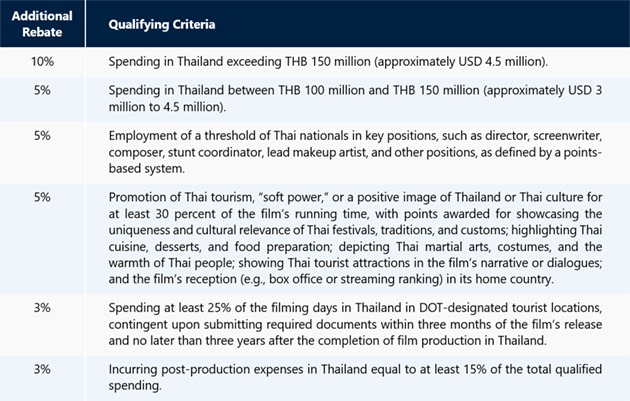
On top of this primary incentive, additional incentives are available; however, the total possible cash rebate is capped at 30 percent, and the additional incentives can only amount to an added 15 percent. Also, the total rebate (including both primary and additional incentives) for films with a budget of less than THB 100 million (approx. USD 3 million) is capped at 25%.

To obtain a higher rebate rate, productions may apply for the following additional incentives:
Compliance Requirements

Foreign production companies seeking to benefit from Thailand’s enhanced film incentives must navigate a structured application and compliance process. The 2024 announcement establishes different processing periods for applications based on spending thresholds. Noncompliance with these procedural requirements could jeopardize eligibility for the rebates, regardless of the actual amount spent in the country.

One of the key criteria for receiving the incentives is that the filming must not cause or result in environmental damage or harm to natural resources; otherwise, the approved incentives will be revoked.

The timing of this policy is noteworthy, given the recent decision regarding an environmental dispute in which Thailand’s Ministry of Natural Resources and Environment sued a major production company for over THB 100 million (approx. USD 3 million), alleging ecological damage caused during filming. The lawsuit claimed that alterations to a bay landscape and failure to comply with legal requirements and agreements established with the authorities resulted in extensive environmental harm, including deforestation and coral reef destruction. After 20 years of legal proceedings, the Thai Supreme Court ruled in 2022 that the production company must pay THB 10 million (approx. USD 300,000), or 10% of the original claim. This case underscores the risk of noncompliance with legal requirements, which can result in negative publicity, financial liability, and the loss of eligibility for incentives.

Tax Implications and Documentation Requirements

The rebate mechanism interacts with several Thai tax considerations that foreign production companies should carefully evaluate. The 2024 announcement specifies that the rebate itself is subject to 1% withholding tax under the Thai Revenue Code. Additionally, service and rental expenses paid to Thai providers typically attract withholding tax rates of 3% and 5%, respectively, while most goods and services in Thailand are subject to 7% VAT (value-added tax), significantly impacting overall production budgeting. The rebate application process also requires comprehensive financial documentation as specified in the requisition form, with all expenses requiring proper verification according to Thai Revenue Department standards.

Understanding which preproduction, production, and postproduction expenses qualify (particularly the requirement that physical production expenses in Thailand must be at least 50% of total qualified spending) requires careful planning. Professional tax and legal advice can help companies optimize their structure to maximize eligible expenses while ensuring regulatory compliance.

Final Remarks

Thailand’s revised film incentives under the DOT’s 2024 announcement provide lucrative opportunities for foreign film and television productions. By enhancing financial incentives, Thailand aims to attract more international projects, thereby stimulating economic growth and promoting cultural exchange. As the global film industry continues to evolve, Thailand’s proactive approach positions it as a competitive and attractive destination for filmmakers worldwide. Productions planning to capitalize on these incentives are advised to consult local experts to navigate the regulatory landscape effectively.


RELATED INSIGHTS​ 

June 26, 2025
As modern business strategies increasingly embrace sustainability, the influence of ESG principles is reshaping product design, packaging, and brand protection. From label-free bottles to the legal importance of 3D marks in Thailand, these developments highlight the growing connection between environmental responsibility and intellectual property. The Rise of ESG ESG principles have become critical in shaping business strategies worldwide. Companies are increasingly required to disclose ESG data, which influences investor decisions, loans, and consumer behavior. Studies show that consumers are willing to pay more for sustainable packaging, and businesses with strong ESG commitments often achieve higher growth rates. Product Minimization Trend One sector experiencing significant transformation is the consumer product industry, where brands worldwide are adapting their packaging to align with ESG principles. A notable approach is packaging minimization, exemplified by Pepsi’s introduction of its first label-free PET bottle in China in 2022. Similarly, in Thailand, several bottled water brands have embraced label-free designs, including Sprinkle drinking water’s “Redesign to Reduce” initiative and other similar efforts. These shifts not only enhance brand perception but are also warmly welcomed by consumers and business associates alike. For instance, Cathay Pacific has introduced label-free bottled water on select flights and cabins as part of their ongoing commitment to boosting onboard recycling efforts. From Design to Distinctiveness with 3D Marks Packaging has evolved into a critical component of brand identity, blending functionality with distinctiveness to strengthen consumer recognition and loyalty. This shift carries significant implications for intellectual property. Protecting these designs is no longer optional but essential, given their substantial commercial value. Securing legal protection—whether through design rights or three-dimensional (3D) trademarks—has become a strategic necessity. In an era shaped by sustainability and innovation, safeguarding distinctive packaging is not just a precaution but a fundamental step in maintaining competitive advantage and ensuring enduring brand
June 20, 2025
In a decisive move to strengthen its trade position and reinforce commitments under ongoing tariff negotiations with the United States, the government of Vietnam has made a concerted effort to improve intellectual property enforcement within the country. A key catalyst for this was the prime minister issuing a decision requesting all authorities to initiate sweeping enforcement actions to crack down on counterfeit goods across all provinces. Our firm has been actively involved in these operations. Working in close coordination with Vietnam’s Market Surveillance Authority, Customs, and Border Police, the firm has been instrumental in planning, intelligence gathering, and on-site enforcement. Key operations were conducted in major commercial hubs, including Hanoi and Ho Chi Minh City. In Hanoi, we collaborated with Market Surveillance Team No. 1 to inspect a major wholesaler in Hang Giay. These inspections resulted in the seizure of a significant volume of counterfeit perfumes and the identification of key suppliers within the illegal trade network. In Ho Chi Minh City, our firm supported large-scale inspection campaigns at well-known markets, including Saigon Square. Acting on intelligence, authorities executed multiple raids targeting shops and stalls notorious for selling counterfeit branded products. Specialists from our firm provided logistical support and real-time analysis to ensure swift and effective intervention. Beyond Vietnam’s urban centers, efforts extended to critical border zones in northern and central Vietnam. We worked with Customs and Border Police at major checkpoints to inspect high-risk shipments suspected of containing counterfeit goods. These operations led to the interception of several container loads of illicit products. The nationwide campaign also included targeted actions in several provinces known as hubs for storage and distribution. In Bac Giang, Da Nang, Hai Phong, Kien Giang, and Dong Nai, we assisted in coordinated raids on medium- to large-scale warehouses and distribution centers. These inspections uncovered
June 17, 2025
On January 9, 2025, the Lao official gazette published the newly amended Decision on Trade Inspection Implementation No. 0019/MOIC, dated January 6, 2025. This decision aims to establish principles and rules for trade officers to inspect, fine, and take measures against violators of trade laws and their related regulations on business competition, business operations, and intellectual property rights to protect consumers and business operators in Laos. Changes in Trade Inspection Procedures Previously, trade inspection officers, operating independently under the central Ministry of Industry and Commerce (MOIC) or the provincial-level Department of Industry and Commerce (DOIC), were responsible for administrative raid actions focusing exclusively on intellectual property issues. However, following the enactment of Decision No. 0019/MOIC, trade inspection officers will now be grouped into the Trade Officers Unit, which will also include business competition officers and consumer protection officers. This unit will conduct and participate in raids, considering not only intellectual property laws but also competition and consumer protection laws when imposing penalties on infringers. Trade Inspection Authority Levels Trade inspection implementation is overseen by authorities at three levels: Central level: Department of Business Competition and Trade Inspection, MOIC. The MOIC handles trade inspection work covering all provinces in Laos. Provincial level: DOIC offices in provinces and Vientiane handle trade inspections covering two or more districts. District level: Office of the Industry and Commerce offices in districts. Violations Individuals, legal entities, and organizations violating the newly amended trade inspection decision, the Decree on Trade Inspection, or other related regulations will be educated about the issue, warned, disciplined (for government servants), fined, subject to compensation for damage incurred, or punished by the relevant laws, depending on the gravity of the violation. Trade Violations Violations of trade laws and regulations concerning business operations will result in fines and additional measures. Examples include:
June 11, 2025
Thailand’s tax dispute resolution framework has undergone a significant transformation with the enactment of the Act Establishing the Tax Court and the Procedure for Tax Cases (No. 3) B.E. 2568. Published in the Government Gazette on May 27, 2025, the amended act will come into force on November 24, 2025, which is 180 days after its publication. The amended act marks a pivotal shift in the jurisdiction and procedures of the Tax Court, most notably by empowering it to adjudicate certain criminal tax cases for the first time. Background and Rationale The Tax Court was originally established in 1985 as a specialized forum to handle complex tax disputes, including those related to revenue, customs, and excise taxes. The creation of the Tax Court recognized the need for judicial expertise in tax law, given its technical and specialized nature. The latest amendment is designed to address procedural inefficiencies, modernize court processes, and align Thailand’s tax litigation system with international standards. The reform demonstrates Thailand’s commitment to enhancing the efficiency, transparency, and fairness of its tax dispute resolution mechanisms. Key Amendments and Provisions Six of the key changes in the amendment are highlighted below. Expansion of jurisdiction to criminal tax cases. The most significant change is the extension of the Tax Court’s jurisdiction to include criminal offenses under the Revenue Code, customs law, excise tax law, and other tax-related laws that may be specified by royal decree. New sections in the act explicitly grant the Tax Court authority to hear and decide criminal tax cases, so individuals and entities accused of criminal tax evasion or other tax-related crimes will now have their cases heard by judges with specialized tax expertise. The law also clarifies the Tax Court’s jurisdiction when a single act constitutes multiple offenses (some tax-related, some not) or when