
You are using an outdated browser and your browsing experience will not be optimal. Please update to the latest version of Microsoft Edge, Google Chrome or Mozilla Firefox. Install Microsoft Edge

March 12, 2025

Updates on Thailand’s Film Incentive Measures

In November 2024, Thai Prime Minister Paethongtarn Shinawatra unveiled ambitious plans to enhance tax incentives for foreign film productions during a networking reception in Los Angeles, coinciding with her visit to the APEC Economic Leaders’ Meeting in Lima, Peru. This event, attended by Motion Picture Association executives and leaders from top US film companies, marked a significant commitment to boosting foreign investment in Thailand’s film industry.

Thailand’s Department of Tourism (DOT) prioritized the initiative by updating the Announcement on Guidelines, Procedures, and Conditions for Applying for Benefits Under the Incentive Measures for Foreign Film Production in Thailand in December 2024 to further position Thailand as a destination for large-scale international film and television productions.

Key Amendments to Film Incentives under the 2024 Announcement

The 2024 announcement introduced major changes, including (1) removal of the rebate cap, previously set at THB 150 million (approx. USD 4.5 million) per project, enabling rebates based on total qualified spending, and (2) an increase in cash rebate rates. The maximum allowable cash rebate rate was increased to 30 percent from the previous cap of 20 percent. The base rate of 15 percent remains unchanged.

The primary incentive available under the 2024 announcement is a 15 percent cash rebate on qualified spending in Thailand of at least THB 50 million (approx. USD 1.5 million).

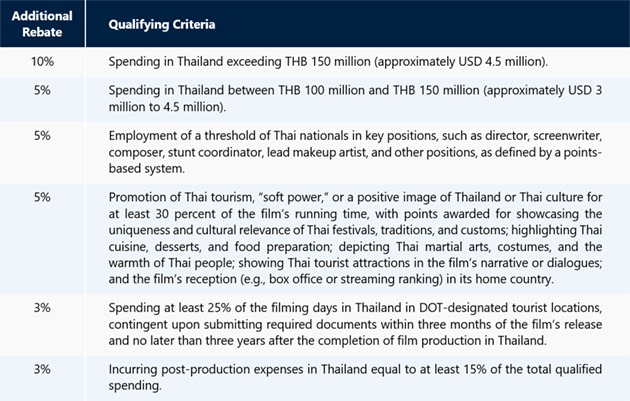
On top of this primary incentive, additional incentives are available; however, the total possible cash rebate is capped at 30 percent, and the additional incentives can only amount to an added 15 percent. Also, the total rebate (including both primary and additional incentives) for films with a budget of less than THB 100 million (approx. USD 3 million) is capped at 25%.

To obtain a higher rebate rate, productions may apply for the following additional incentives:
Compliance Requirements

Foreign production companies seeking to benefit from Thailand’s enhanced film incentives must navigate a structured application and compliance process. The 2024 announcement establishes different processing periods for applications based on spending thresholds. Noncompliance with these procedural requirements could jeopardize eligibility for the rebates, regardless of the actual amount spent in the country.

One of the key criteria for receiving the incentives is that the filming must not cause or result in environmental damage or harm to natural resources; otherwise, the approved incentives will be revoked.

The timing of this policy is noteworthy, given the recent decision regarding an environmental dispute in which Thailand’s Ministry of Natural Resources and Environment sued a major production company for over THB 100 million (approx. USD 3 million), alleging ecological damage caused during filming. The lawsuit claimed that alterations to a bay landscape and failure to comply with legal requirements and agreements established with the authorities resulted in extensive environmental harm, including deforestation and coral reef destruction. After 20 years of legal proceedings, the Thai Supreme Court ruled in 2022 that the production company must pay THB 10 million (approx. USD 300,000), or 10% of the original claim. This case underscores the risk of noncompliance with legal requirements, which can result in negative publicity, financial liability, and the loss of eligibility for incentives.

Tax Implications and Documentation Requirements

The rebate mechanism interacts with several Thai tax considerations that foreign production companies should carefully evaluate. The 2024 announcement specifies that the rebate itself is subject to 1% withholding tax under the Thai Revenue Code. Additionally, service and rental expenses paid to Thai providers typically attract withholding tax rates of 3% and 5%, respectively, while most goods and services in Thailand are subject to 7% VAT (value-added tax), significantly impacting overall production budgeting. The rebate application process also requires comprehensive financial documentation as specified in the requisition form, with all expenses requiring proper verification according to Thai Revenue Department standards.

Understanding which preproduction, production, and postproduction expenses qualify (particularly the requirement that physical production expenses in Thailand must be at least 50% of total qualified spending) requires careful planning. Professional tax and legal advice can help companies optimize their structure to maximize eligible expenses while ensuring regulatory compliance.

Final Remarks

Thailand’s revised film incentives under the DOT’s 2024 announcement provide lucrative opportunities for foreign film and television productions. By enhancing financial incentives, Thailand aims to attract more international projects, thereby stimulating economic growth and promoting cultural exchange. As the global film industry continues to evolve, Thailand’s proactive approach positions it as a competitive and attractive destination for filmmakers worldwide. Productions planning to capitalize on these incentives are advised to consult local experts to navigate the regulatory landscape effectively.


RELATED INSIGHTS​ 

June 4, 2025
The growth of Vietnam’s vibrant digital economy offers tremendous potential but is also a driver of the persistent problem of online intellectual property (IP) infringement. The spectrum of issues faced by IP rights holders runs from copyright piracy on digital services (such as streaming and torrent sites) to the sale of counterfeit goods via e-commerce sites and social platforms to the misuse of rights through misleading use of trademarks. These infringements do not only eat into profits; they damage brand reputation and mislead consumers. As a result, site blocking and keyword blocking have become increasingly important components of the enforcement toolkit available in Vietnam. Legal Framework for Blocking Actions Site and keyword blocking in Vietnam is supported by a growing legal framework, particularly following the 2022 amendment to the IP Law. Prior to this, the legal basis for blocking was scattered across various laws, and internet service providers (ISPs) were only obligated to block access to infringing content upon official requests from authorities. The introduction of Article 198b under the amended IP Law marked a significant shift, establishing a clearer mechanism for rights holders to request site blocking directly. This provision obliges them to act upon valid takedown or blocking requests. In addition to the IP Law, other key legislation includes the Law on Information Technology, the Law on Cybersecurity, the Law on Advertising, and various decrees. Together, these laws provide a more structured and enforceable basis for blocking actions in Vietnam, though practical enforcement still depends on ISP cooperation and the clarity of the infringement evidence. Competent Authorities Previously, rights holders could pursue administrative actions through specialized inspectorates under the Ministry of Science and Technology, the Ministry of Culture, Sports and Tourism, or the Vietnam E-Commerce and Digital Economy Agency (iDEA). However, due to a recent government restructuring,
June 3, 2025
On March 12, 2025, Cambodia’s Ministry of Economy and Finance issued Prakas No. 192 on Tax Rules and Procedures for Trust to determine the tax rules and procedures for trust operations. With the exception of trusts whose legal form is a company or enterprise, all trustors, trustees, and beneficiaries engaged in trust operations in Cambodia are subject to this new regulation. Taxpayer Registration A trustee company must register as a medium or large taxpayer. An independent individual trustee must register as a small, medium, or large taxpayer depending on the amount of turnover or the value of the fixed assets of the business, as stipulated in the Prakas on the Clarification of Taxpayers under the Self-Assessment Regime. Independent individual trustees must register as taxpayers within 15 working days from the commencement of economic activity or from the receipt of a license or authorization from the Trust Regulator. Accounting Records Accounting records should follow the rules stipulated in Article 6 of the Law on Taxation., which requires small taxpayers to use simplified accounting, while medium and large taxpayers must adhere to the Cambodian International Financial Reporting Standards (CIFRS).The trustee must maintain separate accounting records between its own operations and the trust. If the trustee manages more than one trust, the trustee must prepare separate records for each trust. For all the records, the trustee must clearly identify the ownership of all assets, liabilities, expenses, and other transactions. Taxation of Trustee’s Income Trust property or funds that are transferred to a trustee for management are not considered income or property of the trustee. However, any allowances or commissions that the trustee receives from managing the trust are taxed as income. The trustee must follow the general rules on expenses outlined under Cambodian tax law to record all income and expenses related
May 28, 2025
Tilleke & Gibbins attorneys in Vietnam have contributed the 2025 edition of Doing Business in Vietnam, a comprehensive Q&A-style resource from Thomson Reuters Practical Law that provides essential insights for companies navigating business operations in Vietnam. The guide presents a detailed overview of the country’s legal framework and regulatory environment, reflecting recent updates in Vietnamese legislation and practice. This annually updated guide offers key information on the following areas: Legal system: Structure of the Vietnamese judiciary and the role of codified law. Foreign investment: Conditions for market access, licensing requirements, foreign ownership restrictions, and investment incentives. Business vehicles: Formation and operation of legal entities, including limited liability companies, joint-stock companies, and representative offices. Employment: Employment contracts, social insurance, labor rights, and procedures for hiring foreign nationals. Tax: Overview of corporate income tax, personal income tax, value-added tax, and other tax obligations. Intellectual property: Procedures for protecting and enforcing patents, trademarks, copyrights, and other IP rights. Data protection: Compliance requirements under Vietnam’s data privacy laws, including the Personal Data Protection Decree. Competition law: Antitrust rules and regulatory oversight under the Law on Competition. Anti-bribery and corruption: Legal framework and enforcement practices aimed at curbing corrupt activities. E-commerce and digital business: Regulations governing online platforms, digital content, and cross-border services. Marketing and advertising: Laws and guidelines on advertising standards and consumer protection. Product regulation and liability: Safety requirements, product liability issues, and roles of relevant authorities. Doing Business in Vietnam is part of Practical Law’s global series of legal guides designed to support international practitioners and businesses. To access the most recent edition of the Vietnam guide, visit the Practical Law website and sign up for a free trial.
May 27, 2025
With the fifth round of negotiations between Thailand and the EU for a free trade agreement (FTA) now complete and the sixth round scheduled for June, both sides appear to be well on the way to meeting the desired Christmas 2025 deadline. The latest discussions were held in Brussels, and Pichai Naripthaphan, Thailand’s commerce minister, announced that the two sides have reached agreement on two chapters: Customs and Trade Facilitation, and Sustainable Food Systems. No details have been released regarding what concessions were made to reach the agreement, but reports suggest that good progress is being made in all remaining chapters. Market access for goods has reportedly become the current focus of negotiations. The first draft of goods and services that will be exempted is expected in early June, which will be welcome news for importers. While the first draft cannot be expected to represent the finalized list, it will at least provide an indication of the goods and services likely to benefit from tariff exemption. Similarly, both sides have begun to share the geographical indications that they wish to be protected, which will be of great interest to producers and manufacturers in Thailand and the EU. This is especially true considering the upcoming amendments to the Geographical Indications Protection Act B.E. 2546 (2003) expected in Thailand, as one of the key changes under the prospective amendment is to enable easier registration for geographical indications protected under international agreements. Other updates from the intellectual property (IP) chapter show good progress in relation to copyright and civil and border enforcement of IP rights. Both sides are also continuing to examine possible bridging proposals for unresolved issues. Given the substantial differences in IP laws between Thailand and the EU, how negotiators will bridge this gap remains at the forefront of most