
You are using an outdated browser and your browsing experience will not be optimal. Please update to the latest version of Microsoft Edge, Google Chrome or Mozilla Firefox. Install Microsoft Edge

March 12, 2025

Updates on Thailand’s Film Incentive Measures

In November 2024, Thai Prime Minister Paethongtarn Shinawatra unveiled ambitious plans to enhance tax incentives for foreign film productions during a networking reception in Los Angeles, coinciding with her visit to the APEC Economic Leaders’ Meeting in Lima, Peru. This event, attended by Motion Picture Association executives and leaders from top US film companies, marked a significant commitment to boosting foreign investment in Thailand’s film industry.

Thailand’s Department of Tourism (DOT) prioritized the initiative by updating the Announcement on Guidelines, Procedures, and Conditions for Applying for Benefits Under the Incentive Measures for Foreign Film Production in Thailand in December 2024 to further position Thailand as a destination for large-scale international film and television productions.

Key Amendments to Film Incentives under the 2024 Announcement

The 2024 announcement introduced major changes, including (1) removal of the rebate cap, previously set at THB 150 million (approx. USD 4.5 million) per project, enabling rebates based on total qualified spending, and (2) an increase in cash rebate rates. The maximum allowable cash rebate rate was increased to 30 percent from the previous cap of 20 percent. The base rate of 15 percent remains unchanged.

The primary incentive available under the 2024 announcement is a 15 percent cash rebate on qualified spending in Thailand of at least THB 50 million (approx. USD 1.5 million).

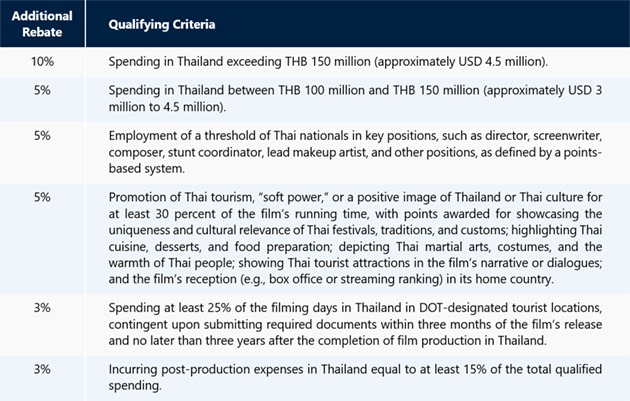
On top of this primary incentive, additional incentives are available; however, the total possible cash rebate is capped at 30 percent, and the additional incentives can only amount to an added 15 percent. Also, the total rebate (including both primary and additional incentives) for films with a budget of less than THB 100 million (approx. USD 3 million) is capped at 25%.

To obtain a higher rebate rate, productions may apply for the following additional incentives:
Compliance Requirements

Foreign production companies seeking to benefit from Thailand’s enhanced film incentives must navigate a structured application and compliance process. The 2024 announcement establishes different processing periods for applications based on spending thresholds. Noncompliance with these procedural requirements could jeopardize eligibility for the rebates, regardless of the actual amount spent in the country.

One of the key criteria for receiving the incentives is that the filming must not cause or result in environmental damage or harm to natural resources; otherwise, the approved incentives will be revoked.

The timing of this policy is noteworthy, given the recent decision regarding an environmental dispute in which Thailand’s Ministry of Natural Resources and Environment sued a major production company for over THB 100 million (approx. USD 3 million), alleging ecological damage caused during filming. The lawsuit claimed that alterations to a bay landscape and failure to comply with legal requirements and agreements established with the authorities resulted in extensive environmental harm, including deforestation and coral reef destruction. After 20 years of legal proceedings, the Thai Supreme Court ruled in 2022 that the production company must pay THB 10 million (approx. USD 300,000), or 10% of the original claim. This case underscores the risk of noncompliance with legal requirements, which can result in negative publicity, financial liability, and the loss of eligibility for incentives.

Tax Implications and Documentation Requirements

The rebate mechanism interacts with several Thai tax considerations that foreign production companies should carefully evaluate. The 2024 announcement specifies that the rebate itself is subject to 1% withholding tax under the Thai Revenue Code. Additionally, service and rental expenses paid to Thai providers typically attract withholding tax rates of 3% and 5%, respectively, while most goods and services in Thailand are subject to 7% VAT (value-added tax), significantly impacting overall production budgeting. The rebate application process also requires comprehensive financial documentation as specified in the requisition form, with all expenses requiring proper verification according to Thai Revenue Department standards.

Understanding which preproduction, production, and postproduction expenses qualify (particularly the requirement that physical production expenses in Thailand must be at least 50% of total qualified spending) requires careful planning. Professional tax and legal advice can help companies optimize their structure to maximize eligible expenses while ensuring regulatory compliance.

Final Remarks

Thailand’s revised film incentives under the DOT’s 2024 announcement provide lucrative opportunities for foreign film and television productions. By enhancing financial incentives, Thailand aims to attract more international projects, thereby stimulating economic growth and promoting cultural exchange. As the global film industry continues to evolve, Thailand’s proactive approach positions it as a competitive and attractive destination for filmmakers worldwide. Productions planning to capitalize on these incentives are advised to consult local experts to navigate the regulatory landscape effectively.


RELATED INSIGHTS​ 

February 27, 2026
On January 26, 2026, Vietnam’s Ministry of Finance issued Circular No. 06/2026/TT-BTC (Circular 06), amending and supplementing Circular No. 13/2015/TT-BTC, which provides guidance on dossiers and procedures for customs recordal and customs supervision in relation to intellectual property rights (IPR). Circular 06 has an effective date of March 1, 2026. Some notable points of Circular 06 include the following: Simplified Documentation for Customs Recordal Applications Circular 06 reduces some documentary requirements for IPR owners: A power of attorney is no longer required to be legalized. Applicants are no longer required to submit title or registration certificates if such documents are issued in digital form. In such cases, it is sufficient to declare comprehensive information on the relevant IPR, enabling customs authorities to verify the information through publicly accessible databases. In practice, this amendment is particularly beneficial for international trademark registrations designating Vietnam. IPR owners may no longer need to obtain a confirmation letter from the Intellectual Property Office of Vietnam regarding the validity of a trademark registration in Vietnam. Instead, they may rely on registration status information available from the World Intellectual Property Organization (WIPO) database, reflecting that the international registration has been granted protection in Vietnam. Clearer Mechanism for Ex Officio Suspension of Suspected Infringing Goods Although ex officio suspension has been referenced in earlier regulations, Circular 06 provides clearer guidance on the circumstances and procedures under which customs may proactively suspend customs procedures for consignments suspected of being counterfeit or pirated goods. Accordingly, customs authorities may initiate the suspension of clearance without waiting for a formal request from IPR owners. Enhanced Supervision of Imported/Exported Goods in E-Commerce Circular 06 also supplements provisions on the inspection of imported and exported goods transacted through e-commerce channels. Customs authorities may apply risk management measures to assess goods traded via e-commerce
February 26, 2026
Thailand is preparing to offer new tools for intellectual property enforcement as the Electronic Transactions Development Agency (ETDA) recently released for public consultation a draft notification requiring social media platforms to verify user identities and conduct know-your-customer (KYC) checks on advertisers. The draft Notification of the Electronic Transactions Commission on Measures to Prevent Technological Crimes for Social Media Service Providers, which is to be issued under the Emergency Decree on Measures for the Prevention and Suppression of Technological Crimes B.E. 2566 (2023), as amended in 2025, primarily aims to combat online fraud and technology-related crimes. However, its new obligations also provide IP owners with valuable tools to identify anonymous infringers. Key Regulatory Mandates The draft notification imposes several verification requirements on social media platforms operating in Thailand. These requirements also strengthen IP rights holders’ ability to identify anonymous infringers, as platforms must: Verify user identities through registered phone numbers and link all accounts to verifiable identities. Conduct KYC checks on advertisers, including individuals, companies, and any third-party payers. Perform heightened identity checks for high-risk or repeat offenders before publishing advertisements. Promptly remove content flagged by the Anti-Technology Crime Division and prescreen advertisements for prohibited or high-risk content. How IP Owners Can Use This Notification for Enforcement The phone number–based verification requirement enables IP owners to work more effectively with enforcement authorities in tracing individuals or entities responsible for infringing content. The comprehensive advertiser KYC obligations, including mandatory disclosure of third-party payment sources, create a clear audit trail even when bad actors attempt to obscure their identity through intermediaries or shell accounts. This traceability is essential for pursuing damages and dismantling organized counterfeit operations. The ETDA is now considering adjustments to the draft notification after receiving comments during the public consultation period, which ended on February 2, 2026. Following finalization
February 25, 2026
Tilleke & Gibbins has updated the Vietnam chapter in the newly released Licensing 2026 guide, published by Lexology Panoramic. The comparative guide provides companies and other interested readers with information on licensing law and practice in various countries around the world. Licensing 2026 provides detailed information on the following topics: Restrictions, laws and licensing arrangements Intellectual property issues: Paris Convention for the Protection of Industrial Property, contesting the validity of licensor’s IP rights, invalidity and expiry of IP rights, security interests, proceedings against third parties, sublicensing, jointly owned IP, first to file, scope of patent protection, trade secrets, copyright Software licensing: Perpetual licensing, legal requirements, user restrictions Royalties and payments, currency conversion, and taxes: Relevant legislation, restrictions, taxation of foreign licensors Competition law issues: Restrictions on trade, legal restrictions, and IP-related court rulings Indemnification, disclaimers, and damages: Prevalence and enforceability of indemnity provisions and contractual waivers of damages Termination: Right to terminate, impact of termination Bankruptcy: Impact of licensee or licensor bankruptcy Dispute resolution: Governing law, arbitration, enforceability, injunctive relief, contractual waivers The Vietnam chapter is available below as a PDF. Readers can gain 30 days of complementary access to the full Licensing 2026 guide and the rest of Lexology Panoramic’s varied offerings through this link.
January 30, 2026
On December 26, 2025, the government of Vietnam promulgated Decree No. 341/2025/ND-CP on administrative sanctions for violations of copyright and related rights (Decree 341), with an effective date of February 15, 2026. The new decree replaces Decree No. 131/2013/ND-CP, as amended, and represents the first comprehensive revision of the administrative enforcement framework in this area in eight years. Legislative Context and Objectives Decree 341 reflects Vietnam’s evolving copyright and related-rights framework, particularly in light of the country’s commitments under bilateral, regional, and multilateral treaties governing the digital environment. While the decree retains a number of provisions from the previous regime, it also introduces significant amendments to infringing acts, penalty thresholds, remedial measures, and enforcement procedures. The primary objectives of the new decree are to (i) enhance the deterrent effect of administrative sanctions; (ii) harmonize sanctions with the 2025 amendments to the Law on Intellectual Property and criminal law principles; and (iii) address enforcement challenges arising from online and cross-border exploitation of copyrighted works. Expanded Scope of Sanctionable Subjects Under Decree 341, administrative sanctions apply not only to Vietnamese entities committing infringing acts within Vietnam, but also to Vietnamese and foreign entities that commit acts of infringement on the internet where the protected content is accessed, consumed, or exploited by users in Vietnam. This expansion reflects the realities of cross-border digital exploitation. However, the decree does not yet provide precise definitions of key terms such as “users” or “consumers” of digital content in Vietnam, which may require further regulatory clarification. Monetary Penalties and Penalty Structure The statutory maximum fines remain unchanged, at VND 250 million for individuals and VND 500 million for organizations, but the penalty framework is substantially restructured. Fines are now calibrated based on three core criteria: (i) the amount of illegal profit obtained; (ii) the level of