
You are using an outdated browser and your browsing experience will not be optimal. Please update to the latest version of Microsoft Edge, Google Chrome or Mozilla Firefox. Install Microsoft Edge

March 12, 2025

Updates on Thailand’s Film Incentive Measures

In November 2024, Thai Prime Minister Paethongtarn Shinawatra unveiled ambitious plans to enhance tax incentives for foreign film productions during a networking reception in Los Angeles, coinciding with her visit to the APEC Economic Leaders’ Meeting in Lima, Peru. This event, attended by Motion Picture Association executives and leaders from top US film companies, marked a significant commitment to boosting foreign investment in Thailand’s film industry.

Thailand’s Department of Tourism (DOT) prioritized the initiative by updating the Announcement on Guidelines, Procedures, and Conditions for Applying for Benefits Under the Incentive Measures for Foreign Film Production in Thailand in December 2024 to further position Thailand as a destination for large-scale international film and television productions.

Key Amendments to Film Incentives under the 2024 Announcement

The 2024 announcement introduced major changes, including (1) removal of the rebate cap, previously set at THB 150 million (approx. USD 4.5 million) per project, enabling rebates based on total qualified spending, and (2) an increase in cash rebate rates. The maximum allowable cash rebate rate was increased to 30 percent from the previous cap of 20 percent. The base rate of 15 percent remains unchanged.

The primary incentive available under the 2024 announcement is a 15 percent cash rebate on qualified spending in Thailand of at least THB 50 million (approx. USD 1.5 million).

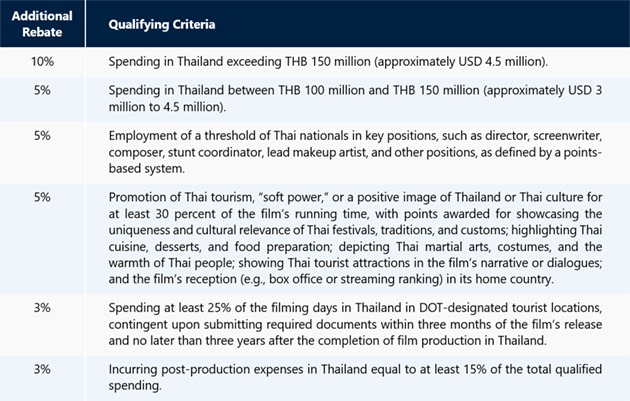
On top of this primary incentive, additional incentives are available; however, the total possible cash rebate is capped at 30 percent, and the additional incentives can only amount to an added 15 percent. Also, the total rebate (including both primary and additional incentives) for films with a budget of less than THB 100 million (approx. USD 3 million) is capped at 25%.

To obtain a higher rebate rate, productions may apply for the following additional incentives:
Compliance Requirements

Foreign production companies seeking to benefit from Thailand’s enhanced film incentives must navigate a structured application and compliance process. The 2024 announcement establishes different processing periods for applications based on spending thresholds. Noncompliance with these procedural requirements could jeopardize eligibility for the rebates, regardless of the actual amount spent in the country.

One of the key criteria for receiving the incentives is that the filming must not cause or result in environmental damage or harm to natural resources; otherwise, the approved incentives will be revoked.

The timing of this policy is noteworthy, given the recent decision regarding an environmental dispute in which Thailand’s Ministry of Natural Resources and Environment sued a major production company for over THB 100 million (approx. USD 3 million), alleging ecological damage caused during filming. The lawsuit claimed that alterations to a bay landscape and failure to comply with legal requirements and agreements established with the authorities resulted in extensive environmental harm, including deforestation and coral reef destruction. After 20 years of legal proceedings, the Thai Supreme Court ruled in 2022 that the production company must pay THB 10 million (approx. USD 300,000), or 10% of the original claim. This case underscores the risk of noncompliance with legal requirements, which can result in negative publicity, financial liability, and the loss of eligibility for incentives.

Tax Implications and Documentation Requirements

The rebate mechanism interacts with several Thai tax considerations that foreign production companies should carefully evaluate. The 2024 announcement specifies that the rebate itself is subject to 1% withholding tax under the Thai Revenue Code. Additionally, service and rental expenses paid to Thai providers typically attract withholding tax rates of 3% and 5%, respectively, while most goods and services in Thailand are subject to 7% VAT (value-added tax), significantly impacting overall production budgeting. The rebate application process also requires comprehensive financial documentation as specified in the requisition form, with all expenses requiring proper verification according to Thai Revenue Department standards.

Understanding which preproduction, production, and postproduction expenses qualify (particularly the requirement that physical production expenses in Thailand must be at least 50% of total qualified spending) requires careful planning. Professional tax and legal advice can help companies optimize their structure to maximize eligible expenses while ensuring regulatory compliance.

Final Remarks

Thailand’s revised film incentives under the DOT’s 2024 announcement provide lucrative opportunities for foreign film and television productions. By enhancing financial incentives, Thailand aims to attract more international projects, thereby stimulating economic growth and promoting cultural exchange. As the global film industry continues to evolve, Thailand’s proactive approach positions it as a competitive and attractive destination for filmmakers worldwide. Productions planning to capitalize on these incentives are advised to consult local experts to navigate the regulatory landscape effectively.


RELATED INSIGHTS​ 

January 30, 2026
Vietnam’s Intellectual Property (IP) Law, despite being amended in 2022, underwent another significant revision at the end of 2025. The latest amendment aimed to address five major policy objectives set by the Vietnamese government, including promoting innovation, digital transformation, and international integration. Among the most notable changes in the 2025 IP Law, which takes effect on 1 April 2026, is the expansion of industrial design protection under Article 4.13. The revised definition now includes partial designs and intangible designs, marking a transformative shift in Vietnam’s industrial design regime. This change has particularly significant implications on designs classified under Class 32 of the Locarno Classification—which covers graphic designs, logos, ornamentation, surface patterns, arrangements, and other intangible products. These designs, previously excluded from protection in Vietnam, are now recognized under the new legal framework. Background: Status of Class 32 Designs Before 2026 Th Intellectual Property Office of Vietnam currently applies the 13th edition of the Locarno Classification for industrial design filings. However, not all classes in this system have historically been eligible for protection. Under the 2022 IP Law, Class 32 designs were explicitly excluded based on the following legal grounds: Definition under Article 4.13 (2022 IP Law): “An industrial design is the external appearance of a product or a component for assembly into a complex product, expressed in shapes, lines, colors, or a combination thereof, and visible during the exploitation of the product’s utility or the complex product.” Product requirements under Article 21.2 of Circular 23/2023/TT-BKHCN: A product is defined as an object, a tool, a device, or means, manufactured by industrial or handicraft methods, with clear structure and function. A component for assembly into a complex product must be capable of independent circulation and detachable from the complex product. Based on these definitions, Class 32 designs, such as graphical
December 30, 2025
The Intellectual Property Office of Vietnam (IP Office), with support from the Japan International Cooperation Agency (JICA), is drafting additional annexes to its Guidelines for Patent Examination, focusing on the examination of patent applications in the pharmaceutical and biotechnology sectors. The new annexes are expected to be officially issued in early 2026 as Annexes III and IV, following the successful issuance in 2023 of Annexes I and II addressing computer program-related inventions. The IP Office recently organized a seminar to gather feedback on the draft annexes from intellectual property representatives, academic institutions, research institutes, and other interested parties, emphasizing its intention to receive further constructive opinions to refine the guidelines for pharmaceuticals and biotechnology. Why These Guidelines Matter Patent examination in Vietnam has traditionally relied on the Guidelines for Patent Examination issued under Decision No. 487/QD-SHTT (2010), recently supplemented by Annexes I and II. While these documents provide a solid foundation, they do not fully address practical challenges in examining pharmaceutical and biotech inventions, particularly issues related to clarity, sufficiency of disclosure, enablement, features of function and utility, combination therapies, and inventions involving artificial intelligence (AI) applications in these fields. Annexes III and IV aim to close these gaps by introducing structured principles and illustrative examples. Guidance on Patent Specification Requirements Annex III provides detailed guidance on the requirements for patent specifications in pharmaceuticals and biotechnology, covering two main parts: Part A addresses sufficiency of disclosure, clarity of specifications, and consistency between claims and descriptions. Part B covers inventions related to Markush-type compounds, claims containing exclusion statements (disclaimers), and additional experimental data submitted during examination. The Guidelines outline specific disclosure requirements for subject matters such as compounds, formulations, pharmaceutical compositions, genes, polypeptides, proteins, vectors, transgenic organisms, modified organisms, and hybrid cells. Annex III emphasizes that disclaimers are not accepted
December 17, 2025
Vietnam’s National Assembly approved wide-ranging amendments to the Intellectual Property (IP) Law on December 10, 2025, marking one of the most significant overhauls of the country’s IP regime in recent years. The changes, which supplement and refine existing provisions, are designed to align Vietnam’s framework more closely with international standards while addressing practical challenges faced by rights holders and practitioners. The amendments will come into force on April 1, 2026. The most notable changes are detailed below. Recognition of partial and nonphysical industrial designs: Industrial design protection has been broadened to cover partial designs and nonphysical forms (class 32), explicitly extending rights to parts of products that are not independently circulated as well as digital and intangible product appearances. The law clarifies that the external appearances of nonphysical products are protected industrial designs, and circulation of digital copies of any part of that appearance will be treated as an act of using the industrial design. The provision on the industrial applicability of industrial designs has also been amended accordingly to include the uniform reproduction of nonphysical products in cyberspace. Resolving conflicts between overlapping rights: The IP Law provides a safeguard against conflicts when a single subject matter is protected by multiple IP rights. Where overlapping rights exist, the later-arising right will be terminated if its exercise interferes with the normal exploitation of an earlier right. The decision to terminate such a later right rests with the court. Use of published data for AI training: Organizations and individuals may use lawfully published and publicly accessible documents and data for scientific research, testing, and AI system training. Such use must not unreasonably prejudice the rights or legitimate interests of authors or IP rights holders. Where the documents and data fall under copyright or related rights protection, their use must also comply
December 12, 2025
Similar to other types of corporate disputes, tax-related conflicts often begin with an earnest attempt to resolve matters outside the courtroom. The prospect of engaging in tax litigation can be daunting, given the potential strain on commercial relationships, the legal expenses, and the uncertainty surrounding its resolution. However, there are instances when tax litigation becomes the sole avenue for seeking redress. For individuals and entities contemplating the pursuit of tax-related legal remedies, the Thai legal system offers an accessible, impartial, and equitable platform for dispute resolution. Tilleke & Gibbins’ latest update to Tax Litigation in Thailand provides an outline for navigating tax-related disputes within the Thai legal framework. It aims to equip readers with a fundamental understanding of procedures and practices within the Thai tax litigation landscape. The full guide is available through the button below.