
You are using an outdated browser and your browsing experience will not be optimal. Please update to the latest version of Microsoft Edge, Google Chrome or Mozilla Firefox. Install Microsoft Edge

March 12, 2025

Updates on Thailand’s Film Incentive Measures

In November 2024, Thai Prime Minister Paethongtarn Shinawatra unveiled ambitious plans to enhance tax incentives for foreign film productions during a networking reception in Los Angeles, coinciding with her visit to the APEC Economic Leaders’ Meeting in Lima, Peru. This event, attended by Motion Picture Association executives and leaders from top US film companies, marked a significant commitment to boosting foreign investment in Thailand’s film industry.

Thailand’s Department of Tourism (DOT) prioritized the initiative by updating the Announcement on Guidelines, Procedures, and Conditions for Applying for Benefits Under the Incentive Measures for Foreign Film Production in Thailand in December 2024 to further position Thailand as a destination for large-scale international film and television productions.

Key Amendments to Film Incentives under the 2024 Announcement

The 2024 announcement introduced major changes, including (1) removal of the rebate cap, previously set at THB 150 million (approx. USD 4.5 million) per project, enabling rebates based on total qualified spending, and (2) an increase in cash rebate rates. The maximum allowable cash rebate rate was increased to 30 percent from the previous cap of 20 percent. The base rate of 15 percent remains unchanged.

The primary incentive available under the 2024 announcement is a 15 percent cash rebate on qualified spending in Thailand of at least THB 50 million (approx. USD 1.5 million).

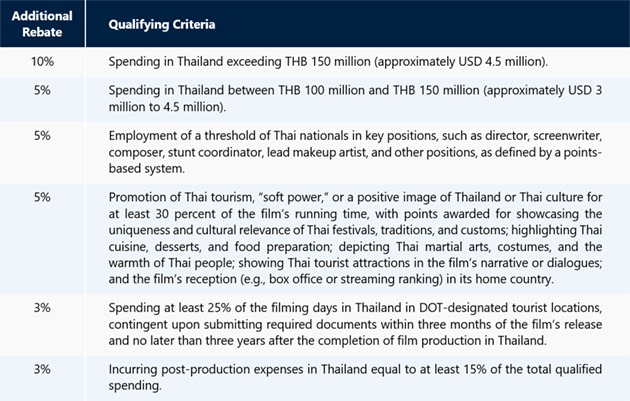
On top of this primary incentive, additional incentives are available; however, the total possible cash rebate is capped at 30 percent, and the additional incentives can only amount to an added 15 percent. Also, the total rebate (including both primary and additional incentives) for films with a budget of less than THB 100 million (approx. USD 3 million) is capped at 25%.

To obtain a higher rebate rate, productions may apply for the following additional incentives:
Compliance Requirements

Foreign production companies seeking to benefit from Thailand’s enhanced film incentives must navigate a structured application and compliance process. The 2024 announcement establishes different processing periods for applications based on spending thresholds. Noncompliance with these procedural requirements could jeopardize eligibility for the rebates, regardless of the actual amount spent in the country.

One of the key criteria for receiving the incentives is that the filming must not cause or result in environmental damage or harm to natural resources; otherwise, the approved incentives will be revoked.

The timing of this policy is noteworthy, given the recent decision regarding an environmental dispute in which Thailand’s Ministry of Natural Resources and Environment sued a major production company for over THB 100 million (approx. USD 3 million), alleging ecological damage caused during filming. The lawsuit claimed that alterations to a bay landscape and failure to comply with legal requirements and agreements established with the authorities resulted in extensive environmental harm, including deforestation and coral reef destruction. After 20 years of legal proceedings, the Thai Supreme Court ruled in 2022 that the production company must pay THB 10 million (approx. USD 300,000), or 10% of the original claim. This case underscores the risk of noncompliance with legal requirements, which can result in negative publicity, financial liability, and the loss of eligibility for incentives.

Tax Implications and Documentation Requirements

The rebate mechanism interacts with several Thai tax considerations that foreign production companies should carefully evaluate. The 2024 announcement specifies that the rebate itself is subject to 1% withholding tax under the Thai Revenue Code. Additionally, service and rental expenses paid to Thai providers typically attract withholding tax rates of 3% and 5%, respectively, while most goods and services in Thailand are subject to 7% VAT (value-added tax), significantly impacting overall production budgeting. The rebate application process also requires comprehensive financial documentation as specified in the requisition form, with all expenses requiring proper verification according to Thai Revenue Department standards.

Understanding which preproduction, production, and postproduction expenses qualify (particularly the requirement that physical production expenses in Thailand must be at least 50% of total qualified spending) requires careful planning. Professional tax and legal advice can help companies optimize their structure to maximize eligible expenses while ensuring regulatory compliance.

Final Remarks

Thailand’s revised film incentives under the DOT’s 2024 announcement provide lucrative opportunities for foreign film and television productions. By enhancing financial incentives, Thailand aims to attract more international projects, thereby stimulating economic growth and promoting cultural exchange. As the global film industry continues to evolve, Thailand’s proactive approach positions it as a competitive and attractive destination for filmmakers worldwide. Productions planning to capitalize on these incentives are advised to consult local experts to navigate the regulatory landscape effectively.

RELATED INSIGHTS​ 

July 7, 2025
On June 20, 2025, Cambodia’s Ministry of Economy and Finance issued Instruction No. 19116 to clarify when board members and company directors must receive salaries and pay payroll taxes. Board members and company directors who are not considered employees are subject to a withholding tax. This category consists of people who complete services for a nonresident individual and people who perform independent work for a company in Cambodia. Board members and company directors who are considered employees, including those appointed by a foreign head office to temporarily manage a company in Cambodia, must pay payroll taxes on any salary they receive, regardless of whether they are paid by a local or foreign branch of the company. The above obligations apply regardless of whether the person has a work permit. Board members and company directors are exempt from paying payroll tax if they: Are not present and not performing a regular management role at the company despite being registered on the company’s statutes or patent tax card; Participate only in board meetings and occasional shareholder meetings; and Do not receive a salary from a company in Cambodia. Overall, this instruction provides an important clarification regarding the tax obligations of board members and company directors. Companies should pay attention to the classification of their board members and directors and be mindful of the exemption.   This article was written with the assistance of Tilleke & Gibbins interns Amelia Gemma Erickson and Amrin Keat.
July 2, 2025
On June 17, 2025, Cambodia’s Ministry of Economy and Finance issued Instruction No. 18574 on Tax Obligations for Share Premiums to clarify that enterprises are not required to pay any income tax on share premiums that meet the conditions set out in the instruction. As outlined in the relevant provisions of the Law on Taxation (Royal Kram No. NS/RKM/0523/004) and Prakas No. 578 MEF.PrK.GDT on Tax on Income, taxable income is the difference between an asset’s value at the beginning and end of a period. This calculation deducts capital contributions, which are not taxable. A share premium is the amount of money that a company receives in excess of the par value of a share when the company issues new shares to a shareholder through a share subscription. In other words, share premiums are capital contributions made by shareholders into the equity of the company and, as a result, are not taxable. However, the government may nevertheless view share premiums as taxable if the company fails to meet certain legal conditions. Cambodian law requires share subscriptions to be properly recorded in the company’s accounting books and supported by documentary evidence. The recent instruction states that if an enterprise does not have proper documentation, any increase in equity, such as a capital increase through share premiums, will be treated as taxable income in accordance with the law. The instruction provides the following example: Enterprise A issues 200,000 new shares to an investor. The shares were registered with a par value of KHR 4,000 per share and were sold for a sale price of KHR 10,000 per share. The share premium of KHR 1.2 billion, which is calculated by subtracting the total par value (KHR 800 million) from the total value of the new capital (KHR 2 billion), is a capital
June 30, 2025
Vietnam is making notable strides in decentralization, aiming to grant greater autonomy to local government entities to streamline administrative procedures. As part of this effort, the government issued Decree No. 133/2025/ND-CP on decentralization of state management of the Ministry of Science and Technology dated June 12, 2025 (Decree 133). Effective from July 1, 2025, Decree 133 decentralizes and delegates numerous state management functions—including in intellectual property (IP) and technology transfer—to provincial-level People’s Committees (PCs). This reform signals a profound shift in how IP rights are administered and enforced across Vietnam. While this offers new opportunities for IP owners, agents, and innovators, it also introduces additional operational complexities. Impact on IP and Technology Transfer Decree 133 significantly reallocates responsibilities in IP and technology transfer, primarily to provincial-level PCs. Provincial PCs and other provincial authorities are now empowered to handle a wide range of tasks, including but not limited to the following: Issuance of duplicates and reissuance of certificates of registration. Registration of license agreements for the transfer of usage rights for industrial property objects (e.g., trademarks, patents) and recording amendments, extensions, or early terminations of such agreements. Enforcing decisions on compulsory licensing of patent use rights. Evaluation and approval of technology transfer contracts—a key step in facilitating localized technological advancements. Permitting the establishment of foreign-invested scientific organizations and their branches, to encourage foreign direct investment in local R&D and technology development. Approval of provincial-level R&D tasks, aligning with local socio-economic development priorities. Legal Implications The decentralization and delegation brought forth by Decree 133 carry several significant legal implications: Echoing Decree 133, the Intellectual Property Office of Vietnam issued Notification No. 2351/TB-SHTT on June 26, 2025, announcing the cessation of 19 administrative procedures at the national level. Specifically, from July 1, 2025, the IP Office will no longer accept requests related
June 27, 2025
Three American giants are actively protecting their intellectual property rights against generative AI, as two legal battles commence on both sides of the Atlantic. In the UK, Seattle-based media company Getty Images accuses UK-based Stability AI of multiple IP infringements. In the US, The Walt Disney Company and Universal Studios are teaming up against Midjourney, an AI startup, with their main ground being copyright infringement. Both cases are centered around questions legal minds have been posing since the introduction of generative AI: Is the output of generative AI an infringement? And who is ultimately responsible for the output, the platform or the user? Getty Images v. Stability AI Getty initially filed a claim in the High Court in 2023, which resulted in Stability applying for reverse summary judgment on the grounds that Getty had no real prospect of success, arguing that their operations took place outside the UK. However, the High Court judge hearing the case decided that the claims brought by Getty did have a real prospect of succeeding in court. Despite this, Stability saw a small victory when the court ruled that the representative action brought by Getty would not succeed due to the difficulties in identifying who qualified for the class. The proposed class was comprised of 50,000 rightsholders who alleged their rights were also infringed. Stability was successful in arguing that identifying these individuals would be challenging due to the unclear definition of the class. This current trial is centered around four main grounds: Copyright infringement. Getty accuses Stability of using content that Getty owns or has an exclusive license for when training their model, Stable Diffusion, resulting in the generated output containing substantial parts of that content. Getty is also alleging secondary copyright infringement, arguing that Stability is importing an article into the UK