
You are using an outdated browser and your browsing experience will not be optimal. Please update to the latest version of Microsoft Edge, Google Chrome or Mozilla Firefox. Install Microsoft Edge

March 12, 2025

Updates on Thailand’s Film Incentive Measures

In November 2024, Thai Prime Minister Paethongtarn Shinawatra unveiled ambitious plans to enhance tax incentives for foreign film productions during a networking reception in Los Angeles, coinciding with her visit to the APEC Economic Leaders’ Meeting in Lima, Peru. This event, attended by Motion Picture Association executives and leaders from top US film companies, marked a significant commitment to boosting foreign investment in Thailand’s film industry.

Thailand’s Department of Tourism (DOT) prioritized the initiative by updating the Announcement on Guidelines, Procedures, and Conditions for Applying for Benefits Under the Incentive Measures for Foreign Film Production in Thailand in December 2024 to further position Thailand as a destination for large-scale international film and television productions.

Key Amendments to Film Incentives under the 2024 Announcement

The 2024 announcement introduced major changes, including (1) removal of the rebate cap, previously set at THB 150 million (approx. USD 4.5 million) per project, enabling rebates based on total qualified spending, and (2) an increase in cash rebate rates. The maximum allowable cash rebate rate was increased to 30 percent from the previous cap of 20 percent. The base rate of 15 percent remains unchanged.

The primary incentive available under the 2024 announcement is a 15 percent cash rebate on qualified spending in Thailand of at least THB 50 million (approx. USD 1.5 million).

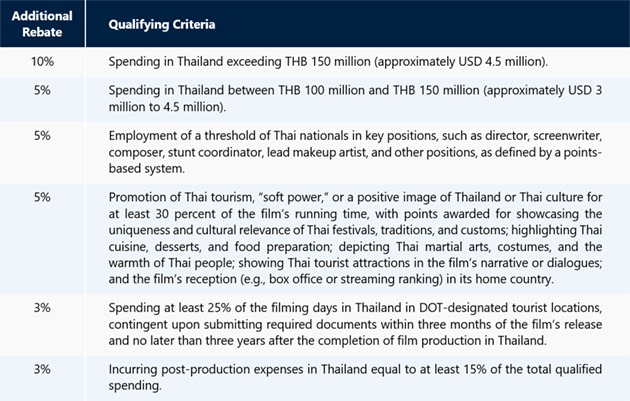
On top of this primary incentive, additional incentives are available; however, the total possible cash rebate is capped at 30 percent, and the additional incentives can only amount to an added 15 percent. Also, the total rebate (including both primary and additional incentives) for films with a budget of less than THB 100 million (approx. USD 3 million) is capped at 25%.

To obtain a higher rebate rate, productions may apply for the following additional incentives:
Compliance Requirements

Foreign production companies seeking to benefit from Thailand’s enhanced film incentives must navigate a structured application and compliance process. The 2024 announcement establishes different processing periods for applications based on spending thresholds. Noncompliance with these procedural requirements could jeopardize eligibility for the rebates, regardless of the actual amount spent in the country.

One of the key criteria for receiving the incentives is that the filming must not cause or result in environmental damage or harm to natural resources; otherwise, the approved incentives will be revoked.

The timing of this policy is noteworthy, given the recent decision regarding an environmental dispute in which Thailand’s Ministry of Natural Resources and Environment sued a major production company for over THB 100 million (approx. USD 3 million), alleging ecological damage caused during filming. The lawsuit claimed that alterations to a bay landscape and failure to comply with legal requirements and agreements established with the authorities resulted in extensive environmental harm, including deforestation and coral reef destruction. After 20 years of legal proceedings, the Thai Supreme Court ruled in 2022 that the production company must pay THB 10 million (approx. USD 300,000), or 10% of the original claim. This case underscores the risk of noncompliance with legal requirements, which can result in negative publicity, financial liability, and the loss of eligibility for incentives.

Tax Implications and Documentation Requirements

The rebate mechanism interacts with several Thai tax considerations that foreign production companies should carefully evaluate. The 2024 announcement specifies that the rebate itself is subject to 1% withholding tax under the Thai Revenue Code. Additionally, service and rental expenses paid to Thai providers typically attract withholding tax rates of 3% and 5%, respectively, while most goods and services in Thailand are subject to 7% VAT (value-added tax), significantly impacting overall production budgeting. The rebate application process also requires comprehensive financial documentation as specified in the requisition form, with all expenses requiring proper verification according to Thai Revenue Department standards.

Understanding which preproduction, production, and postproduction expenses qualify (particularly the requirement that physical production expenses in Thailand must be at least 50% of total qualified spending) requires careful planning. Professional tax and legal advice can help companies optimize their structure to maximize eligible expenses while ensuring regulatory compliance.

Final Remarks

Thailand’s revised film incentives under the DOT’s 2024 announcement provide lucrative opportunities for foreign film and television productions. By enhancing financial incentives, Thailand aims to attract more international projects, thereby stimulating economic growth and promoting cultural exchange. As the global film industry continues to evolve, Thailand’s proactive approach positions it as a competitive and attractive destination for filmmakers worldwide. Productions planning to capitalize on these incentives are advised to consult local experts to navigate the regulatory landscape effectively.


RELATED INSIGHTS​ 

August 25, 2025
Indonesia’s current regulations on franchises, as stipulated under Government Regulation No. 35/2024 on Franchising and its implementing regulation, Ministry of Trade (MOT) Regulation No. 71/2019 regarding Implementation of Franchising, highlight fundamental changes in franchise registration. These changes have introduced additional complexities and challenges in the franchise registration procedure, making it more difficult for franchise owners to navigate the process. New procedure Franchise applications are still submitted through the Online Single Submission (OSS) portal of the Capital Investment Coordinating Board (BKPM). However, the new procedure requires each applicant, including foreign franchisors, to have an OSS account and a business registration number (NIB) issued by BKPM. An application for franchise registration must be submitted under the applicant’s own account—submissions can no longer be made through the account of a consultant. Once a franchise application is submitted, the authority will distribute the submission to the MOT—the authorized ministry for franchise registration. Any notification or decision upon the registration made by the MOT will be available in the OSS system. Applicants should regularly monitor the status of the franchise application because no notifications will be sent to applicants to alert them of any deficiency. Here is the summary of the new procedure for franchisors: Notable Requirements The disclosure document, or prospectus, is the key focus for the MOT in examining a franchise registration for a franchisor. This document is subject to thorough scrutiny by the MOT to ensure that all mandatory information meets the requirements set in the franchise regulations. The current regulations specifically require that the mandatory clause “business system” in the prospectus cover operational standards and procedures, which should include human resource management, administration, operational management, standard operating methods, business location selection, business premises design, employee requirements, and marketing strategies. Other clauses that are equally important to pay attention to are:
August 21, 2025
Although the “passing off” principle has sometimes faced criticism for potentially broadening trademark protection—particularly in cases involving unregistered or unconventional marks like shapes, scents, or sounds—it serves an essential purpose. It safeguards the rights of business owners and shields consumers from deception, ensuring fair competition and reflecting the realities of modern commerce. What is passing off, and why is registrability not required? The passing-off principle is a legal concept rooted in English law, aimed at preventing a person from falsely representing or using a mark similar to another’s in a way that causes consumers to mistakenly believe the goods or services come from the same source. Under Thai law, the passing-off principle is provided under Section 46 of the Thai Trademark Act, which states: No person shall be entitled to bring legal proceedings to prevent or to recover damages for the infringement of an unregistered trademark. The provisions of this Section shall not affect the right of the owner of an unregistered trademark to bring legal proceedings against any person for passing off goods as those of the owner of the trademark. The passing-off principle can be interpreted as a practical legal concept. It does not require proof that the mark is registrable or meets the registrability criteria under trademark law. It is sufficient to show that the mark has established goodwill and that the other party’s use of a similar mark is likely to confuse consumers, making it a straightforward and effective tool for protecting brand assets. Requiring a claimant to prove that an unregistered mark could have been registered would undermine the very function of passing off. The doctrine was conceived precisely to fill the gaps left by the registration system. Imposing registrability criteria would nullify its function and leave many commercially valuable identifiers unprotected. If the
August 15, 2025
Indonesia’s Directorate General of Intellectual Property (DGIP) has introduced a temporary feature in its online filing system to accommodate the submission of annual patent working statements. The requirement to submit these annual working statements was introduced under the amended Patent Law enacted on October 28, 2024, but the implementing regulation has still not been issued. Annual Working Statements Article 20A of the amended Patent Law requires all patentees to submit an annual statement regarding the implementation of their patents in Indonesia. This obligation applies to all active patents, regardless of when they were granted. The annual working statement declares the status of implementation of the patented invention within Indonesia. Acceptable forms of implementation include: Manufacturing the patented product (whether commercialized or not) Utilizing the patented process (whether commercialized or not) Importation Licensing If the patent has not yet been implemented in Indonesia, the DGIP provides an option to indicate: “The mentioned registered patent has not been implemented in Indonesia.” The statement must be made using the official template provided by the DGIP through the online filing system. Submission The working statement must be submitted annually no later than December 31 of each calendar year. No supporting documents are needed for the submission apart from the signed form itself. A color scanned copy will suffice; the original document is not required. There is currently no official fee for submitting the working statement. While the submission process may eventually align with annuity fee payments, the current process remains separate due to the pending implementing regulation. The submission process may be subject to change upon issuance of the implementing regulation, which is under discussion and expected in the coming months. In the interim, the DGIP accepts submissions of overdue working statements, allowing patentees to fulfill their obligations retroactively. This flexibility is expected
July 31, 2025
The Madrid System for international trademark registration provides the opportunity for a simplified and cost-effective way to register trademarks in multiple countries through a single application. Indonesia joined the Madrid System in 2018, and in 2024 alone, it received over 8,600 applications through this system. Despite the system’s effectiveness, it is important for trademark owners to be aware of the potential risks of refusal that can arise during the process of registration. Trademark applicants must pay close attention to these critical points when designating Indonesia. Appointing a Local Representative to Respond An applicant or representative of an international registration (IR) application that has been provisionally refused must appoint a local Indonesian representative in order to submit a response to the provisional refusal. This appointment is solely for the purpose of responding to the refusal in Indonesia; it is not necessary if the IR has not received any rejection. Furthermore, the local representative should not be registered with WIPO, as doing so would affect representation across all designated countries. Timing When it comes to calculating the deadline for responding to a provisional refusal, there is a discrepancy between the methods used by the DGIP and WIPO. Under the Indonesian Trademark Law, trademark owners can file a response within 30 working days, excluding weekends and national holidays. However, the WIPO cover letter accompanying the DGIP’s provisional refusal notice specifies both the start date and the deadline for responding to the notification, which is calculated as 30 calendar days, including weekends and national holidays. Therefore, a response to the provisional refusal of IR should be submitted in accordance with the WIPO cover letter to prevent any formality issue. Grounds for Refusal After an IR application is published in Indonesia’s Trademark Gazette, it undergoes substantive examination by the Directorate General of Intellectual Property (DGIP) examiners. The