
You are using an outdated browser and your browsing experience will not be optimal. Please update to the latest version of Microsoft Edge, Google Chrome or Mozilla Firefox. Install Microsoft Edge

August 25, 2025

The Impact of Recent Franchise Regulation Changes in Indonesia

Indonesia’s current regulations on franchises, as stipulated under Government Regulation No. 35/2024 on Franchising and its implementing regulation, Ministry of Trade (MOT) Regulation No. 71/2019 regarding Implementation of Franchising, highlight fundamental changes in franchise registration. These changes have introduced additional complexities and challenges in the franchise registration procedure, making it more difficult for franchise owners to navigate the process.

New procedure

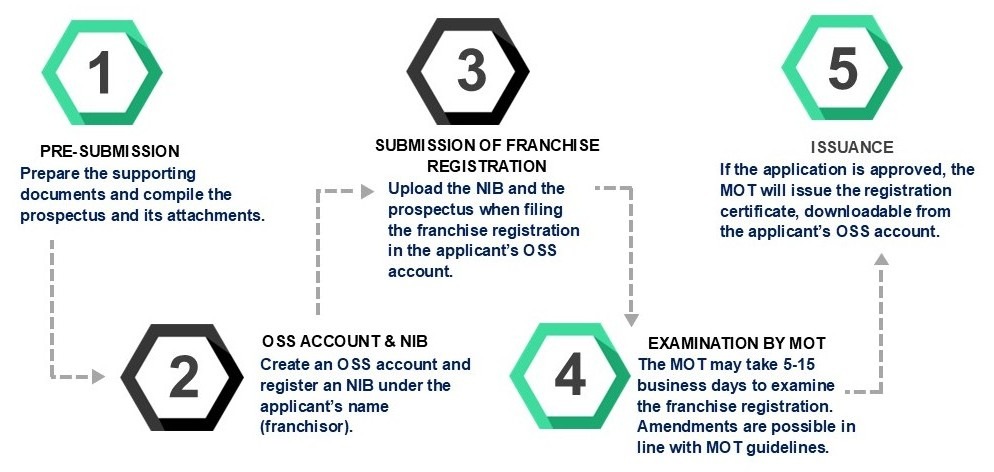
Franchise applications are still submitted through the Online Single Submission (OSS) portal of the Capital Investment Coordinating Board (BKPM). However, the new procedure requires each applicant, including foreign franchisors, to have an OSS account and a business registration number (NIB) issued by BKPM. An application for franchise registration must be submitted under the applicant’s own account—submissions can no longer be made through the account of a consultant.

Once a franchise application is submitted, the authority will distribute the submission to the MOT—the authorized ministry for franchise registration. Any notification or decision upon the registration made by the MOT will be available in the OSS system. Applicants should regularly monitor the status of the franchise application because no notifications will be sent to applicants to alert them of any deficiency.

Here is the summary of the new procedure for franchisors:
Notable Requirements

The disclosure document, or prospectus, is the key focus for the MOT in examining a franchise registration for a franchisor. This document is subject to thorough scrutiny by the MOT to ensure that all mandatory information meets the requirements set in the franchise regulations.

The current regulations specifically require that the mandatory clause “business system” in the prospectus cover operational standards and procedures, which should include human resource management, administration, operational management, standard operating methods, business location selection, business premises design, employee requirements, and marketing strategies.

Other clauses that are equally important to pay attention to are:

  • Identity of the franchisor: The identity should be in line with the IP owner. If not, a license agreement will be required.
  • Business legality of the franchisor: The business license must be attached to the prospectus.
  • Profit statements for the last two years: Audited financial report showing profit and loss.

Impact

The requirement for franchisors and franchisees to have an OSS account introduces additional steps and expenses in the franchise registration process. This requirement can be particularly burdensome for franchise business actors, as franchise registration is often facilitated by third parties, such as consultants. The new regulation mandates that the registration be submitted under the franchisor’s own account, which can be especially challenging for franchisees located overseas.

Ideally, creating an OSS account would be an option rather than a compulsion—this would ease the registration process for franchise business owners. Additionally, the OSS system should be made easier to navigate.

Nonetheless, the requirements stand for now, and business operators should take note of the additional steps that apply to them.


RELATED INSIGHTS​ 

July 27, 2026
Vietnam’s new E-Commerce Law, which took effect on 1 July 2026 along with its implementing Decree No. 248/2026/ND-CP (Decree 248), marks a significant development in the country’s approach to online intellectual property (IP) enforcement, reflecting a clear shift from a reactive model of intermediary liability to one that expects platforms to play a more active role in preventing infringement. From notice-and-takedown to platform responsibility The most significant change introduced by the E-Commerce Law is the transformation of the legal role of e-commerce platforms. The existing safe harbor provisions under the IP Law and the copyright notice-and-takedown regime established by Decree 17/2023/ND-CP (Decree 17) largely required intermediaries to act only after receiving notice of infringement. Once infringing content had been removed, the platform’s legal obligation was generally considered fulfilled. The new legislation adopts a fundamentally different approach. Article 17 of the E-Commerce Law requires intermediary platforms to screen information relating to goods and services before publication in order to prevent listings involving counterfeit or IP-infringing goods, and goods of unknown origin. Rather than relying exclusively on complaints from rights holders, platforms are now expected to implement preventive measures before infringing listings become publicly available. Decree 248 further requires platforms to update keyword filters based on recommendations issued by competent authorities. These filtering mechanisms are intended to prevent prohibited listings from appearing on the platform and represent a further move away from a purely complaint-driven enforcement model. The legislation also introduces Vietnam’s first statutory stay-down obligation. Under the E-Commerce Law and Decree 248, major digital platforms must maintain automated systems capable of reviewing, warning against, and removing unlawful listings while also implementing measures to prevent repeat violations, defined under Decree 248 as conduct that has previously been identified and handled by the platform, but continues to recur. This obligation addresses one
July 8, 2026
On July 7, 2026, the Trade Competition Commission of Thailand (TCCT) issued a press release announcing the establishment of two new subcommittees designed to intensify oversight of digital platforms and modern trade businesses. The formation of the digital platform subcommittee marks a significant escalation in competition enforcement following the TCCT’s Guidelines on Multi-Sided Platforms and E-Commerce Businesses, which took effect on March 25, 2026. Platform operators, sellers, and related service providers should expect heightened regulatory scrutiny and potential investigations into practices already flagged under the March guidelines. Two Dedicated Enforcement Bodies The first new body is the digital platform subcommittee—formally the Subcommittee on Supervision, Monitoring, and Prevention of Trade Conduct in Digital Platform Business. It is tasked with driving intensive oversight of digital platform businesses. It will coordinate with government agencies, the private sector, business operators, and other relevant stakeholders to supervise and prevent trade conduct that may affect competition, and to promote free and fair competition in the digital platform sector. The subcommittee will be composed of TCCT members and representatives from the Department of Internal Trade. The second body—the Subcommittee on Determining Guidelines and Action Plans Concerning Competition Conditions in Modern Wholesale and Retail Business—will study, analyze, and monitor market structure in modern wholesale and retail businesses, compile databases to analyze retail business concentration, assess impacts on small-scale operators, and propose supervisory measures for the retail sector. TCCT members will serve on the subcommittee alongside experts from government and private organizations, including the Office of Industrial Economics, the Office of Small and Medium Enterprises Promotion, the Thai SME Federation, and the Thai SME Council. Operational Impact for Industry Participants These subcommittees provide the TCCT with a focused mechanism to investigate various trade practices deemed unfair, and the TCCT has authority under the Trade Competition Act to issue cease-and-desist
June 29, 2026
Thailand’s cabinet has approved the draft Act on Liability for Defective Goods, commonly called Thailand’s “Lemon Law.” The Draft Act is currently pending consideration by Parliament. The draft law aims to strengthen buyers’ position in pursuing cases against sellers. While the Civil and Commercial Code offers provisions governing liability for defective goods, it is difficult in practice for buyers to successfully make a claim against sellers, particularly where defects are latent and not discoverable at the time of sale or delivery. By introducing product-specific rules and clearer remedies, the new law is intended to modernize Thailand’s consumer protection framework and align it more closely with international standards, and to help relieve the buyer’s burden of proof against the seller in product liability cases. If enacted, the draft act will take effect 180 days after publication in the Government Gazette, giving businesses a transition period to assess their compliance obligations. This article provides an overview of the key provisions of the draft act and highlights some practical considerations for businesses operating in Thailand. Scope and Key Definitions The draft act applies to sellers—defined as persons who sell goods in the ordinary course of business—and protects buyers, a term defined broadly to include not just the original purchaser but also transferees and successors in title. This expands the class of people who can bring claims. The law does not apply to used goods, live animals, or goods exempted by future ministerial regulation. It also leaves intact any separate warranties, promises, advertisements, or other guarantees a seller has given; those remain enforceable alongside the new statutory rights. General Liability for Defective Goods Sellers are liable for defects that exist at the time of delivery, regardless of whether the seller knew about them. Liability arises where a defect reduces: The benefit intended under
June 19, 2026
For the first time, Thailand’s Food and Drug Administration (FDA) has published a consolidated list identifying all substances that have successfully passed its novel food safety evaluation process. The list is a step forward in regulatory transparency, but it also highlights a feature of the Thai regime that food companies often overlook: each approval is tied exclusively to the company that applied for it. A substance’s appearance on the list does not give other companies the green light to use it. This article examines the structure of Thailand’s novel food approval framework, the implications of applicant exclusivity, and the strategic choices it requires of food companies looking to bring novel ingredients to the Thai market. Thai FDA Food Safety Evaluation Framework Notification No. 376 of the Ministry of Public Health requires novel food substances to undergo a food safety assessment, with an exemption only for novel foods manufactured exclusively for export. The framework also encompasses “foods that do not qualify as novel foods” but which present characteristics warranting a safety evaluation, such as differing quality standards, increased serving sizes, or applications in specific food categories, where such changes affect consumption levels, nutritional value, or consumer safety. The recently published list of foods that passed the safety evaluation by the Thai FDA is structured by substance category and identifies the approved company (domestic manufacturer or importer), country of origin, substance name and trade name, approved purpose of use, and date of the Thai FDA’s approval notification certificate. A notable feature of Thailand’s novel food regime is that the approval result is tied exclusively to the company that submitted the application. Publication of the consolidated list does not constitute a general authorization to use the approved substances. The Thai FDA’s approval certificate specifies the approved conditions of use and the requirements