You are using an outdated browser and your browsing experience will not be optimal. Please update to the latest version of Microsoft Edge, Google Chrome or Mozilla Firefox. Install Microsoft Edge

September 5, 2019

Update on Thailand’s “Delisting” of Marijuana and Hemp from the Scope of Category 5 Narcotics

On Friday August 30, 2019, a Notification of the Thai Ministry of Public Health (“MOPH Notification”) was published in the Government Gazette. The MOPH Notification went into effect on August 31, 2019, one day after its publication.

This MOPH Notification outlines another Thai Government initiative in connection with the free cannabis policy, this time carving out further aspects of marijuana and hemp use from the stringent regulations under the Narcotics Act.

Marijuana is described in the MOPH Notification as plants of the cannabis genus, including all parts of a marijuana plant and the substances or chemicals found in a marijuana plant. Hemp is defined as plants falling within Cannabis sativa L. Subsp. sativa, including all parts of a hemp plant.

In fact, marijuana and hemp are not entirely “delisted” from the classification of Category 5 Narcotics as identified in the Narcotics Act. While these plants are still listed as Narcotics, the MOPH Notification serves to prescribe “exceptions”, meaning aspects and particulars of marijuana and hemp related products that are not considered Narcotics.

The new exceptions are summarized below.

For both marijuana and hemp

(1) Marijuana or hemp stalks, stem cores, and fibers are excepted, if dried. The products made of such dry parts are excepted, as well.

(2) Cannabidiol (CBD) extracted from marijuana or hemp is excepted if having at least 99% purity and no more than 0.01 percent by weight of tetrahydrocannabinol (THC).

(3) Extracts of marijuana or hemp having CBD as the main constituent and no more than 0.2% by weight of THC, which are considered “drugs” as per the Drug Act, or Herbal Products as identified in the Herbal Products Act.

For hemp only

(4) Hemp seeds or hemp seed oil, which are considered Food as identified in the Food Act.

(5) Hemp seed oil or hemp seed extracts, which are considered Cosmetics as identified in the Cosmetics Act.

In other words, hemp products according to the above descriptions may now be classified as Medicinal Drugs, Herbal Products, Food, or Cosmetics under their respective regulations. Marijuana may now be classified as Medicinal Drugs or Herbal Products only.

It should be noted that during the first five years under the MOPH Notification of August 30, 2019, the exceptions per (3) – (5) above apply only to domestic production by a licensee under the respective laws. This means the importation of products that would otherwise fall within those exceptions would still be regulated by the Narcotics Act—highlighting the Thai Government’s agenda in protecting Thai business operators.

According to the Thai Ministry of Public Health’s public conference held on September 2, 2019, the exception per (2) above for high-purity extracts (99% or higher of CBD; 0.01% or lower of THC) are intended to cover laboratory-grade standard extracts. For the (3) – (5) exceptions, the Thai FDA will later issue further rules under the Drug Act, the Herbal Products Act, the Cosmetics Act, or the Food Act to specifically accommodate the use of marijuana and hemp extracts in the respective products.

Moreover, amendments to the previous Industrial Hemp Regulation of 2016 are in the pipeline. The purpose of these amendments are to include non-public entities as parties having standing to apply for industrial hemp licenses.

Abridged Translation of the MOPH Notification
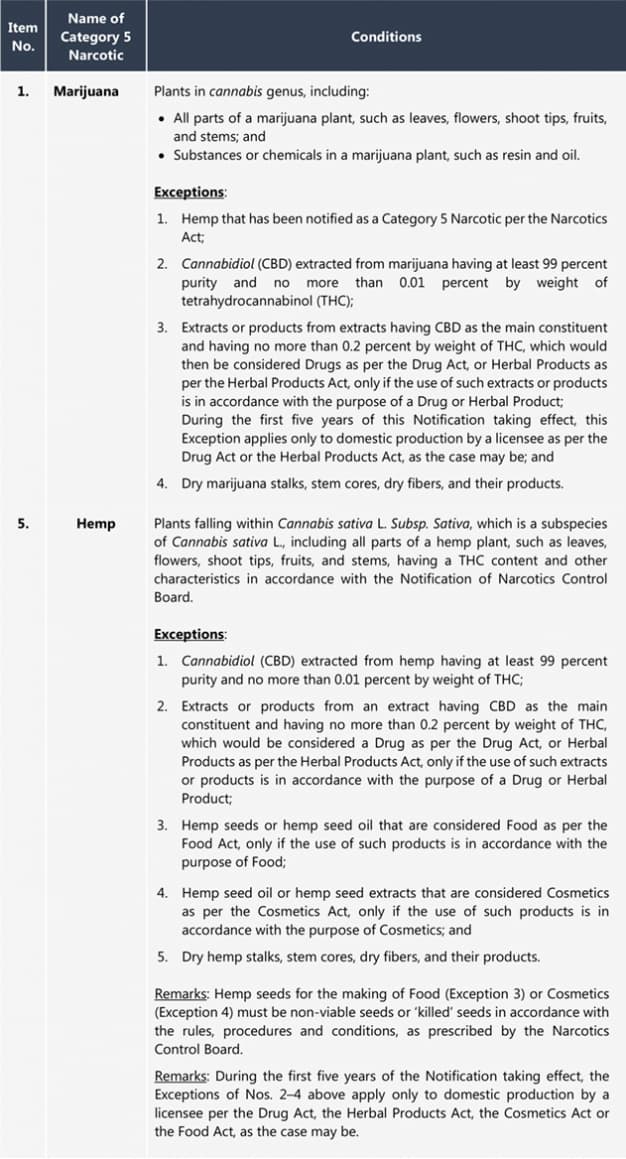
Remarks: The present MOPH Notification (2019) does not affect Items Nos. 2–4 on this list, which were prescribed by the previous MOPH Notification of 2018. Said unaffected items are:

No. 2:    Kratom (Mitragyna speciose);

No. 3:    Opium poppies (Papaver somniferum L. and Papaver bracteatum Lindl.); and

No. 4:    Psilocybin mushrooms.

Details about the above Nos. 2–4 are omitted from this update.

RELATED INSIGHTS​ 

October 15, 2025
The Indonesian Food and Drug Administration (BPOM) has introduced more stringent oversight of health supplements containing probiotics with new guidelines that require clinical trials for certain products and expanded documentation standards. BPOM Regulation No. 17 of 2025 replaces the previous 2021 regulation and establishes a comprehensive framework for evaluating probiotic strains used in health supplements. Assessment Requirements The new regulation expands the scope of assessment to include not only categorization and documentation but also technical procedures, strain classification, and clinical trial requirements. Unlike the previous regulation, which provided general guidance, the updated framework creates a comprehensive system for evaluating both registered probiotic strains and new or combined strains. Manufacturers must now submit supporting documentation covering strain identification and functional characterization, safety, efficacy, and product quality. The previous regulation required documentation only on safety, efficacy, and quality. Clinical Trials One of the most significant changes is the requirement for clinical trials conducted in Indonesia for applications that include benefit claims other than maintaining digestive health, or where there are modifications to benefit claims. The regulation specifies that phase 1 trials must demonstrate safety, while phase 2 trials must validate efficacy using statistically valid methods such as double-blind, randomized, placebo-controlled studies). In addition, phase 3 and phase 4 trials may be required, and postmarket surveillance data must be submitted. Technical Assessment Framework Annex 4, a newly introduced section, establishes technical procedures for assessing health supplements containing probiotics in Indonesia. This comprehensive framework outlines criteria for evaluating new probiotic strains, including strain identification, functional characterization, safety, efficacy, and product quality. The annex introduces a clear classification of claims for health supplement products containing probiotics: General claims(e.g., maintaining digestive health). Functional claims(e.g., normal biological function or activity in the body). Risk reduction claims(e.g., lowering disease risk). The regulation restricts use of the term
October 3, 2025
On September 26, 2025, the Contract Committee under Thailand’s Consumer Protection Board issued a regulation that aims to standardize contracts and enhance consumer protection within the beauty and wellness industry. The Notification on Prescribing the Beauty Service Business as a Contract-Controlled Business B.E. 2568 (2025), which takes effect on January 24, 2026, requires business operators to use a prescribed standard contract in Thai and adhere to strict mandatory provisions and prohibitions. These regulations apply to operators across all in-person and online service channels, including via digital platforms. “Beauty services business” is defined as the provision of services under an agreement allowing consumers to receive a series of treatments, either over a set number of sessions or within a set period. This includes massage, spa, other methods for cleanliness, beauty, or care of facial or body skin, and weight control and body shaping—including services offered electronically. The law excludes surgery, liposuction, and medical treatments performed by licensed practitioners. The notification establishes the following key requirements: Mandatory contract and formatting. All contracts with consumers must use the standard contract form, in Thai, with clear, readable text (minimum font size of 2 millimeters, no more than 11 characters per inch), and include all essential terms from the annexed form. Contract execution. Contracts must be made in duplicate, with one copy given to the consumer at signing. For agreements concluded through electronic channels, the process must comply with the Electronic Transactions Act and use the same required terms. Digital platforms. Business operators who provide services facilitated through a digital platform as an intermediary are ultimately responsible for ensuring the consumer receives a compliant contract. Prohibited clauses. The law prohibits clauses that limit or exclude liability for damages to life, body, health, mind, or property resulting from breach of contract or a wrongful act;
September 16, 2025
Since Thailand formally removed Mitragyna speciosa (kratom) from the list of narcotic drugs, the country has progressed from outright prohibition to a structured, license-based regime. While the Ministry of Public Health oversees cannabis plant regulation, the Ministry of Justice (MOJ) is the regulatory authority overseeing kratom plants. For the avoidance of doubt, separate Ministry of Public Health notifications prohibit the use of kratom as a food ingredient unless a food safety evaluation has been conducted; however, this restriction does not affect trade in unprocessed leaves per se. For businesses in Thailand dealing exclusively in kratom leaves, the most consequential development is the Ministerial Regulation on the Application for Permits and Notifications for the Importation and Exportation of Kratom Leaves B.E. 2568 (2025), a bylaw of the Kratom Plant Act 2022. The ministerial regulation establishes the following notable definitions: “Kratom leaves”: Fresh or dried leaves in their natural, unprocessed state (no extracts, concentrates, or infused products). “Import/Export”: Any act of bringing kratom leaves into or out of Thailand, whether for commercial sale, industrial processing abroad, or research. Import/Export Licensing Under the Kratom Plant Act, a license is mandatory for importing or exporting kratom leaves. Individuals, juristic persons, community enterprises, and state agencies in Thailand are eligible to obtain a license to import (or a license to export) kratom leaves. Licenses are available to qualified individuals and juristic persons. Individuals must satisfy the following qualifications to be eligible for a license: Thai nationality, ≥ 20 years old, resident in Thailand. Not incompetent, quasi-incompetent, or under legal guardianship. No license suspension currently in force under the Kratom Act or Narcotics Code. No license revocation in the previous two years. No conviction under the Kratom Act or Narcotics Code within the previous two years (unless fully released from punishment). Juristic persons must satisfy