
You are using an outdated browser and your browsing experience will not be optimal. Please update to the latest version of Microsoft Edge, Google Chrome or Mozilla Firefox. Install Microsoft Edge

August 25, 2025

The Impact of Recent Franchise Regulation Changes in Indonesia

Indonesia’s current regulations on franchises, as stipulated under Government Regulation No. 35/2024 on Franchising and its implementing regulation, Ministry of Trade (MOT) Regulation No. 71/2019 regarding Implementation of Franchising, highlight fundamental changes in franchise registration. These changes have introduced additional complexities and challenges in the franchise registration procedure, making it more difficult for franchise owners to navigate the process.

New procedure

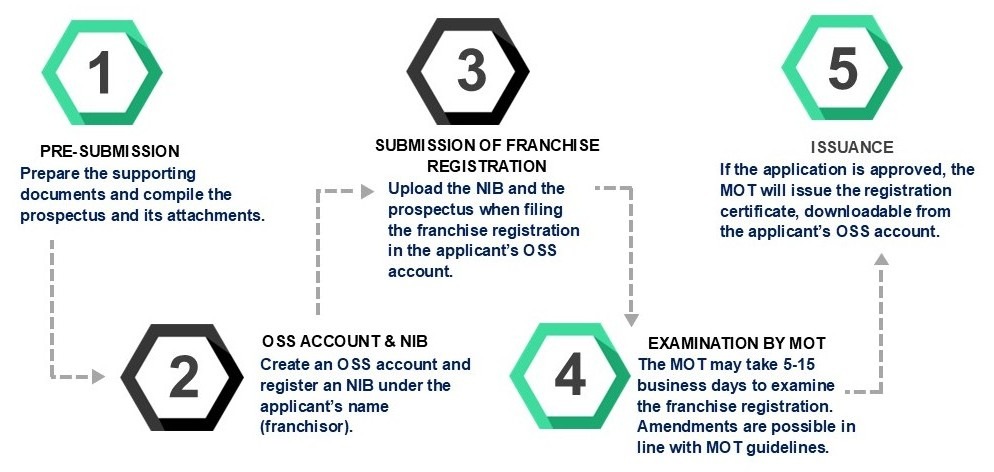
Franchise applications are still submitted through the Online Single Submission (OSS) portal of the Capital Investment Coordinating Board (BKPM). However, the new procedure requires each applicant, including foreign franchisors, to have an OSS account and a business registration number (NIB) issued by BKPM. An application for franchise registration must be submitted under the applicant’s own account—submissions can no longer be made through the account of a consultant.

Once a franchise application is submitted, the authority will distribute the submission to the MOT—the authorized ministry for franchise registration. Any notification or decision upon the registration made by the MOT will be available in the OSS system. Applicants should regularly monitor the status of the franchise application because no notifications will be sent to applicants to alert them of any deficiency.

Here is the summary of the new procedure for franchisors:
Notable Requirements

The disclosure document, or prospectus, is the key focus for the MOT in examining a franchise registration for a franchisor. This document is subject to thorough scrutiny by the MOT to ensure that all mandatory information meets the requirements set in the franchise regulations.

The current regulations specifically require that the mandatory clause “business system” in the prospectus cover operational standards and procedures, which should include human resource management, administration, operational management, standard operating methods, business location selection, business premises design, employee requirements, and marketing strategies.

Other clauses that are equally important to pay attention to are:

  • Identity of the franchisor: The identity should be in line with the IP owner. If not, a license agreement will be required.
  • Business legality of the franchisor: The business license must be attached to the prospectus.
  • Profit statements for the last two years: Audited financial report showing profit and loss.

Impact

The requirement for franchisors and franchisees to have an OSS account introduces additional steps and expenses in the franchise registration process. This requirement can be particularly burdensome for franchise business actors, as franchise registration is often facilitated by third parties, such as consultants. The new regulation mandates that the registration be submitted under the franchisor’s own account, which can be especially challenging for franchisees located overseas.

Ideally, creating an OSS account would be an option rather than a compulsion—this would ease the registration process for franchise business owners. Additionally, the OSS system should be made easier to navigate.

Nonetheless, the requirements stand for now, and business operators should take note of the additional steps that apply to them.


RELATED INSIGHTS​ 

November 18, 2024
A new notification on required labeling and packaging for alcoholic beverages was published in Thailand’s Government Gazette on November 8, 2024, taking full effect the following day. The notification (Notification of the Alcoholic Beverage Control Committee Re: Criteria, Methods, and Conditions for Packaging of Alcoholic Beverages and Warning Statements of Alcoholic Beverages Both Produced Domestically and Imported into Thailand 2024) essentially reaffirms a mandatory requirement for packaging and warning statements for alcoholic beverages, which echoes existing regulations from 2009 and 2017. Under the authority of the Alcoholic Beverage Control Act B.E. 2551 (2008) (ABCA), the notification reinforces the Alcoholic Beverage Control Committee’s objective of promoting consumer awareness through standardized warning labels. The notification addresses the following key aspects: Packaging definitions. The notification defines packing-related terms for the first time under the ABCA. These terms include (1) packaging, (2) containers (also known as primary packaging), and (3) outer packaging (secondary packaging). Packaging requirements. Containers for alcoholic beverages produced or imported for sale in Thailand must be at least 0.175 liters each. Warning statements. Although alcoholic beverages are classified as food under the Food Act B.E. 2522 (1979), the notification exempts alcoholic beverages from general food labeling requirements prescribed in the Food Act. Instead, it mandates that the following warning statements be prominently displayed: Sale of liquor to persons under 20 years old is prohibited; Drinking reduces driving ability; and Not suitable for persons under 20 years old. Format. The notification specifies that these warning statements must be written in Thai, in bold characters, with a minimum type size of five millimeters. The warning must be enclosed in a box that contrasts with the label background and surrounding content. Exemptions. Certain products, such as alcoholic beverages imported as samples or otherwise not intended for commercial sale, are exempt from the warning
November 1, 2024
Tilleke & Gibbins has contributed the Thailand chapter to Franchise 2025 from the International Comparative Legal Guides (ICLG) series published by Global Legal Group. This comprehensive guide provides detailed analysis of franchise laws and regulations across multiple jurisdictions worldwide. Each chapter of the guide follows a Q&A format, organized into key sections covering critical aspects of franchise law and operations, including: Relevant legislation and rules governing franchise transactions Business organization options for franchised operations Competition law considerations Protection of intellectual property and brands Liability issues and risk mitigation Governing law and dispute resolution Real estate matters Online trading regulations Termination requirements Joint employer risks and vicarious liability Currency controls and taxation Commercial agency considerations Good faith obligations and fair dealing requirements Ongoing relationship management Franchise renewal processes Franchise migration procedures Electronic signatures and document retention The Thailand chapter, authored by Alan Adcock and Kasama Sriwatanakul, examines these topics in detail, with particular attention to recent developments like the Trade Competition Commission’s Franchising Guidelines which introduced new disclosure requirements and protections for franchisees. The complete Thailand chapter is available as a PDF below. The Thailand chapter—and the full Franchise 2025 guide—are also freely available on the ICLG website.
October 8, 2024
Thailand’s Electronic Transactions Development Agency (ETDA) issued guidelines for managing advertisements on digital platform services (DPSs) earlier this year. These guidelines aim to prevent fraud, illegal product or service offerings, and inducements to commit illegal acts, and are likely to provide a basis for greater regulation of this issue in the future. Key obligations for DPS business operators under the guidelines are detailed below. Advertiser Screening and Data Collection Verification and collection: Business operators must establish processes for verifying and collecting advertiser data. This includes steps, methods, and required information for advertiser registration. Identity verification: Business operators should follow identity verification requirements for advertiser registration. This may include using identity verification results from other identity providers or conducting their own identity verification processes with a minimum identity assurance level (IAL) of IAL2. Data storage: Advertiser data must be stored in a machine-readable format. Business operators must maintain records for watchlists, blacklists, and whitelists. Prepublication Advertisement Review Review process: Business operators should review advertisements before publication. This review should consider factors such as prohibited or restricted advertisements, required permissions, and avoiding sensitive user data. Postpublication Monitoring Advertisement monitoring: Business operators must monitor published advertisements using automated systems, staff, or contracted personnel. Criteria for prioritizing reviews should be established. Reporting channels: Business operators must provide channels for users to report illegal or inappropriate advertisements. Reports must be promptly addressed, prioritizing cases involving intellectual property owners or multiple credible reports. Advertiser account monitoring: Business operators must monitor advertiser accounts. This includes considering factors such as the number of reports/flags received and compliance with service agreements and community standards. For more information on this initiative from the ETDA, or on any aspect related to Thailand’s regulations for DPSs, please contact Athistha (Nop) Chitranukroh at [email protected], Thammapas Chanpanich at [email protected], Pornpan Wichawut at [email protected],
September 26, 2024
Indonesia enacted a new franchise regulation, Government Regulation No. 35 of 2024 on Franchising (“GR 35/2024”), on September 2, 2024. Franchising in Indonesia was previously governed by Government Regulation No. 42 of 2007 on Franchising (“GR 42/2007”), along with an implementing regulation, Ministry of Trade Regulation No. 71 of 2019 regarding Implementation of Franchising (“MOT Regulation 71/2019”). This new regulation repeals GR 42/2007. However, MOT Regulation No. 71/2019 remains in effect until a new MOT regulation can be enacted. The new franchise regulation contains several amendments and provides more detailed requirements to complement MOT Regulation No. 71/2019. Comparison of GR 35/2024 to GR 42/2007 Minimum years of business operation. The new regulation reduces the minimum duration that a franchise registration applicant must have been operating from five years to three years. Intellectual property (IP) status. Any relevant IP must now be registered before a franchise registration application can be submitted. This is a change from the previous regulations, under which it was possible to obtain a franchise registration (STPW) while an IP application was still pending, and if the IP application could not be registered, the STPW would be canceled. Registration requirements for foreign franchisors. Under the new regulation, foreign franchisors must provide a legalized or apostilled business permit document from the country of origin in addition to the previously required franchise offering prospectus and statement letter from the relevant Indonesian authority. Administrative sanctions. The new regulation has adjusted the three escalating stages of administrative sanctions to (1) two warning letters, (2) a 14-day suspension from business activities, and (3) STPW revocation. This varies from the three stages under the previous regulation (three warning letters, fine, and STPW revocation). The new regulation also expands the list of noncompliant actions that are subject to these administrative sanctions. In addition to