
You are using an outdated browser and your browsing experience will not be optimal. Please update to the latest version of Microsoft Edge, Google Chrome or Mozilla Firefox. Install Microsoft Edge

August 25, 2025

The Impact of Recent Franchise Regulation Changes in Indonesia

Indonesia’s current regulations on franchises, as stipulated under Government Regulation No. 35/2024 on Franchising and its implementing regulation, Ministry of Trade (MOT) Regulation No. 71/2019 regarding Implementation of Franchising, highlight fundamental changes in franchise registration. These changes have introduced additional complexities and challenges in the franchise registration procedure, making it more difficult for franchise owners to navigate the process.

New procedure

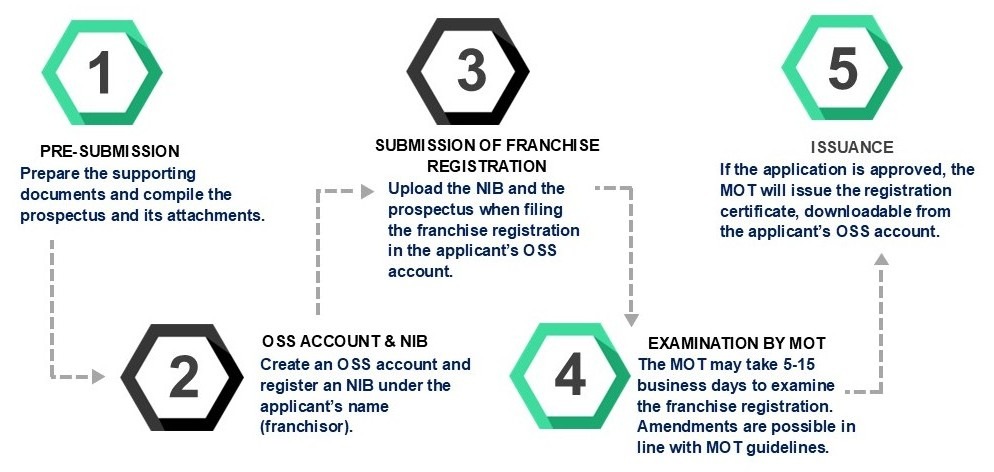
Franchise applications are still submitted through the Online Single Submission (OSS) portal of the Capital Investment Coordinating Board (BKPM). However, the new procedure requires each applicant, including foreign franchisors, to have an OSS account and a business registration number (NIB) issued by BKPM. An application for franchise registration must be submitted under the applicant’s own account—submissions can no longer be made through the account of a consultant.

Once a franchise application is submitted, the authority will distribute the submission to the MOT—the authorized ministry for franchise registration. Any notification or decision upon the registration made by the MOT will be available in the OSS system. Applicants should regularly monitor the status of the franchise application because no notifications will be sent to applicants to alert them of any deficiency.

Here is the summary of the new procedure for franchisors:
Notable Requirements

The disclosure document, or prospectus, is the key focus for the MOT in examining a franchise registration for a franchisor. This document is subject to thorough scrutiny by the MOT to ensure that all mandatory information meets the requirements set in the franchise regulations.

The current regulations specifically require that the mandatory clause “business system” in the prospectus cover operational standards and procedures, which should include human resource management, administration, operational management, standard operating methods, business location selection, business premises design, employee requirements, and marketing strategies.

Other clauses that are equally important to pay attention to are:

  • Identity of the franchisor: The identity should be in line with the IP owner. If not, a license agreement will be required.
  • Business legality of the franchisor: The business license must be attached to the prospectus.
  • Profit statements for the last two years: Audited financial report showing profit and loss.

Impact

The requirement for franchisors and franchisees to have an OSS account introduces additional steps and expenses in the franchise registration process. This requirement can be particularly burdensome for franchise business actors, as franchise registration is often facilitated by third parties, such as consultants. The new regulation mandates that the registration be submitted under the franchisor’s own account, which can be especially challenging for franchisees located overseas.

Ideally, creating an OSS account would be an option rather than a compulsion—this would ease the registration process for franchise business owners. Additionally, the OSS system should be made easier to navigate.

Nonetheless, the requirements stand for now, and business operators should take note of the additional steps that apply to them.


RELATED INSIGHTS​ 

September 9, 2024
The popularity of the franchise business model has been growing rapidly in Southeast Asia in recent years, with some of the world’s top brands becoming common sights in the commercial districts and shopping malls of major regional cities in Cambodia, Indonesia, Laos, Myanmar, Thailand, and Vietnam. While for most countries in this part of the world, franchising has not been explicitly mentioned in legislation, well prepared franchise business operations can comfortably adapt to each country’s regulatory framework, and the growth is poised to continue even as the global retail sector redesigns and redoubles its efforts in the wake of the COVID-19 outbreak. In fact, the franchise business model, which is both global and hyper-local at once, is one of the most promising solutions that entrepreneurs are turning to in their quest to overcome the challenges of the new economic reality. The Regional Guide to Franchising Law in Southeast Asia provides key, up-to-date insights into the legal frameworks regulating franchise operations in these Southeast Asian countries, and helps brand owners understand the most relevant laws, authorities, and procedures for their business. Some of the essential topics covered for each jurisdiction include considerations in negotiating and designing franchise agreements, protecting intellectual property rights, and important information on judicial and arbitral procedures should a dispute arise between franchisor and franchisee. Practitioners from Tilleke & Gibbins’ offices in Cambodia, Indonesia, Laos, Myanmar, Thailand, and Vietnam contributed to guide—not only by providing legal expertise on the laws and mechanisms applicable in each jurisdiction, but also by examining strategies for establishing and running resilient franchise operations in Southeast Asia. The full guide can be accessed as a PDF through the button below.
July 9, 2024
On July 3, 2024, the Committee on Contracts of Thailand’s Consumer Protection Board announced the Notification re: Stipulation of Cash-on-Delivery (COD) Logistics Services as a Controlled-Receipt Business under the Consumer Protection Act B.E. 2522 (1979). The notification regulates businesses “providing goods transportation services that collect cash on delivery,” which refers to business operators responsible for transporting goods from sender (i.e., the merchant of the goods) to consumer (i.e., the purchaser of the goods) and upon delivery collects payment from the consumer either in cash or via bank transfer. The obligations that the notification imposes on these business operators are described below. Receipts Business operators must prepare a receipt as evidence of payment according to the specified requirements and deliver it to the consumer immediately upon receiving payment for the goods. The receipt must include text in Thai that is clearly visible and legible, with a font size of at least two millimeters and no more than 11 characters per inch. The text must contain essential information and conditions as specified in the notification, including: The duration that the business operator will hold the money received from the consumer before releasing it to the sender; The timeframe within which the consumer must notify the business operator to return the goods and request a refund; Information about the employees who deliver the goods and collect payment from consumers; The name of the person authorized to issue the receipt; Details about the parcel specifying the nature of the goods, including the name, type, kind, characteristics, size, weight, quantity, color, volume or capacity, and price of the goods; and A statement that the consumer has the right to reject the delivered goods or receive a refund. The receipt also must not contain any statement prohibited by the notification. Examples include: Text stipulating that
March 25, 2024
Attorneys from Tilleke & Gibbins in Vietnam have provided an updated Vietnam chapter for Fashion Law 2024, a guide to law surrounding the business of fashion in jurisdictions around the world. The guide, which covers 20 key jurisdictions in the global fashion industry, offers insights into local legal frameworks for a range of issues, such as brand enforcement and protection, e-commerce and marketing, and sustainability. The Vietnam chapter of Fashion Law 2024 provides detailed information on the following topics: Main intellectual property rights for fashion products Contractual arrangements in manufacturing, distribution, and advertising Regulations and enforcement of online marketing Unfair competition rules and judicial interpretation Specific regulations on sustainability and ESG in fashion Special import and export rules for fashion products The full Vietnam chapter is available for free through the button below and on the Global Legal Post website. Tilleke & Gibbins also contributed the Thailand chapter to the guide.
March 25, 2024
Tilleke & Gibbins has provided an updated Thailand chapter for Fashion Law 2024 from Global Legal Post. The guide covers 20 key jurisdictions in the global fashion industry, offering insights into local legal frameworks surrounding issues such as brand enforcement and protection, e-commerce and marketing, and sustainability considerations. The Thailand chapter of Fashion Law 2024 provides detailed information on the following topics: Main intellectual property rights for fashion products Contractual arrangements in manufacturing, distribution, and advertising Regulations and enforcement of online marketing Unfair competition rules and judicial interpretation Specific regulations on sustainability and ESG in fashion Special import and export rules for fashion products The full Thailand chapter is available for free through the button below and on the Global Legal Post website. Tilleke & Gibbins also contributed the Vietnam chapter to the guide.