
You are using an outdated browser and your browsing experience will not be optimal. Please update to the latest version of Microsoft Edge, Google Chrome or Mozilla Firefox. Install Microsoft Edge

August 25, 2025

The Impact of Recent Franchise Regulation Changes in Indonesia

Indonesia’s current regulations on franchises, as stipulated under Government Regulation No. 35/2024 on Franchising and its implementing regulation, Ministry of Trade (MOT) Regulation No. 71/2019 regarding Implementation of Franchising, highlight fundamental changes in franchise registration. These changes have introduced additional complexities and challenges in the franchise registration procedure, making it more difficult for franchise owners to navigate the process.

New procedure

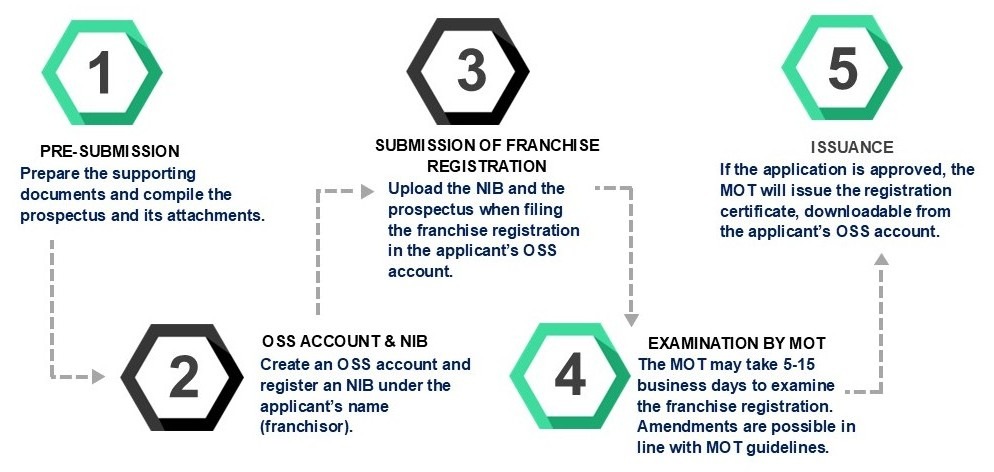
Franchise applications are still submitted through the Online Single Submission (OSS) portal of the Capital Investment Coordinating Board (BKPM). However, the new procedure requires each applicant, including foreign franchisors, to have an OSS account and a business registration number (NIB) issued by BKPM. An application for franchise registration must be submitted under the applicant’s own account—submissions can no longer be made through the account of a consultant.

Once a franchise application is submitted, the authority will distribute the submission to the MOT—the authorized ministry for franchise registration. Any notification or decision upon the registration made by the MOT will be available in the OSS system. Applicants should regularly monitor the status of the franchise application because no notifications will be sent to applicants to alert them of any deficiency.

Here is the summary of the new procedure for franchisors:
Notable Requirements

The disclosure document, or prospectus, is the key focus for the MOT in examining a franchise registration for a franchisor. This document is subject to thorough scrutiny by the MOT to ensure that all mandatory information meets the requirements set in the franchise regulations.

The current regulations specifically require that the mandatory clause “business system” in the prospectus cover operational standards and procedures, which should include human resource management, administration, operational management, standard operating methods, business location selection, business premises design, employee requirements, and marketing strategies.

Other clauses that are equally important to pay attention to are:

  • Identity of the franchisor: The identity should be in line with the IP owner. If not, a license agreement will be required.
  • Business legality of the franchisor: The business license must be attached to the prospectus.
  • Profit statements for the last two years: Audited financial report showing profit and loss.

Impact

The requirement for franchisors and franchisees to have an OSS account introduces additional steps and expenses in the franchise registration process. This requirement can be particularly burdensome for franchise business actors, as franchise registration is often facilitated by third parties, such as consultants. The new regulation mandates that the registration be submitted under the franchisor’s own account, which can be especially challenging for franchisees located overseas.

Ideally, creating an OSS account would be an option rather than a compulsion—this would ease the registration process for franchise business owners. Additionally, the OSS system should be made easier to navigate.

Nonetheless, the requirements stand for now, and business operators should take note of the additional steps that apply to them.


RELATED INSIGHTS​ 

February 22, 2021
Following the recent imposition of sanctions on Myanmar individuals and companies by the US, the UK and Canada have now imposed new sanctions. As with the US sanctions, these new measures impact UK and Canadian citizens and companies, and non-UK and non-Canadian companies and citizens with interests in those jurisdictions. The EU has indicated that it is planning to issue similar sanctions in the near future. New UK Sanctions In addition to the 16 individuals already sanctioned by the UK government, on February 18, 2021, the UK government announced that three individuals have been sanctioned for serious human rights violations and are now subject to asset freezes and travel bans. The full list of Myanmar individuals and companies sanctioned by the UK is available on the website of the Office of Financial Sanctions Implementation. Breaches of UK financial sanctions are criminal offences punishable in the UK by up to 7 years imprisonment and heavy fines. New Canadian Sanctions Also on February 18, timed to coincide with the UK sanctions, new Canadian sanctions were imposed on nine individuals. As with the UK, Canada already had a number of individuals in the Myanmar military on its sanctions list, and the new additions bring the total number of individuals sanctioned by Canada to 54. All assets of these individuals in Canada are now frozen, and they are banned from travelling to Canada. Canadian businesses or entities may not do business with any of the 54 individuals. Full details of the impact of the sanctions are available on the Government of Canada’s website, as is a database of the Myanmar individuals and companies subject to them. Breach of Canadian sanctions carries with it up to 5 years’ imprisonment in Canada and/or a large fine. Other Countries The EU is reportedly drawing up sanctions
February 18, 2021
As you will no doubt know, on February 1, 2021, the Myanmar military declared a state of emergency in Myanmar for a period of one year. State Counsellor Daw Aung Sang Su Kyi was detained, as were the president and various significant political and civil leaders. Min Aung Hlaing, commander-in-chief of the Tatmadaw (Myanmar armed forces) has installed himself as chairman of the State Administration Council, the current administration. New sanctions The reaction of the Biden administration has been swift. On February 10, 2021, President Biden issued Executive Order 14014, which provides bases to impose sanctions on individuals and companies deemed by the US to, among other things: operate in the defense sector of Myanmar; be responsible for policies that undermine democratic processes in Myanmar; have taken actions to undermine democratic processes or institutions, or prohibit, limit, or penalize the exercise of free speech, in Myanmar; or be a spouse or child of the foregoing. On the next day, February 11, the US Office of Foreign Assets Control (OFAC), imposed sanctions under the new executive order on ten individuals—including General Min Aung Hlaing—and three companies, including Cancri Gems & Jewelry Co, Myanmar Imperial Jade Co, and Myanmar Ruby Enterprise.  All such individuals and companies have now been designated on the US list of specially designated nationals (SDNs). Effect of sanctions As a result of such sanctions, the property of these individuals or companies that is located in the US or is under the possession or control of US companies and citizens is frozen, and US companies and citizens are generally prohibited from dealing deal with any such property.  Reportedly, roughly USD 1 billion of funds belonging to the individuals and companies blocked on February 11 are located in the US and thus now frozen. The SDN list As many
January 13, 2021
The Thai Industrial Standards Institute (TISI) has postponed a requirement to display QR codes next to the Thailand Industrial Standards (TIS) logo on certain product labels, linking to each product’s licensing information. Originally scheduled to take effect on January 21, 2021, TISI has agreed to extend this implementation date by a further six months owing to complexities involving product labeling and the COVID-19 pandemic. Manufacturers and importers therefore have an extra six months to prepare for compliance with the new regulations, which will now come into force on July 20, 2021. Thailand’s Ministry of Industry (MOI) requires various manufactured goods, such as gas water heaters, fans, light bulbs, rice cookers, fuel oils, toys, and so on, to meet Thailand’s industrial standards before they are imported or manufactured domestically. The standards, governing product qualities such as design, shape, manufacturing process, durability, safety, and packaging, are laid out in the Industrial Product Standards Act (No. 6) B.E. 2548 (2005) and overseen by the TISI (which operates as part of the MOI). As the MOI prescribes these compulsory standards, via TISI, to ensure product safety and prevent harm to consumers and the public, once a product becomes subject to them it cannot be manufactured or imported without an appropriate license from TISI. Such products must display the TIS logo on their labels. However, many products have been found to display the TIS logo dishonestly—that is, without having been evaluated or licensed by TISI. To deal with this dishonest use of the TIS logo, MOI Regulation Re: Format and Methods to Label and Use Markings on Industrial Products B.E. 2563 (2020) was issued in July 2020, mandating that various household appliances and other approved goods display a QR code linking to the TISI license information. With the postponement of this regulation, all affected