
You are using an outdated browser and your browsing experience will not be optimal. Please update to the latest version of Microsoft Edge, Google Chrome or Mozilla Firefox. Install Microsoft Edge

August 25, 2025

The Impact of Recent Franchise Regulation Changes in Indonesia

Indonesia’s current regulations on franchises, as stipulated under Government Regulation No. 35/2024 on Franchising and its implementing regulation, Ministry of Trade (MOT) Regulation No. 71/2019 regarding Implementation of Franchising, highlight fundamental changes in franchise registration. These changes have introduced additional complexities and challenges in the franchise registration procedure, making it more difficult for franchise owners to navigate the process.

New procedure

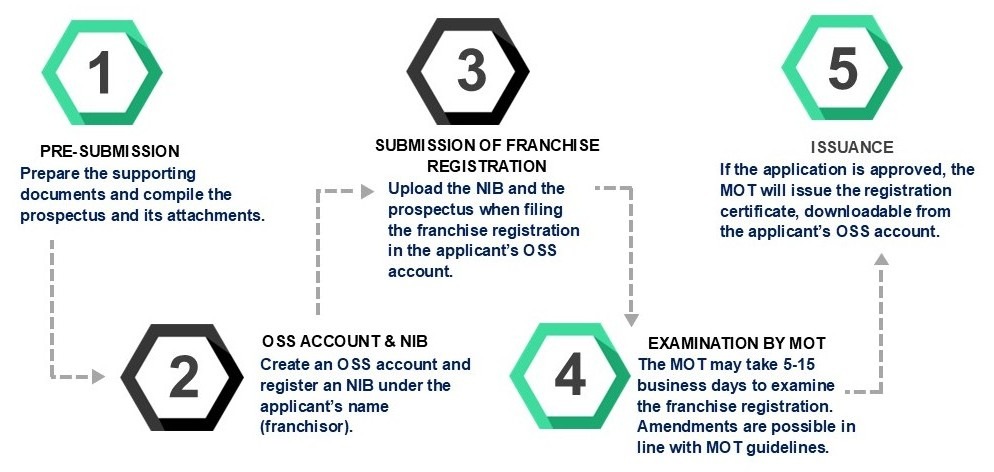
Franchise applications are still submitted through the Online Single Submission (OSS) portal of the Capital Investment Coordinating Board (BKPM). However, the new procedure requires each applicant, including foreign franchisors, to have an OSS account and a business registration number (NIB) issued by BKPM. An application for franchise registration must be submitted under the applicant’s own account—submissions can no longer be made through the account of a consultant.

Once a franchise application is submitted, the authority will distribute the submission to the MOT—the authorized ministry for franchise registration. Any notification or decision upon the registration made by the MOT will be available in the OSS system. Applicants should regularly monitor the status of the franchise application because no notifications will be sent to applicants to alert them of any deficiency.

Here is the summary of the new procedure for franchisors:
Notable Requirements

The disclosure document, or prospectus, is the key focus for the MOT in examining a franchise registration for a franchisor. This document is subject to thorough scrutiny by the MOT to ensure that all mandatory information meets the requirements set in the franchise regulations.

The current regulations specifically require that the mandatory clause “business system” in the prospectus cover operational standards and procedures, which should include human resource management, administration, operational management, standard operating methods, business location selection, business premises design, employee requirements, and marketing strategies.

Other clauses that are equally important to pay attention to are:

  • Identity of the franchisor: The identity should be in line with the IP owner. If not, a license agreement will be required.
  • Business legality of the franchisor: The business license must be attached to the prospectus.
  • Profit statements for the last two years: Audited financial report showing profit and loss.

Impact

The requirement for franchisors and franchisees to have an OSS account introduces additional steps and expenses in the franchise registration process. This requirement can be particularly burdensome for franchise business actors, as franchise registration is often facilitated by third parties, such as consultants. The new regulation mandates that the registration be submitted under the franchisor’s own account, which can be especially challenging for franchisees located overseas.

Ideally, creating an OSS account would be an option rather than a compulsion—this would ease the registration process for franchise business owners. Additionally, the OSS system should be made easier to navigate.

Nonetheless, the requirements stand for now, and business operators should take note of the additional steps that apply to them.


RELATED INSIGHTS​ 

December 28, 2020
The practice of business operators taking advantage of Lao consumers has always concerned Lao authorities, especially because the application of the country’s consumer protection regulatory framework has been restricted and unfamiliar to the country’s civil society. For example, the main piece of legislation, the Law on Consumer Protection no. 02/NA, dated June 30, 2010, enunciates a series of broad principles that are too general to be implemented effectively. Moreover, Laos has no independent entity to assist the country’s consumers in making informed decisions, namely by advising them on local operators’ malpractices and defective products that may endanger their health. Under Lao law, the powers delegated to the Ministry of Industry and Commerce (MOIC) and the Internal Trade Department are limited to administering consumer protection measures, such as controlling the price of products below the government’s price ceiling (e.g., for daily commodities, such as pork and traditional soups) and ensuring that products and services observe the country’s minimum safety standards. In practice, selected ministries have also overseen such measures for products under their respective areas of expertise; for example, the Ministry of Health monitors complaints related to medicinal products and pharmaceuticals. For this reason, the Lao authorities have been leading consultations to fill the legal vacuum and better promote consumer protection measures in the country. From these consultations to revamp and enhance the consumer protection legal framework, in mid-2020 the authorities issued recommendations that provide a legal framework for the establishment of consumer protection associations. This guidance was outlined in the Recommendations Concerning the Establishment and Operation of Consumer Protection Associations no. 0707/MOIC, dated July 30, 2020, which were published in the official gazette of the Ministry of Justice on August 3, 2020. Authority of Consumer Protection Associations The recommendations were issued to elaborate on the scope of consumer protection
December 21, 2020
On August 28, 2020, the Ministry of Commerce (MOC) announced that the “soft-opening period” to refile trademarks under the country’s new Trademark Act would begin on October 1, 2020. This period, which is open to holders of trademarks recorded under Myanmar’s old system and to trademark owners who can prove prior use of their trademarks in the country, is expected to run for six months, though no closing date was stipulated in the MOC announcement. The date of the eventual “grand opening” of the Intellectual Property Department (IPD) will be the filing date for all applications submitted during the soft-opening period. What are the changes? Filing procedure – Under the old system, brand owners (or their agents) had to manually file an original notarized declaration of ownership and legalized power of attorney with the Office of Registration of Deeds (ORD) under the Ministry of Agriculture, Livestock and Irrigation, which would then proceed with recordation. Under the new system, online filing is now in place, the original hard copies are not required, and the authority is the IPD of the Ministry of Commerce. Priority rights – With the implementation of the Trademark Law 2019, Myanmar is changing from its former first-to-use system to a first-to-file one. In addition to the IPD, all concerned authorities, such as the police and the courts, will need to adjust to the new paradigm for defining the rights of trademark owners. Examination procedure – Under the old system as defined under the Registration Act, there was no actual examination of the registrability of a mark; rather, registration could be refused if the officer felt that the mark was likely to be morally or legally objectionable, or likely to hurt the religious sensibilities of any Myanmar citizens. This is changed under the new system, and all
November 30, 2020
Vietnamese cuisine has a growing reputation internationally, and a visit to Vietnam will quickly reveal that food plays a very important role in the country’s identity and culture, as well as its economy. More than 80% of the population makes a living through some form of agriculture, and approximately 35% of household income in Vietnam is spent on food and beverages. As food is the most essential of necessities, and thus the first priority in household spending, this percentage tends to be high in developing countries, declining as incomes rise.
September 21, 2020
The Myanmar Customs Department (MCD) organized another Intellectual Property Awareness and Product Identification Workshop at its Customs Training School in Yangon on August 6, 2020, for its frontline customs officers. Such workshops are held numerous times every year, serving as a platform for foreign brand owners and their local representatives to educate and update the enforcement officers on methods for differentiating their genuine products from counterfeits and imitations when inspecting suspicious shipments at ports of entry into the country.