
You are using an outdated browser and your browsing experience will not be optimal. Please update to the latest version of Microsoft Edge, Google Chrome or Mozilla Firefox. Install Microsoft Edge

March 2, 2021

The Effects of Thailand’s Competition Law and Its Application to the Food Delivery Market

Informed Counsel

Thailand’s long-awaited new Trade Competition Act B.E. 2560 (2017) (TCA) came into effect on October 5, 2017, and the legislation’s extensive reforms of both substantive and procedural rules from the preceding version of the law have been both effective and revolutionizing. Significantly, the TCA lays out an efficient structure for the Trade Competition Commission (TCC) and grants independence to its administrative office, the Office of Trade Competition Commission (OTCC). Consequently, enforcement of this law—which had been almost absent in the past 20 years—is picking up pace. This article will examine the ongoing developments under this law in recent years, and will highlight its current application by discussing some of the TCC’s latest guidelines.

TCC: A Developer-Regulator

Since its establishment in 2018, the TCC has proven that its role and responsibilities are beyond those of a conventional regulator and law enforcer. The OTCC, with the support of its ad hoc subcommittees, have been actively monitoring the conduct of business operators and the level of competition in various markets and sectors, and the commission is well recognized for its publicizing of the TCA and establishment of new regulations under the law. Through various channels and platforms, a series of regulations, reports on market conditions, press releases, rulings, and precautionary statements have been published, and the TCC’s spokesperson often appears in the media to educate the public. To streamline the exchange of information and collaboration, the TCC and the OTCC have entered into an MOU with six sectoral regulators, including the Securities and Exchange Commission of Thailand, the Office of Insurance Commission, and others.

The TCC has also exercised its pre-emptive power to prevent suspicious trade practices and transactions. Prohibitive warnings have been issued against potential infringement, such as unfair trade practices by food delivery platform operators and a proposed merger by potentially market-dominating major hospitals.

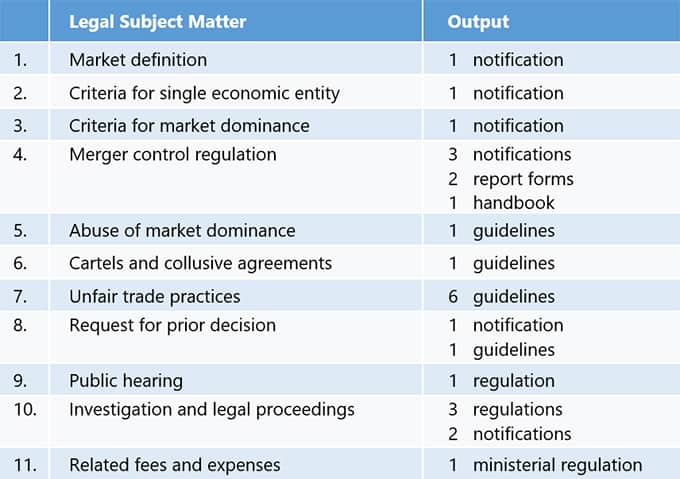
The TCC has realized that promotion of compliance is equally important to enforcement. Besides regulations and notifications, which set forth rules and restrictions, the TCC has started to promulgate handbooks, general guidelines, and market-specific guidance, as summarized in the table below.
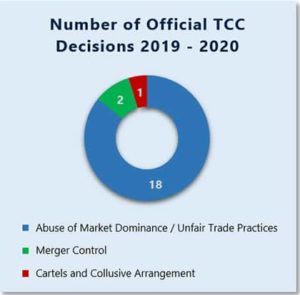
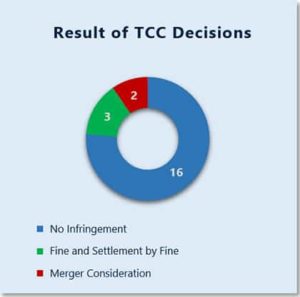
The TCC has the authority to rule on alleged violations and to approve or deny merger applications. All cases the TCC has received so far have been processed swiftly, and decisions—together with their reasoning—have been published with remarkable efficiency. The charts below illustrate statistics for the cases decided by the TCC during the 2019–2020 period. Notwithstanding the relatively low number of cases that resulted in penalties, it is notable that these penalties have been applied evenly and are far-reaching. The infringers on whom fines were imposed or cease-and-desist orders served include a large energy drink manufacturer, modern trade businesses, and a car supplier. Because of their reputations and the amount of the fines, these penalties have attracted much attention from the public and the media. Further public attention was garnered during the USD 10.6 billion acquisition of one large retailer by another Thai retail giant in late 2020 (which the TCC eventually approved with certain conditions), which put the TCC’s discretionary role in the spotlight and has become a landmark merger control case in Thailand.
Guidelines on Unfair Trade Practices

The object of the unfair trade practices provision of the TCA is to prevent any trade practices that cause damage to other operators. This provision has an extensive reach and may prohibit trade practices that have become common in some industries. Over time, the TCC will fine-tune their approach by observing and studying specific markets or industries and actively seek out unfair trade practices or arrangements and suffering parties. To date, the TCC has found four specific industries in which the commission has deemed it necessary to intervene and regulate market conduct of one party in order to protect another mistreated party. As a result, the TCC has launched market-specific guidelines for modern trade, franchise business, fruit trading, and—most recently—food delivery. To demonstrate more clearly how the TCC can intervene, the following section will look at this latest guidance in detail.

Food Delivery Guidelines

The COVID-19 pandemic brought phenomenal growth to e-commerce trading and food delivery services via online platforms, on which restaurant operators have become more and more dependent. The growing market power of the platforms prompted the TCC to issue guidelines to control the platform operators’ conduct, particularly when it comes to their trade practices and contract terms and conditions for participating restaurants.

The Guidelines on Unfair Trade Practices between Digital Platform Operators for Food Delivery and Restaurants were published in the Government Gazette on November 23, 2020, and took effect on December 23, 2020. The guidelines describe best-practice principles and indicate the arrangements, conditions, and restrictions that food delivery platform operators may or may not impose upon restaurants participating in their platform.

The main principle set forth in the TCC’s food delivery guidelines is that the business conduct and commercial conditions imposed by platform operators on restaurants must be fair, noncompulsory, and nondiscriminatory, and must not obstruct another party’s business operations. Furthermore, terms and conditions of the business arrangement should be written, clear, and justifiable.

The TCC’s guidance also contains the following list of conduct that could be deemed unfair under the TCA:

  1. Unfair charges, such as unjustified increases in commission fees or gross profit, discriminatory charging of different rates among similar restaurants, charging advertising fees or promotional expenses for no benefits in return, and unexpected charges or demands for remuneration or benefits.
  2. Setting trade conditions to impede the operations of competitors, such as prohibiting restaurants from participating in other food delivery platforms without justification.
  3. Unfairly exploiting superior bargaining power, such as by forcing restaurants to sell the same type of food at the same price in all sale channels without justification.
  4. Extending credit terms, terminating agreements, and excluding restaurants from the platform without justification.

The guidelines seem favorable to restaurant operators, who may now be able to avoid challenging these practices through potentially lengthy and costly legal proceedings. Instead, restaurateurs are given the right to file complaints with the TCC against food delivery platform operators that may have breached the guidelines. If found guilty, platform operators could incur a hefty fine—up to 10% of their last annual revenue—plus a cease-and-desist order from the TCC to bring the infringement to an end, or other remedial measures.

The TCC’s movements in this area exhort digital platform operators to review and reassess their agreements, business conduct, trade practices, and conditions or directions for restaurant operators. Platforms may also need to seek legal counsel to ensure that their planned actions will comply with the TCC’s guidance before they launch new marketing initiatives or modify existing terms and conditions, especially in relation to prices and fees for restaurant operators.

Conclusion

These guidelines for food delivery platforms are the first attempt by the TCC to regulate the e-commerce market, an industry that has developed rapidly in Thailand. The commission’s action here shows its intent to stay vigilant and ready to move on relevant emerging issues, and it signals that there could be further action on the conduct of e-commerce operators in Thailand if a need is seen. Overall, we can conclude that the revamped trade competition legal and regulatory environment in Thailand—starting with the updated TCA in 2017—has truly set in motion significant changes that aim to provide a fair and equitable field for doing business in Thailand.


RELATED INSIGHTS​ 

September 18, 2026
In August 2026, Vietnam’s Ministry of Industry and Trade released a draft decree to replace Decree No. 35/2020/ND-CP detailing certain articles of the Competition Law (Decree 35). The key changes under the draft decree and their implications for M&A transactions in Vietnam are summarized below. Definition of “Management Body” Decree 35 uses the term “management body” (bộ phận điều hành) as one of the criteria to determine the group of affiliated enterprises for the purpose of merger filing. However, there is no definition of the term, leaving enterprises without a basis on which to apply it consistently. The draft decree introduces a statutory definition of “management body,” being a person or group of persons who (i) own more than 50% of charter capital or voting shares; (ii) hold ownership or use rights over more than 50% of an enterprise’s assets; (iii) are an enterprise manager under enterprise law; or (iv) have decision-making power over the enterprise’s resolutions, daily business operations, or business and investment plans. This helps enterprises better assess the scope of merger filing. Determination of Relevant Product Market Under Decree 35, the relevant product market is defined solely by reference to goods and services interchangeable in characteristics, intended use, and price without accommodating digital or zero-price products. The draft decree expands the relevant product market to include “products” (sản phẩm) in addition to traditional “goods and services,” which captures digital information products, AI products, and other novel offerings. Additionally, it adds “other relevant competitive factors” such as quality of products, goods, and services for determining the relevant product market, supplementing the existing factors of characteristics, intended use, and price. This addresses cases where price substitutability is not meaningful for certain consumers or users, i.e., zero-price products. Determination of Relevant Geographic Market Under Decree 35, only physical geographic
September 15, 2026
The Myanmar Investment Commission (MIC) has issued a notification that gives investors with projects in Myanmar clearer guidance for securing approval and for changing, expanding, or exiting an approved project. Issued on August 19, 2026, MIC Notification No. 5/2026 replaces MIC Notification No. 26/2021 and sets procedures for state or regional investment committees to review, approve, and supervise investment projects, including project amendments, investment increases, land-use rights applications, compliance inspections, and suspension or termination of approved businesses. Endorsement Application Timeline and Deemed Acceptance In Myanmar, prospective investors seeking approval under the Myanmar Investment Law generally do so through an MIC permit or an MIC endorsement, depending on the nature of the investment. While certain large-scale investment projects require an MIC permit, projects that are not required to obtain an MIC permit may instead apply for an MIC endorsement. Investors seeking MIC endorsement for their planned projects typically submit their applications to the relevant state or regional investment committee. These committees are established under the Myanmar Investment Law and are authorized to approve investments of less than USD 5 million, subject to the project’s nature and location. MIC Notification No. 5/2026 specifies that upon receiving an endorsement application, the relevant investment committee office will check it for completeness and determine whether it can be considered at the state or regional level or must be referred to the MIC; if it must be forwarded to the MIC, this will be done within 10 working days. If an application is within its purview, the committee may reject the endorsement application within 15 working days of receipt; otherwise, the application is deemed accepted. If approved, the endorsement certificate will be issued within 10 working days of the approval decision, subject to applicable procedures. Endorsement Certificate Amendment The notification clarifies which amendments a state
September 9, 2026
Certain securities, derivatives, and treasury activities in Thailand were opened to foreign investors when Thailand’s Ministry of Commerce published two new ministerial regulations in the Government Gazette on August 28, 2026. The regulations significantly broaden the service activities that foreign-owned businesses may conduct without a license or certificate under the Foreign Business Act B.E. 2542, as amended (FBA). Securities and Derivatives Business Exemptions Prior to the issuance of these ministerial regulations, the exemptions covered (1) securities brokerage and derivatives brokerage with their only underlying assets being agricultural commodities, financial instruments, and securities; and (2) dealers, advisers, and fund managers conducting derivatives business under Thailand’s derivatives laws. The ministerial regulations provide broader exemptions. In addition to derivatives under the laws on derivatives as before, the following two major categories are provided: Derivatives whose underlying assets or variables fall outside the scope of Thailand’s laws on derivatives. This addresses a gap in the previous framework, which did not comprehensively exempt derivatives tied to nonregulated underlying assets or variables, such as certain commodities. Foreign brokers, advisors, and fund managers can now facilitate a broader range of hedging and risk management instruments without triggering FBA licensing requirements. Derivatives traded outside a derivatives exchange, or over the counter (OTC), whose payments are calculated by reference to foreign exchange rates or interest rates. This removes an FBA licensing barrier for foreign providers of widely used OTC hedging products, broadening the solutions available to importers and exporters managing currency exposure and to borrowers seeking greater certainty over financing costs. The ministerial regulations also exempt brokers and agents handling transactions involving either of these two derivatives categories. For securities businesses, the ministerial regulations add exemptions for margin loans used to purchase securities and for securities repurchase transactions. These additions clarify whether such activities qualify as exempt brokerage
September 4, 2026
Foreign business restrictions on telecommunications, treasury center businesses, and intragroup support services were eased when Thailand published the Ministerial Regulation Prescribing Service Businesses Not Requiring Permission for Foreign Business Operations (No. 5) B.E. 2569 (2026) in the Government Gazette on August 28, 2026. The ministerial regulation expands the categories of service businesses that foreign investors may operate without a foreign business license (FBL) under the Foreign Business Act B.E. 2542 (1999) (FBA). Of particular relevance to the telecommunications, fintech, and technology sectors, the ministerial regulation exempts: Type 1 telecommunications licensees, which do not have their own networks; Treasury center businesses operated in accordance with Thailand’s exchange control regulations; and Certain intragroup administrative, human resources, and information technology management services. Telecommunications Services Foreign-owned businesses providing telecommunications services under a type 1 telecommunications license may now operate without obtaining an FBL. This may streamline market entry for qualifying telecommunications and digital infrastructure businesses. The exemption applies only to the FBA licensing requirement. Operators must continue to comply with applicable requirements under the Telecommunications Business Act and the regulations of the National Broadcasting and Telecommunications Commission, and the change does not affect foreign ownership restrictions applicable to type 2 or type 3 telecommunications businesses. Treasury Center Businesses The ministerial regulation also exempts qualifying treasury center businesses from the FBL requirement. This may facilitate centralized treasury functions in Thailand, including liquidity management, foreign exchange management, and intragroup funding arrangements. Treasury center operations remain subject to applicable requirements of the Bank of Thailand and other competent authorities. Intragroup Administrative, HR, and IT Services Certain administrative, human resources, and information technology management services provided between affiliated entities are also exempt, provided the relevant entities satisfy prescribed ownership or management criteria. The exemption is available where the service provider and recipient are related through specified ownership