
You are using an outdated browser and your browsing experience will not be optimal. Please update to the latest version of Microsoft Edge, Google Chrome or Mozilla Firefox. Install Microsoft Edge

September 30, 2025

Thailand’s Employee Committees and Their Statutory Protection

Over the past several years, during and after the COVID-19 pandemic, Thai employees and labor unions have faced reductions in benefits and welfare from their employers. Consequently, they have pursued various strategies to enhance their compensation packages. One such approach involves establishing employee committees to negotiate with employers regarding benefits and welfare. Additionally, companies with existing unions typically nominate representatives to serve on these employee committees. Many employers, however, remain unfamiliar with both the committee’s role and the heightened procedural requirements that apply when disciplinary measures are contemplated against committee members. Because any violation of a committee member’s statutory rights can expose the employer—and its directors or authorized representatives—to criminal liability, a clear understanding of the relevant legal framework is essential.

The Labor Relations Act B.E. 2518 (LRA) provides the statutory foundation for establishing employee committees. The purpose of the committee is to promote harmonious industrial relations and create a formal channel through which employees and employers can discuss workplace matters on a regular basis.

Any workplace that employs at least fifty employees must, upon request by employees or the labor union, facilitate the creation of a committee. Members may be elected directly by employees or, where applicable, appointed by the labor union. Each member serves a three-year term. The LRA prescribes minimum committee sizes based on the employer’s headcount, as shown in the table below.
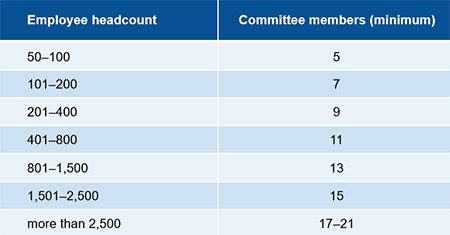
If union members constitute more than 20 percent of the total workforce, the union must appoint at least one more committee member than the number of nonunion members elected by the general workforce. If union membership exceeds 50 percent of the workforce, the union acquires the exclusive right to appoint every committee member. Where multiple unions exist and their combined appointments would exceed the statutory committee size, the employer may lawfully refuse to recognize the excess appointees.

Employees appointed by the union assume office on the date of appointment, even if the election of nonunion members has not yet occurred.

The employer must meet with the committee at least once every three months, or sooner if requested by the union or by more than half of the committee members for reasonable cause, to address:

  • Provision and improvement of employee welfare;
  • Formulation or amendment of work rules;
  • Employee complaints; and
  • Settlement of workplace disputes.

If the committee deems any employer action unfair or unduly burdensome to employees, the committee, an individual employee, or the union may file a petition with the Labor Court for relief.

Special Protections for Committee Members

The LRA prohibits employers from dismissing, reducing the wages of, imposing disciplinary sanctions against, or otherwise obstructing a committee member in the performance of their duties—and from taking any action that would render the member unable to continue working—without first obtaining permission from the Labor Court. Noncompliance constitutes a criminal offense punishable by imprisonment of up to one month, a fine of up to THB 1,000 (approx. USD 30), or both. Supreme Court precedent confirms that these penalties attach immediately upon the unlawful act; a subsequent court order authorizing the dismissal does not cure the prior violation.

The court-approval requirement applies even when the member has breached company work rules. Although the employer may seek the committee member’s dismissal based on such misconduct, the court retains discretion to impose a lesser penalty if it finds termination disproportionate to the offense. Conversely, once the court has authorized termination, the dismissal does not constitute an unfair labor practice, and the employee is barred from filing a complaint with the Labor Relations Committee.

In light of these provisions, employers should proceed with caution when contemplating any disciplinary or obstructive measure against a committee member. Compliance with the LRA’s procedural safeguards is paramount to avoid exposure to criminal liability and ensure lawful continuation of business operations.

RELATED INSIGHTS​ 

December 19, 2025
On December 12, 2025, Thailand’s Ministry of Labor published a ministerial regulation prescribing the minimum and maximum wages used as a base for calculating social security contributions. The regulation, which takes effect on January 1, 2026, sets a flat minimum base wage of THB 1,650 per month and a phased increase of the maximum base wage over the following six years, as outlined in the table below. Impact on Social Security Benefits Not only will monthly contributions increase as a result of the adjustment to the maximum wages used as a base for calculating social security contributions, but the maximum benefits available to insured persons will also be enhanced, as shown in the next table. Employer Obligations From January 1, 2026, employers must correctly withhold wages and remit social security contributions for both the employer’s and employees’ portions in compliance with the revised thresholds. Failure to comply may expose employers to penalties under the Social Security Act B.E. 2533 (1990). Employers should ensure that payroll systems are updated as necessary to reflect these changes to the wage ceiling used for social security contribution calculations.
December 8, 2025
As Thailand transitions into an aged society, retirement policy and workplace protections for older workers have come into sharper focus. With public sentiment increasingly open to working beyond the traditional retirement age, questions about employee rights and employer obligations are more relevant than ever. In October 2025, Prime Minister Anutin Charnvirakul proposed increasing the statutory retirement age to 65 for government officers, citing Thailand’s aged-society status and the potential social and economic benefits of longer working lives. While academics and stakeholders have raised concerns about systemic impacts, public opinion remains divided, with many workers signaling a willingness to continue working beyond the current norm. Against this backdrop, it’s worth revisiting what the Labor Protection Act B.E. 2541 (1998) (LPA) requires in regard to retirement and severance pay. This article explains the current legal landscape under the LPA, with a focus on retirement and severance pay for employees over 60, recent judicial developments, and practical options for structuring postretirement engagements. Retirement as Termination Under the LPA Under the LPA, retirement—whether set by agreement between employer and employee or unilaterally stipulated by the employer—is deemed a termination of employment. As a result, employees who retire under such terms are entitled to severance pay. The law also adds a default rule: if there is no agreed or prescribed retirement age, or if the prescribed retirement age exceeds 60, an employee aged 60 or older may declare an intention to retire. The declaration takes effect 30 days after notice, and the employer must pay severance accordingly. In short, retirement triggered by agreement, the employer’s work rules, or an employee’s valid notice is treated as a termination, and statutory severance pay is owed. Hiring or Rehiring Employees Over 60 Practical issues arise when an employer’s work rules set a retirement age that does not
December 2, 2025
Investing in Mainland Southeast Asia is Tilleke & Gibbins’ essential guide for investors looking to do business in this vibrant region, whether it’s starting operations as a newly established entity or expanding into new territories or business models.
November 20, 2025
Lawyers from Tilleke & Gibbins’ labor and employment team have contributed a new Vietnam chapter to Thomson Reuters Practical Law’s Employment and Employee Benefits Global Guide. The guide provides a high-level comparative overview of employment laws and regulations across various jurisdictions around the world. Tilleke & Gibbins also contributed the Myanmar chapter of the guide. The Vietnam chapter covers a wide range of typical employment matters, such as limitations on working hours, paid leave requirements, minimum wage, and health and safety obligations. In addition, the guide provides insight on various topics of special interest to foreign investors doing business in Vietnam, including the following: Mandatory contents of a labor contract; Visas and permits required for expatriate employees; Employers’ obligations for protecting employees’ privacy and personal data; Procedural requirements for the dismissal of an employee; Employer and parent company liability. To view the latest version of the Employment and Employee Benefits Vietnam chapter, please visit the Practical Law website and enroll in the free Practical Law trial to gain full access.