
You are using an outdated browser and your browsing experience will not be optimal. Please update to the latest version of Microsoft Edge, Google Chrome or Mozilla Firefox. Install Microsoft Edge

September 30, 2025

Thailand’s Employee Committees and Their Statutory Protection

Over the past several years, during and after the COVID-19 pandemic, Thai employees and labor unions have faced reductions in benefits and welfare from their employers. Consequently, they have pursued various strategies to enhance their compensation packages. One such approach involves establishing employee committees to negotiate with employers regarding benefits and welfare. Additionally, companies with existing unions typically nominate representatives to serve on these employee committees. Many employers, however, remain unfamiliar with both the committee’s role and the heightened procedural requirements that apply when disciplinary measures are contemplated against committee members. Because any violation of a committee member’s statutory rights can expose the employer—and its directors or authorized representatives—to criminal liability, a clear understanding of the relevant legal framework is essential.

The Labor Relations Act B.E. 2518 (LRA) provides the statutory foundation for establishing employee committees. The purpose of the committee is to promote harmonious industrial relations and create a formal channel through which employees and employers can discuss workplace matters on a regular basis.

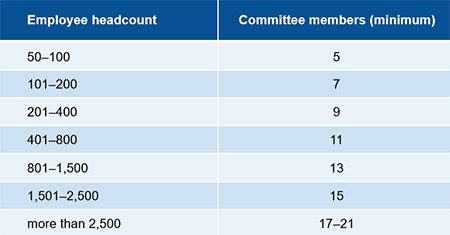
Any workplace that employs at least fifty employees must, upon request by employees or the labor union, facilitate the creation of a committee. Members may be elected directly by employees or, where applicable, appointed by the labor union. Each member serves a three-year term. The LRA prescribes minimum committee sizes based on the employer’s headcount, as shown in the table below.
If union members constitute more than 20 percent of the total workforce, the union must appoint at least one more committee member than the number of nonunion members elected by the general workforce. If union membership exceeds 50 percent of the workforce, the union acquires the exclusive right to appoint every committee member. Where multiple unions exist and their combined appointments would exceed the statutory committee size, the employer may lawfully refuse to recognize the excess appointees.

Employees appointed by the union assume office on the date of appointment, even if the election of nonunion members has not yet occurred.

The employer must meet with the committee at least once every three months, or sooner if requested by the union or by more than half of the committee members for reasonable cause, to address:

  • Provision and improvement of employee welfare;
  • Formulation or amendment of work rules;
  • Employee complaints; and
  • Settlement of workplace disputes.

If the committee deems any employer action unfair or unduly burdensome to employees, the committee, an individual employee, or the union may file a petition with the Labor Court for relief.

Special Protections for Committee Members

The LRA prohibits employers from dismissing, reducing the wages of, imposing disciplinary sanctions against, or otherwise obstructing a committee member in the performance of their duties—and from taking any action that would render the member unable to continue working—without first obtaining permission from the Labor Court. Noncompliance constitutes a criminal offense punishable by imprisonment of up to one month, a fine of up to THB 1,000 (approx. USD 30), or both. Supreme Court precedent confirms that these penalties attach immediately upon the unlawful act; a subsequent court order authorizing the dismissal does not cure the prior violation.

The court-approval requirement applies even when the member has breached company work rules. Although the employer may seek the committee member’s dismissal based on such misconduct, the court retains discretion to impose a lesser penalty if it finds termination disproportionate to the offense. Conversely, once the court has authorized termination, the dismissal does not constitute an unfair labor practice, and the employee is barred from filing a complaint with the Labor Relations Committee.

In light of these provisions, employers should proceed with caution when contemplating any disciplinary or obstructive measure against a committee member. Compliance with the LRA’s procedural safeguards is paramount to avoid exposure to criminal liability and ensure lawful continuation of business operations.

RELATED INSIGHTS​ 

February 22, 2021
Following the recent imposition of sanctions on Myanmar individuals and companies by the US, the UK and Canada have now imposed new sanctions. As with the US sanctions, these new measures impact UK and Canadian citizens and companies, and non-UK and non-Canadian companies and citizens with interests in those jurisdictions. The EU has indicated that it is planning to issue similar sanctions in the near future. New UK Sanctions In addition to the 16 individuals already sanctioned by the UK government, on February 18, 2021, the UK government announced that three individuals have been sanctioned for serious human rights violations and are now subject to asset freezes and travel bans. The full list of Myanmar individuals and companies sanctioned by the UK is available on the website of the Office of Financial Sanctions Implementation. Breaches of UK financial sanctions are criminal offences punishable in the UK by up to 7 years imprisonment and heavy fines. New Canadian Sanctions Also on February 18, timed to coincide with the UK sanctions, new Canadian sanctions were imposed on nine individuals. As with the UK, Canada already had a number of individuals in the Myanmar military on its sanctions list, and the new additions bring the total number of individuals sanctioned by Canada to 54. All assets of these individuals in Canada are now frozen, and they are banned from travelling to Canada. Canadian businesses or entities may not do business with any of the 54 individuals. Full details of the impact of the sanctions are available on the Government of Canada’s website, as is a database of the Myanmar individuals and companies subject to them. Breach of Canadian sanctions carries with it up to 5 years’ imprisonment in Canada and/or a large fine. Other Countries The EU is reportedly drawing up sanctions
January 26, 2021
On January 1, 2021, the government of Vietnam issued Decree No. 152/2020/ND-CP dated December 30, 2020, providing guidance concerning foreigners working in Vietnam (Decree 152). Foreign investors and expatriates should be aware of some notable new points.
January 12, 2021
Due to the resurgence of the COVID-19 pandemic in Thailand since December, 2020, Thailand’s Ministry of Labor recently published two regulations under the Social Security Act (SSA) in the Government Gazette: The Regulation on Entitlement to Compensatory Benefits in the Event of Unemployment Due to Force Majeure from the Pandemic of Dangerous Communicable Disease Under Relevant Law Relating to Communicable Diseases B.E. 2563 (2020) (the Force Majeure Regulation); and The Regulation on Determination of the Amount of Contributions to the Social Security Funds B.E. 2563 (2020) (the SSF Contribution Regulation). Details of the two regulations are provided below. The Force Majeure Regulation This regulation is similar to a previous regulation from April, 2020, during the first wave of the pandemic, stating that the definition of force majeure under the Social Security Act B.E. 2533 (1990) (the SSA) includes hazards from pandemics of dangerous communicable diseases (including COVID-19). This definition therefore affords protection to insured persons (i.e., employees) in the event that the COVID-19 pandemic results in their being unable to work, or their employers being unable to operate their business normally. This regulation allows the Social Security Office (SSO) to pay compensation to employees who: are insured persons who qualify to receive compensatory benefit in case of unemployment in accordance with the SSA; have to cease working temporarily during the period from December 19, 2020 onwards; and do not receive wages from their employer during the temporary cessation. This applies only if the circumstances above result from the following force majeure events related to hazards from COVID-19 (or other pandemics of dangerous communicable diseases that affect the public under the Communicable Diseases Act B.E. 2558 (2015)): The employee cannot work, or the employer does not allow the employee to work, because of quarantine or to comply with a COVID-19
November 3, 2020
Many Thai and international companies have expanded rapidly into Myanmar in recent years, in what had seemed to be an unstoppable expansion of cross-border trade resulting from the country’s emergence back onto the global stage. For those companies, the COVID-19 situation in Myanmar has been a cause for much concern and uncertainty—doubly so for those who had hired staff in the jurisdiction, as a lack of clarity regarding their obligations as employers was compounded by a lack of information on the situation on the ground.