
You are using an outdated browser and your browsing experience will not be optimal. Please update to the latest version of Microsoft Edge, Google Chrome or Mozilla Firefox. Install Microsoft Edge

September 30, 2025

Thailand’s Employee Committees and Their Statutory Protection

Over the past several years, during and after the COVID-19 pandemic, Thai employees and labor unions have faced reductions in benefits and welfare from their employers. Consequently, they have pursued various strategies to enhance their compensation packages. One such approach involves establishing employee committees to negotiate with employers regarding benefits and welfare. Additionally, companies with existing unions typically nominate representatives to serve on these employee committees. Many employers, however, remain unfamiliar with both the committee’s role and the heightened procedural requirements that apply when disciplinary measures are contemplated against committee members. Because any violation of a committee member’s statutory rights can expose the employer—and its directors or authorized representatives—to criminal liability, a clear understanding of the relevant legal framework is essential.

The Labor Relations Act B.E. 2518 (LRA) provides the statutory foundation for establishing employee committees. The purpose of the committee is to promote harmonious industrial relations and create a formal channel through which employees and employers can discuss workplace matters on a regular basis.

Any workplace that employs at least fifty employees must, upon request by employees or the labor union, facilitate the creation of a committee. Members may be elected directly by employees or, where applicable, appointed by the labor union. Each member serves a three-year term. The LRA prescribes minimum committee sizes based on the employer’s headcount, as shown in the table below.
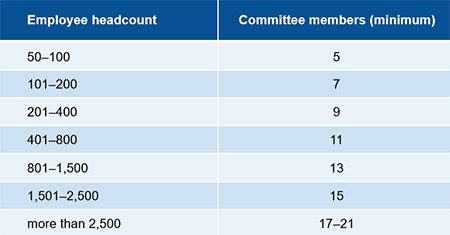
If union members constitute more than 20 percent of the total workforce, the union must appoint at least one more committee member than the number of nonunion members elected by the general workforce. If union membership exceeds 50 percent of the workforce, the union acquires the exclusive right to appoint every committee member. Where multiple unions exist and their combined appointments would exceed the statutory committee size, the employer may lawfully refuse to recognize the excess appointees.

Employees appointed by the union assume office on the date of appointment, even if the election of nonunion members has not yet occurred.

The employer must meet with the committee at least once every three months, or sooner if requested by the union or by more than half of the committee members for reasonable cause, to address:

  • Provision and improvement of employee welfare;
  • Formulation or amendment of work rules;
  • Employee complaints; and
  • Settlement of workplace disputes.

If the committee deems any employer action unfair or unduly burdensome to employees, the committee, an individual employee, or the union may file a petition with the Labor Court for relief.

Special Protections for Committee Members

The LRA prohibits employers from dismissing, reducing the wages of, imposing disciplinary sanctions against, or otherwise obstructing a committee member in the performance of their duties—and from taking any action that would render the member unable to continue working—without first obtaining permission from the Labor Court. Noncompliance constitutes a criminal offense punishable by imprisonment of up to one month, a fine of up to THB 1,000 (approx. USD 30), or both. Supreme Court precedent confirms that these penalties attach immediately upon the unlawful act; a subsequent court order authorizing the dismissal does not cure the prior violation.

The court-approval requirement applies even when the member has breached company work rules. Although the employer may seek the committee member’s dismissal based on such misconduct, the court retains discretion to impose a lesser penalty if it finds termination disproportionate to the offense. Conversely, once the court has authorized termination, the dismissal does not constitute an unfair labor practice, and the employee is barred from filing a complaint with the Labor Relations Committee.

In light of these provisions, employers should proceed with caution when contemplating any disciplinary or obstructive measure against a committee member. Compliance with the LRA’s procedural safeguards is paramount to avoid exposure to criminal liability and ensure lawful continuation of business operations.

RELATED INSIGHTS​ 

October 12, 2023
Myanmar has made important amendments to its minimum wage framework by increasing the minimum compensation for workers in both the public and private sectors. Background In May 2018, the National Committee for Setting the Minimum Wage determined that all workers in Myanmar should receive a minimum wage of MMK 4,800 per day (approx. USD 2.29), equivalent to MMK 600 per hour for an eight-hour workday. This rule applied to all workers, without differentiation in location or job. Government Workers and Organizations In September 2023, the Ministry of Planning and Finance announced that daily workers in government departments and organizations are entitled to receive an additional benefit of MMK 1,000 on top of their existing daily wage, which was already MMK 4,800. Consequently, they could earn a total of MMK 5,800 per day for eight hours of work. Private-Sector Workers On October 9, 2023, the national committee announced an increase of minimum wages for employees in the private sector. According to Notification No. 2/2023, workers at private-sector employers with more than 10 employees are now entitled to minimum compensation of MMK 5,800 per day (approx. USD 2.77)—an additional MMK 1,000 per eight-hour workday over the previously established minimum wage. The changes took effect on October 1, 2023. For more details about these changes, or any aspect of employee compensation or employment law in Myanmar, please contact Tilleke & Gibbins at [email protected].
August 18, 2023
On August 16, 2023, Laos’ Prime Minister’s Office issued Notice No. 1502/PMO, which increases the minimum wage for all workers in Laos. This increase is a continuation of the stepped increases in the minimum wage that began in mid-2022. The recent notice increases the minimum monthly wage from LAK 1,300,000 (approx. USD 66) to LAK 1,600,000 (approx. USD 82), in accordance with an agreement reached in the government’s ordinary session in July 2023. The new minimum wage rate will take effect on October 1, 2023. This is the third minimum wage increase in Laos since June 2022. Two of the main factors responsible for this heightened frequency of minimum wage increases are the depreciation of the Lao kip against foreign currencies and inflation in the price of goods for daily consumption. These stepped increases also show the government’s proactive approach toward addressing the cost-of-living crisis in Laos and its effect on low-wage workers. For more details on the new minimum wage, or on any other labor and employment matters in Laos, please contact Dino Santaniello at [email protected] or +856 21 262 355.
July 7, 2023
Tilleke & Gibbins is pleased to announce the release of Employment Law Basics in Southeast Asia. This publication serves as an indispensable resource for businesses navigating the complex landscape of employment law in Cambodia, Laos, Myanmar, Thailand, and Vietnam. Authored by Tilleke & Gibbins’ regional team of employment law specialists, the guide provides a detailed overview of key employment law topics essential for businesses operating or planning to expand their operations in Southeast Asia. From employment contracts to termination procedures, each topic is examined in depth to ensure businesses are well-equipped to comply with local regulations and protect their interests. Key topics covered in the guide include: Employment contracts Probationary period Minimum wage Social security and statutory payments Working hours Leave and holidays Work rules Termination Foreign employees Data protection Remote work AI and automation Our guide offers multinational corporations establishing a presence in the region and local enterprises alike practical insights and actionable advice tailored to the unique regulatory environments in Cambodia, Laos, Myanmar, Thailand, and Vietnam. To access the full guide, please download the PDF below.
April 28, 2023
Instead of the typical dystopian scene of flames, wastelands of shattered buildings, and robotic overlords policing the remaining humans, our actual dystopian future may be a workplace filled only with men named Jared who once played lacrosse in high school. This may sound far-fetched, but one resume-screening tool was found to be using an algorithm that concluded two factors were most determinative of job performance: the name Jared and a history of playing lacrosse in high school. The frailties of artificial intelligence (AI) systems in recruitment and hiring could transform our workforces in unpredictable ways. If employers blindly follow AI outcomes without a deeper examination of how the algorithmic decision is reached, hiring outcomes may be not only ridiculous but also discriminatory. Risks of AI-Reliant Hiring Some employers have enthusiastically embraced AI as a way to reduce costs and replace human bias in the recruitment process. Human recruiters do not have a great track record; for example, in France, discrimination in recruitment has posed such a serious problem that the government submits false work biographies with ethnic names to identify and punish employers that unreasonably reject qualified ethnic applicants. Unfortunately, AI is modeled on human thinking, so it may amplify our own prejudices and errant conclusions while giving the appearance of providing a fair and clean process. AI typically learns inductively by training on examples and historical data. Factors such as exclusion of certain groups from educational or career opportunities has often shaped this data, so AI’s decisions may amplify this past prejudice. For instance, Amazon experimented with mechanized recruitment in 2014, but abandoned these efforts prior to implementation after the AI tool selected a predominantly male workforce. The AI learned by analyzing patterns in resumes submitted to the company over the last 10 years. Since over this period