
You are using an outdated browser and your browsing experience will not be optimal. Please update to the latest version of Microsoft Edge, Google Chrome or Mozilla Firefox. Install Microsoft Edge

September 30, 2025

Thailand’s Employee Committees and Their Statutory Protection

Over the past several years, during and after the COVID-19 pandemic, Thai employees and labor unions have faced reductions in benefits and welfare from their employers. Consequently, they have pursued various strategies to enhance their compensation packages. One such approach involves establishing employee committees to negotiate with employers regarding benefits and welfare. Additionally, companies with existing unions typically nominate representatives to serve on these employee committees. Many employers, however, remain unfamiliar with both the committee’s role and the heightened procedural requirements that apply when disciplinary measures are contemplated against committee members. Because any violation of a committee member’s statutory rights can expose the employer—and its directors or authorized representatives—to criminal liability, a clear understanding of the relevant legal framework is essential.

The Labor Relations Act B.E. 2518 (LRA) provides the statutory foundation for establishing employee committees. The purpose of the committee is to promote harmonious industrial relations and create a formal channel through which employees and employers can discuss workplace matters on a regular basis.

Any workplace that employs at least fifty employees must, upon request by employees or the labor union, facilitate the creation of a committee. Members may be elected directly by employees or, where applicable, appointed by the labor union. Each member serves a three-year term. The LRA prescribes minimum committee sizes based on the employer’s headcount, as shown in the table below.
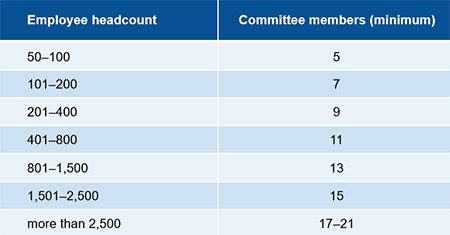
If union members constitute more than 20 percent of the total workforce, the union must appoint at least one more committee member than the number of nonunion members elected by the general workforce. If union membership exceeds 50 percent of the workforce, the union acquires the exclusive right to appoint every committee member. Where multiple unions exist and their combined appointments would exceed the statutory committee size, the employer may lawfully refuse to recognize the excess appointees.

Employees appointed by the union assume office on the date of appointment, even if the election of nonunion members has not yet occurred.

The employer must meet with the committee at least once every three months, or sooner if requested by the union or by more than half of the committee members for reasonable cause, to address:

  • Provision and improvement of employee welfare;
  • Formulation or amendment of work rules;
  • Employee complaints; and
  • Settlement of workplace disputes.

If the committee deems any employer action unfair or unduly burdensome to employees, the committee, an individual employee, or the union may file a petition with the Labor Court for relief.

Special Protections for Committee Members

The LRA prohibits employers from dismissing, reducing the wages of, imposing disciplinary sanctions against, or otherwise obstructing a committee member in the performance of their duties—and from taking any action that would render the member unable to continue working—without first obtaining permission from the Labor Court. Noncompliance constitutes a criminal offense punishable by imprisonment of up to one month, a fine of up to THB 1,000 (approx. USD 30), or both. Supreme Court precedent confirms that these penalties attach immediately upon the unlawful act; a subsequent court order authorizing the dismissal does not cure the prior violation.

The court-approval requirement applies even when the member has breached company work rules. Although the employer may seek the committee member’s dismissal based on such misconduct, the court retains discretion to impose a lesser penalty if it finds termination disproportionate to the offense. Conversely, once the court has authorized termination, the dismissal does not constitute an unfair labor practice, and the employee is barred from filing a complaint with the Labor Relations Committee.

In light of these provisions, employers should proceed with caution when contemplating any disciplinary or obstructive measure against a committee member. Compliance with the LRA’s procedural safeguards is paramount to avoid exposure to criminal liability and ensure lawful continuation of business operations.

RELATED INSIGHTS​ 

December 4, 2024
Thailand Legal Basics, a valuable primer for foreign investors, explores all aspects of living and doing business in Thailand. Written by specialists at Tilleke & Gibbins in Bangkok, it is the only comprehensive English-language guide to the Thai legal system with a focus on the concerns of foreign business and investment.
October 1, 2024
Three of Tilleke & Gibbins’ labor and employment specialists in Vietnam have contributed the Vietnam chapter to the newly issued Labor and Employment Disputes 2024, a comprehensive guide from Lexology Panoramic to labor and employment dispute resolution in various jurisdictions around the world. The Vietnam chapter covers the following topics: Pre-action considerations: Key requirements, third-party funding, contingency fee arrangements Issuing a claim: Forum, territorial jurisdiction, standing, commencing claims, fees, service Defendants and legal personality: Types of claims, time limits, counterclaims Case management: Procedure, rules, amendments to claims, adding parties to proceedings, consolidating proceedings Class and collective actions: Special considerations Evidence: Witnesses, tactical considerations Interim relief: Availability, requirements Trial: Hearings conduct and typical time frames, confidentiality and public access, media reporting Elements of successful claims and burden of proof Alternative dispute resolution: Available types, requirements and expectations Enforcement: Collective employment and labor rights, enforcement of collective rights, standing Remedies and enforcement: Available remedies, assessing compensation, enforcement mechanisms Appeals: Appeal procedure and time frames, other means of challenge Update and trends: Recent cases and developments, technology developments, other issues The Vietnam chapter was authored by Truc Thi Thanh, Linh Ngoc Nguyen, and Kien Trung Trinh. Tilleke & Gibbins also contributed the Cambodia and Thailand chapters to Labor and Employment Disputes 2024.
October 1, 2024
Four of Tilleke & Gibbins’ labor and employment specialists in Bangkok have contributed the Thailand chapter to the newly issued Labor and Employment Disputes 2024, a comprehensive guide from Lexology Panoramic to labor and employment dispute resolution in various jurisdictions around the world. The Thailand chapter covers the following topics: Pre-action considerations: Key requirements, third-party funding, contingency fee arrangements Issuing a claim: Forum, territorial jurisdiction, standing, commencing claims, fees, service Defendants and legal personality: Types of claims, time limits, counterclaims Case management: Procedure, rules, amendments to claims, adding parties to proceedings, consolidating proceedings Class and collective actions: Special considerations Evidence: Witnesses, tactical considerations Interim relief: Availability, requirements Trial: Hearings conduct and typical time frames, confidentiality and public access, media reporting Elements of successful claims and burden of proof Alternative dispute resolution: Available types, requirements and expectations Enforcement: Collective employment and labor rights, enforcement of collective rights, standing Remedies and enforcement: Available remedies, assessing compensation, enforcement mechanisms Appeals: Appeal procedure and time frames, other means of challenge Update and trends: Recent cases and developments, technology developments, other issues The Thailand chapter was authored by Eric M. Meyer, Chusert Supasitthumrong, Pathanin Sornchangwat, and Chayathorn Kruatao, all in the Thailand dispute resolution and litigation team. Tilleke & Gibbins also contributed the Cambodia and Vietnam chapters to Labor and Employment Disputes 2024. The full Thailand chapter is available below as a PDF.
August 14, 2024
Myanmar has once again made significant amendments to its minimum-wage framework by introducing additional allowances for both public- and private-sector workers. On August 9, 2024, the National Committee for Setting the Minimum Wage issued Notification No. 1/2024, which entitles private-sector workers to a new additional daily allowance of MMK 1,000 (approximately USD 0.48). This increase is on top of the MMK 1,000 additional daily allowance introduced last year. As a result, workers at private-sector employers with more than 10 employees are now entitled to the base minimum wage of MMK 4,800 plus additional allowances of MMK 2,000, for a total of MMK 6,800 (approximately USD 3.20) per day for an eight-hour workday, effective August 1, 2024. A similar additional allowance had been announced for workers in government departments and organizations on July 26, 2024. Background The MMK 4,800 (approximately USD 2.29) minimum wage for an eight-hour workday (equivalent to MMK 600 per hour) was established in May 2018 for all workers, irrespective of location or job type. In September 2023, the Ministry of Planning and Finance announced an additional daily benefit of MMK 1,000 for workers in government departments and organizations, and on October 9, 2023, the National Committee for Setting the Minimum Wage extended this benefit to workers at private-sector employers with more than 10 employees, bringing the effective minimum daily wage to MMK 5,800 (approximately USD 2.77). These changes took effect on October 1, 2023. Applicability of Additional Allowances for Private-Sector Workers The latest announcement also entitles employees to the base minimum wage and additional allowances for days used from their entitlement to leave and holidays, in accordance with the 1951 Leave and Holidays Act. However, the daily allowances—totaling MMK 2,000—are not to be included when calculating overtime payments. Instead, overtime payments must be calculated based on